

For twenty years the Moa Hunters have wandered the magnificent mountains and valleys of Te Waipounamu the South Island and Rakiura Stewart Island in search of the elusive moa. Undaunted by our total lack of success, this year we quite literally pushed the boat out, floating down the Whanganui river to look for moa.
While we are all at ease wearing boots and backpacks, paddling Canadian canoes stacked with plastic barrels is a nudge out of our collective comfort zones. Many of us felt slightly unsettled, unsure how well we would adjust to the change of pace.
We wondered how would four days on the waters of the Whanganui measure up to our usual tramping adventures?
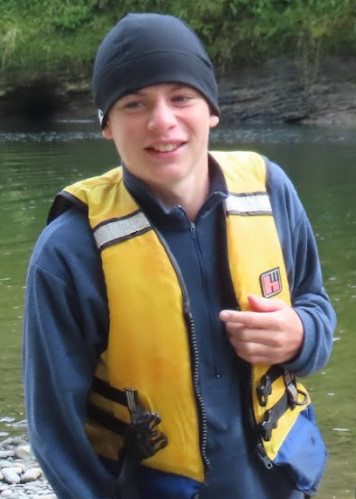
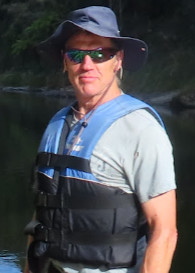
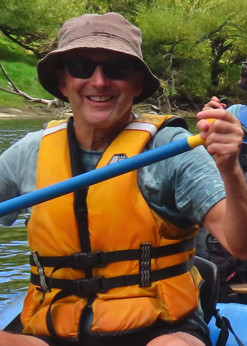
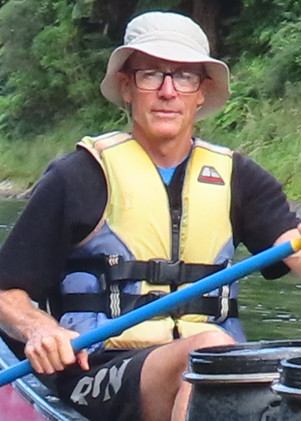
Moa Hunters on this trip: Chris, Lewis, Cooper, John, Adam, Luke, Paul, Richard, Magnus





The Trip:
Day 1: Travel to Auckland, mini-van to Taumaranui
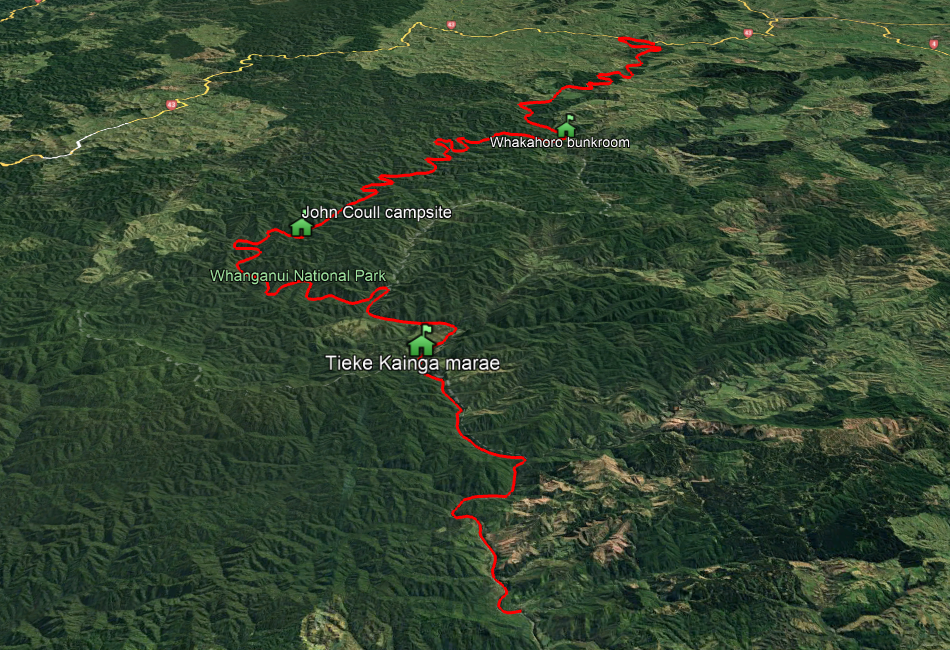
Day 2: Taumaranui to Ohinepane to Whakahoro (6hrs / 35km)
Day 3: Whakahoro to John Coull hut (7hrs / 37.5km)
Day 4: John Coull hut to Tieke Kainga marae (5hrs / 29km)
Day 5: Tieke Kainga marae to Pipiriki to Taumaranui (4.5hrs / 21.5km)

Day 1
Saturday 29th March – Destination Taumaranui
While Auckland isn’t conveniently located anywhere near Taumaranui, it worked well for us all to converge on the big city and travel as a group from there. Lewis flew in from Paraparaumu and Magnus from Nelson, both in fun little fizz planes.
The South Island crew arrived by jet, but not until seemingly every Air New Zealand staff member at Christchurch airport had sniffed and examined Paul’s camp cooker fuel cannister. Being an honest chap, Paul declared said item to check-in staff as soon as he arrived. Following a dubious sniff and a screwed up nose, the cannister was subsequently walked up and down the terminal, nose to nose, until it finally reached a snout of sufficient seniority to sign it off as “OK to travel”. Paul was less amused than the rest of the Moa Hunter crew…
Richard met us all at Auckland airport where we bundled our bags and bodies into a rental van with an identity crisis. We drove to his residence in Flat Bush, added Cooper and his bags to the mix, then hit the road south-bound for Taumaranui.
Cooper is Richard’s eldest son and he joined us for the first time on this trip, becoming the tenth Moa Hunter! We held high hopes that his sharp young eyes might spot moa that our old ones miss.

We rolled into the grounds of Taumaranui Canoe Hire a few clicks after 2:00 pm.
Located five minutes drive out of town, their hillside base is in a lovely spot with the Whanganui river meandering directly below it. We parked up outside the large new shed and began inspecting the barrels and boats we would become intimately familiar with over the next four days.

Lewis had booked four double Canadian canoes and a single sit-on-top kayak for our team. We had opted for the additional rigid seat-backs on the canoes on the assumption they would make travel a bit more comfortable for our old backs.
Each person is allocated two 30 litre plastic barrels for their paraphernalia. Snug fitting lids are held in place with ring clamps, making for a “mostly” waterproof seal. With no guarantee of water-tightness, we all pushed our various clothes and other items safely inside a mix of dry bags and plastic bags before stuffing those into the barrels. An additional (not water tight) 60 litre barrel per canoe is also provided for additional gear that doesn’t mind getting wet.

Getting clothes, food and other items into two 30 litre plastic barrels proved an interesting challenge. Each of us can load our backpacks ready for tramping with eyes closed. But the rigid sides and smallish openings of the barrels made for a bit of a challenge getting things fitted in. After a few packs, unpacks, re-packs, muttering and swearing, we each had some sort of system worked out.

With our barrels neatly packed, we promptly unpacked them again as we needed our sleeping bags for our night in the on-site accommodation.
For dinner we drove into town and had a great feed at the Rusty Nail – a no frills friendly kiwi pub in the centre of town. We spotted an interesting sculpture across the road from the pub, and took it as a good omen.

Our plan was to eat, drink, and watch the Super Rugby. However, by 8:00 pm the Crusaders were getting a bit of a lesson from Moana Pasifika, and some of us who had been up since 4:00am were feeling more than a little jaded. We headed back to Taumaranui Canoe Hire for an early bedtime…
Day 2
SunDay 30th March – Taumaranui to Ohinepane to Whakahoro
Our report time up the hill at the Taumaranui Canoe Hire office and briefing room was 8:00am. To be sure we weren’t late, we hauled ourselves out of bed bright and early, well before sunrise. Breakfast was an easy Bircher muesli, then it was back to stuffing our barrels ready to be loaded onto a trailer under our canoes.
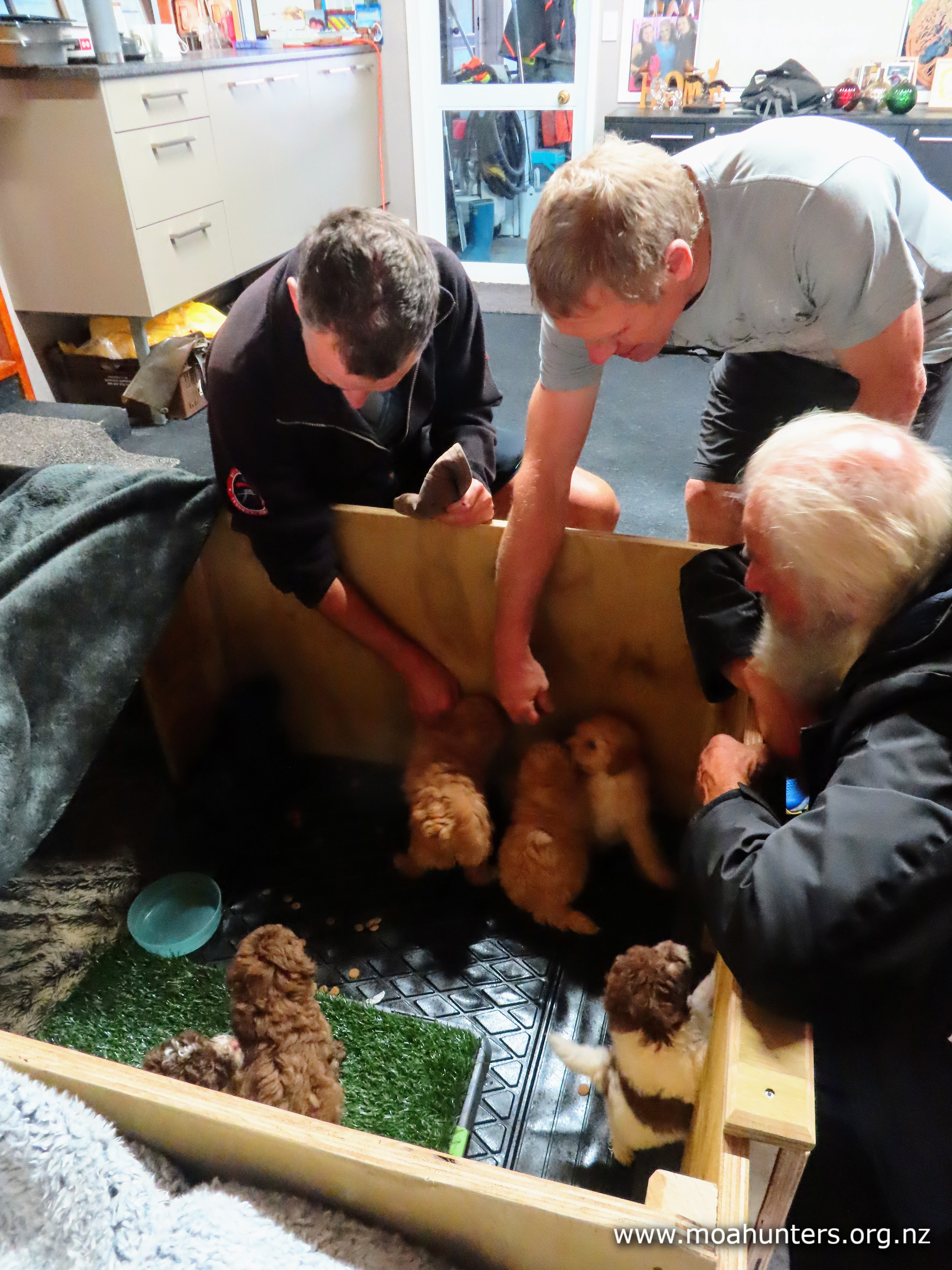
Up the hill at the office, we were greeted by the sound of small yips, yaps and whines from a wooden crate. Puppies!! We were all immediately distracted by their cuteness. Fortunately there was no rush. Barista coffee to start the day is part of the package, and we all gratefully accepted a cup of hot frothy caffeinated goodness.

Once we were all seated in front of a big screen telly in the briefing room, hot slices of bread straight from the oven were offered to us. Yum yum yum.
Jono of Taumaranui Canoe Hire gave us a great 20 minute lesson on the do’s and don’ts of canoeing: How to steer them, where to steer them, and places and situations to avoid. It was an excellent presentation with videos covering off some of the trickier sections of the river, how to tackle rapids, and how not to tackle rapids!
Following that, we piled into the van and were driven twenty minutes down the river to Ohinepane, the start of our adventure.

A further twenty minutes later, we were all set with lifejackets on and barrels securely roped into our canoes. We were raring to go, keen to get on the river and start paddling. Jono suggested we have a bit of a play in the quiet waters before heading downstream. After a few minutes he was happy we were all somewhat competent, and sent us on our way.
Lewis had volunteered to paddle the kayak on day one, with the rest of us paired up in the canoes.

From Ohinepane you get about five minutes of flat water before the first rapid. Naturally we approached it with a little apprehension. We all knew what to do, but could we do it? Theory is one thing, but what would the real thing actually be like? It turned out to be fairly easy and a lot of fun. Nobody ended up in the drink.
First rule of the rapids: Aim for the ‘V’
The ‘V’ is where water flows in from the left and right ahead of you towards the deepest part of the river. It’s hard to describe, but quite obvious when you are on the river. Entering the rapid down the ‘V’ keeps you in the middle of the flow, reducing the chance of ending up sideways to the current, which is a bad thing.


Second rule of the rapids: Keep paddling
While the boat is moving quicker than the water, it is still possible to steer it. If you stop paddling, you are at the mercy of the river. In the rapids we encountered, this is not necessarily catastrophic. In fact, the canoe does tend to find its own way, regardless. But you may hit a rock wall, log or rock along the way!


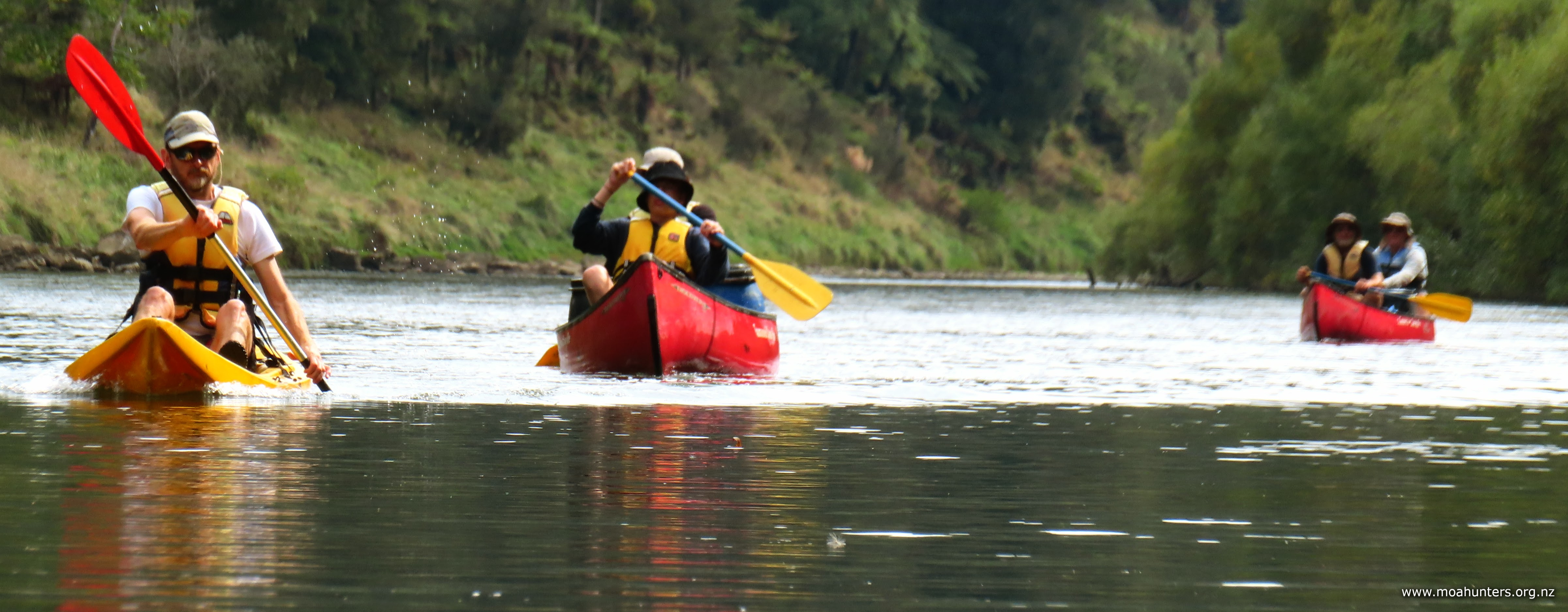
The rest of the morning was very enjoyable alternating sections of flat water and rapids. Around us was a mix of farmland, bush and introduced trees. We regularly caught glimpses of fences, power lines and farming activity.
At 11:30 am we stopped for some scroggin and a drink – a moa hunt tradition we were not going to break just because we were on water instead of land.

By this time we had done quite a few rapids and had all glanced off the odd rock or log. We had also learned that a significant quantity of water splashes into the canoes as you bounce through the wave trains. Fortunately, there is a bailer on board to scoop out the worst of the floodwater once back on easy flat stretches.


We reached Poukaria campsite at the perfect time for lunch. During the height of summer we imagine campsites along the Whanganui would be packed with Te Araroa walkers. But this late in the season, Poukaria was deserted and the perfect spot to refuel our bellies. With only bellbird’s breaking the silence (aside from us!) with their chiming song from the bush, and the river flowing silently past in the valley below, it was a lovely spot for our first lunch break on the Whanganui.
It was on this short break that Adam unleashed the Moa Hunter Theme Song on the unsuspecting gang. With a little help from online AI tools, he had created a catchy anthem tune that to everyone’s delight was played through a couple of times.

Beyond Poukaria we started to get the sense we were leaving civilisation. On both sides of the river the surrounding terrain grew steadily steeper. Along the river banks, ferns and thick native bush replaced introduced willows, bush and bracken.
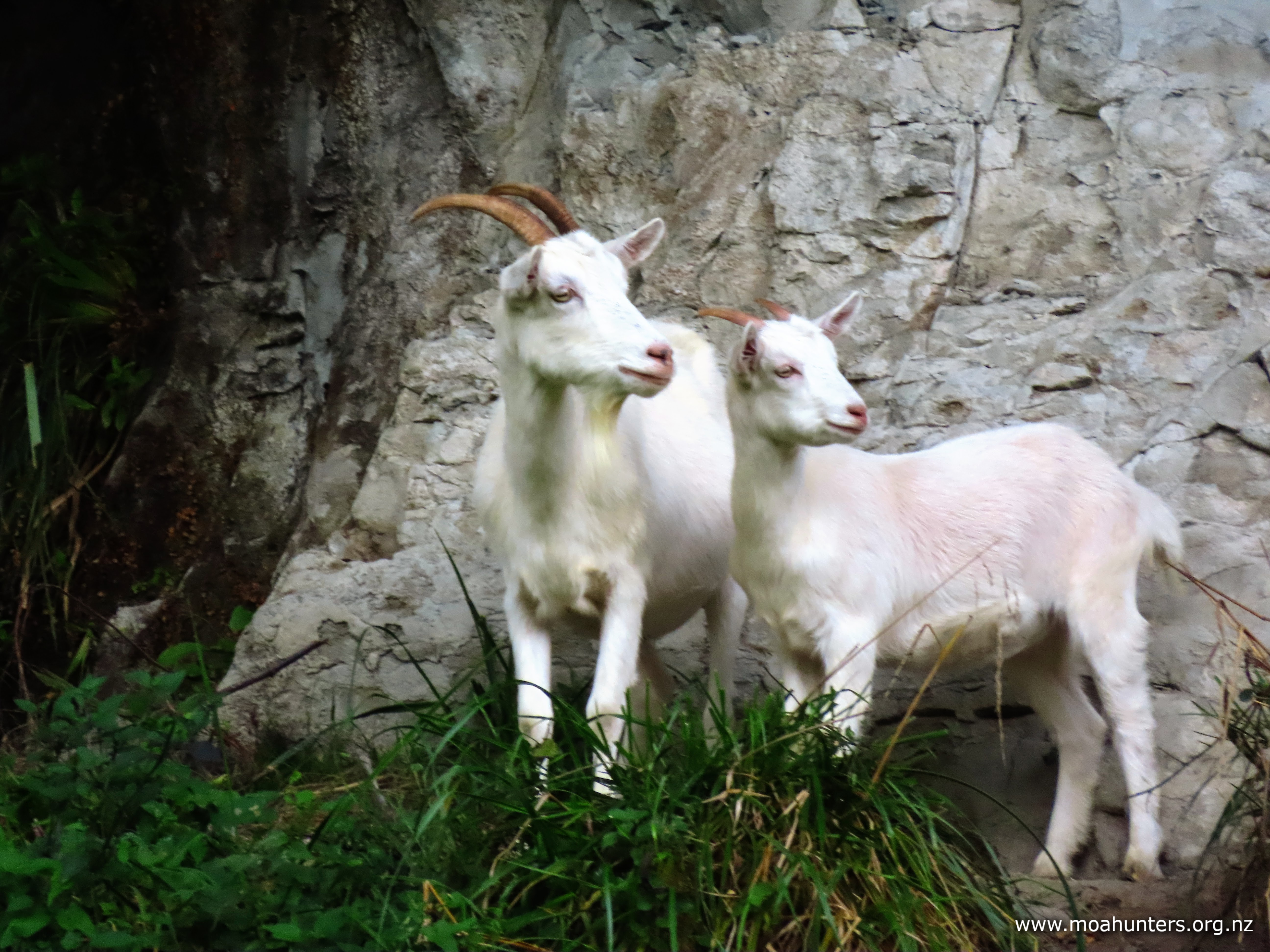
An unexpected introduced inhabitant in these parts (for us southern visitors at least!) were the goats. We regularly spotted them on the banks of the river. Ranging in colour from pure white to fawn to predominantly black, they are a varied and quite pretty pest.
Mostly cloudy skies above us created perfect conditions for paddling. With just a few patches of blue there was a low risk of being burned to a crisp by the still dangerously strong New Zealand sun. That said, we still applied plenty of sunscreen.
There was barely a breath of wind and the sedate waters of the Whanganui were glassy. Paddling these sections was idyllic, each of us enjoying the privilege of being in beautiful surroundings on such a beautiful day.

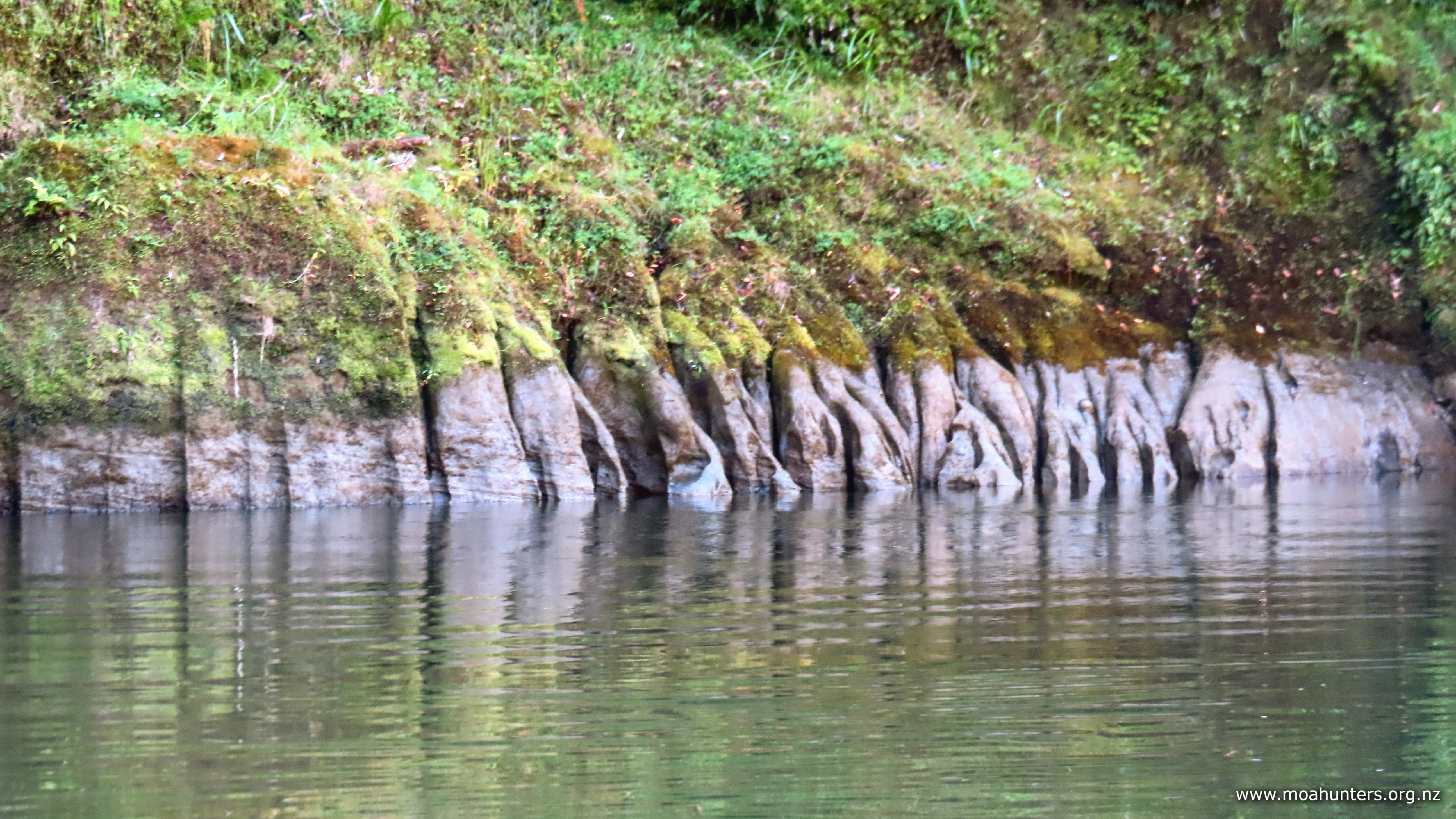
We stopped again late afternoon to rest our arms and fill our tummies. An interesting rocky flat provided the perfect landing spot to haul the canoes onto. A small side stream here had spent many hundreds, maybe thousands of years weaving interesting patterns of erosion into the rock.


It was 5:30pm when we finally arrived at Whakahoro landing. We were not unhappy to be pulling our vessels out the water for the last time that day. It had been a long time on the river, and we were ready to enjoy terra firma for a while.
We had been warned by Jono that the Whakahoro bunkroom and the campsite was a bit of a slog up the hill from the river. The warning was accurate. Four hundred metres up a reasonably steep hill with a heavy barrel in each hand certainly makes the muscles ache and the arms feel longer!
When we finally had all our gear at the bunkroom, we could ease into the evening.
The bunkroom is an interesting design, being a converted 1930’s schoolhouse rather than the purpose-built DOC huts we are accustomed to. The three rows of windows are certainly an unusual feature. Several covered cooking areas beside the camping area are a nice addition. Raised platforms beside each have a sink and running water via a foot pump – a practical waste prevention alternative to the usual taps.


An outdoor education group from Rototuna school in Hamilton were camping nearby. We made a point of saying hello to the teachers and students in the group. After all, we’d be sharing the river with them for the next few days! They were spending the night in tents before their first day on the water tomorrow. We hoped they wouldn’t be too raucous overnight.
It turns out they were much quieter than the heavy snoring produced in the bunkroom…
Day 3
MonDay 31st March – Whakahoro to John Coull hut
One of the translations of ‘whakahoro’ to English is to accelerate, hasten or hurry. It would be fair to say our morning’s activities at Whakahoro could not be accurately described as ‘whakahoro’…
We did get up bright and early and had our barrels repacked and tied into the canoes before 8:00am. But, we were certainly not paddling out onto the river by that time. Instead, we walked a leisurely two minutes from the bunkroom up to the delightfully rustic Blue Duck Station cafe.
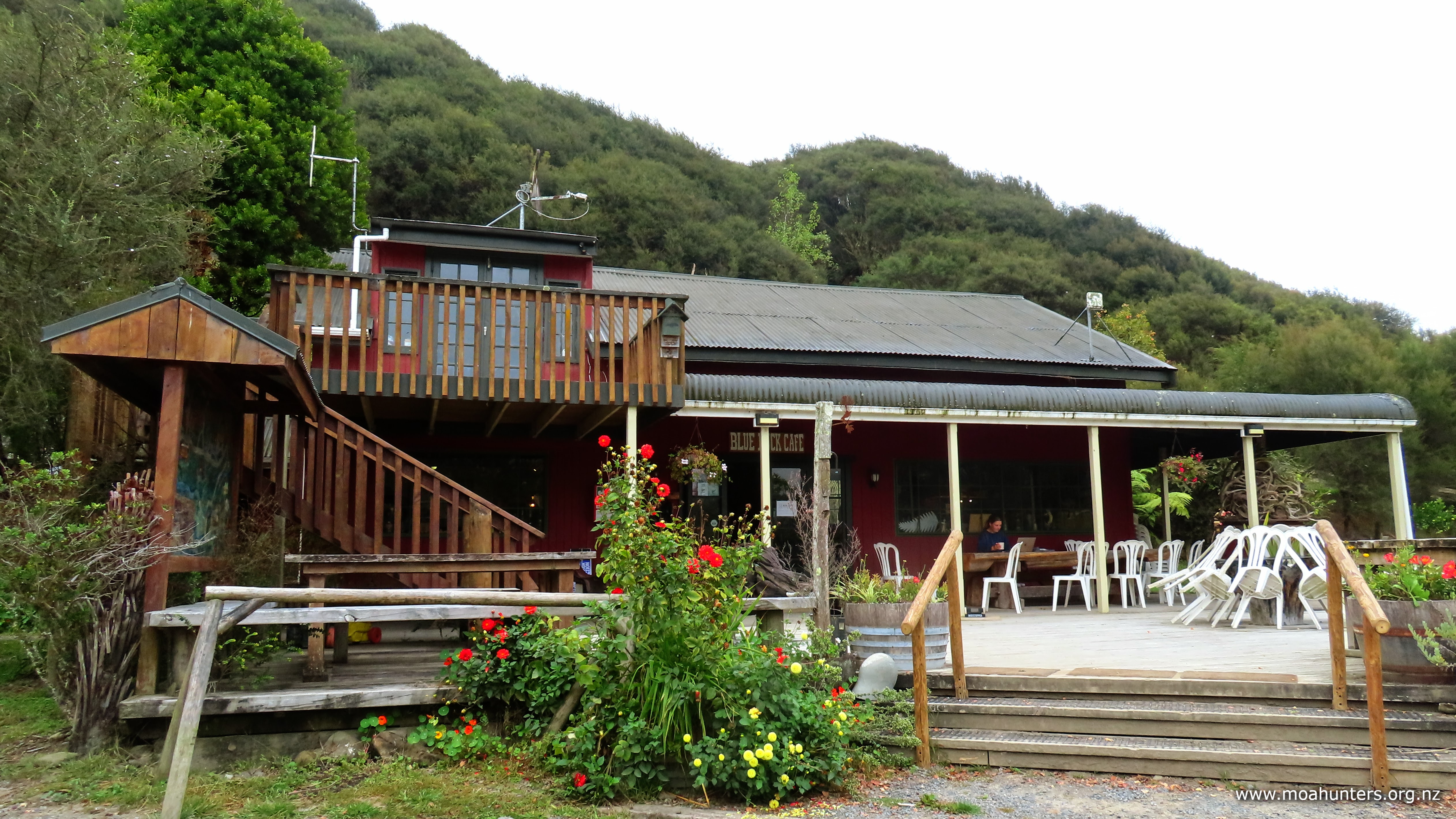
We had contacted them via Facebook messenger a couple of days earlier to confirm they would be open and to warn them that nine hungry blokes would be rolling up at 8:00am on Monday.
Note: On the Whanganui Journey you will likely have zero mobile phone reception for a few days. If you plan to do something like book a cafe, get it done before you jump into a canoe!
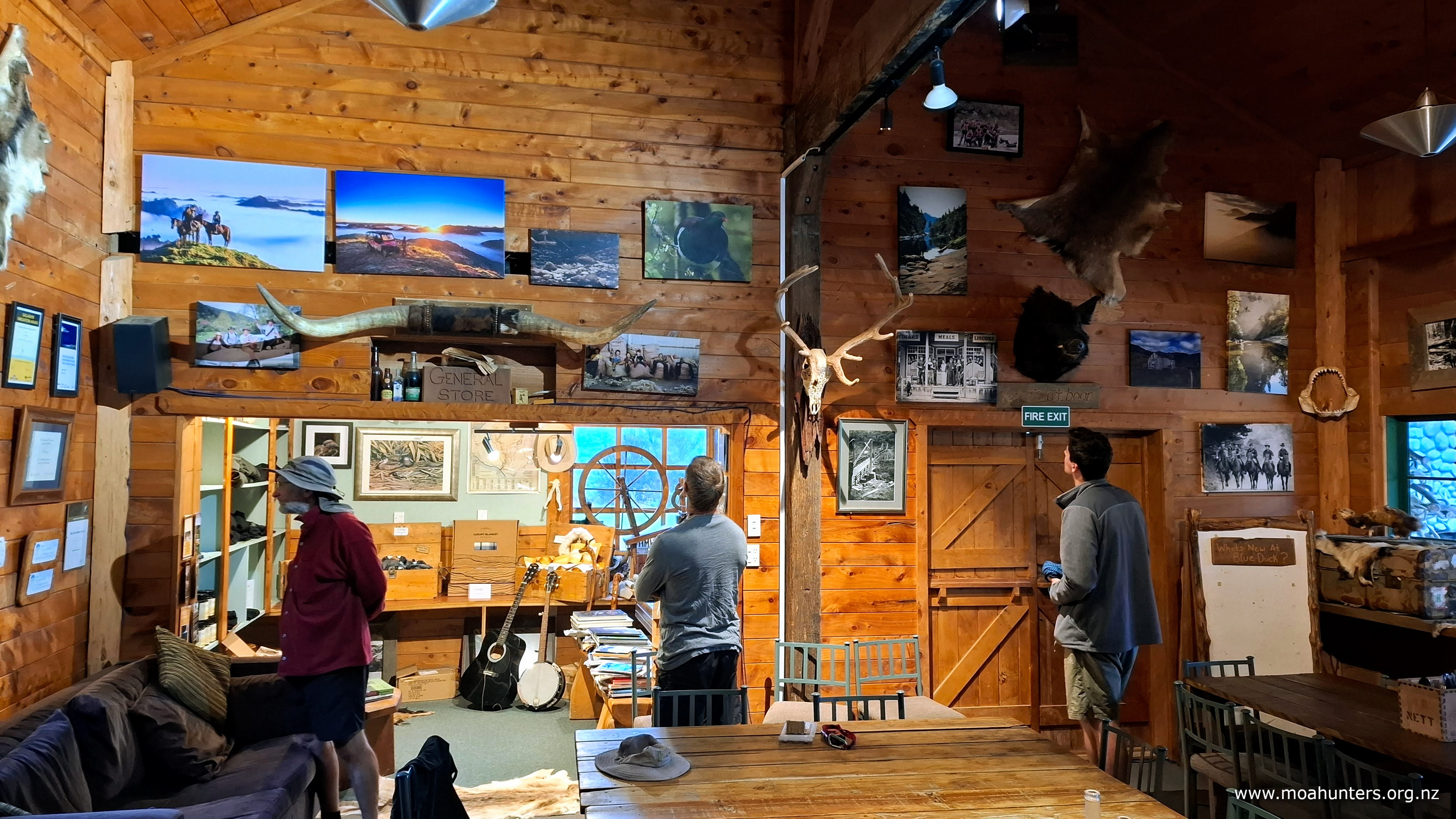
Breakfast was delicious and definitely worth the diversion from our usual porridgy start to the day. We did feel a little guilty that while on a moa hunt we were were in a cafe eating cooked breakfast and sipping espresso coffee… but only a little.
By 9:00am, our bellies were full of paddling fuel, and we were more than ready to tackle the longest day on the river.
Today Magnus took the helm of the kayak and Lewis joined Chris in a canoe. More maneuverable than the canoes, the kayak does have one disadvantage – a single cylinder engine. Up against the two cylinder canoes, and with a surprisingly un-streamlined hull, the kayak could be hard going at times.
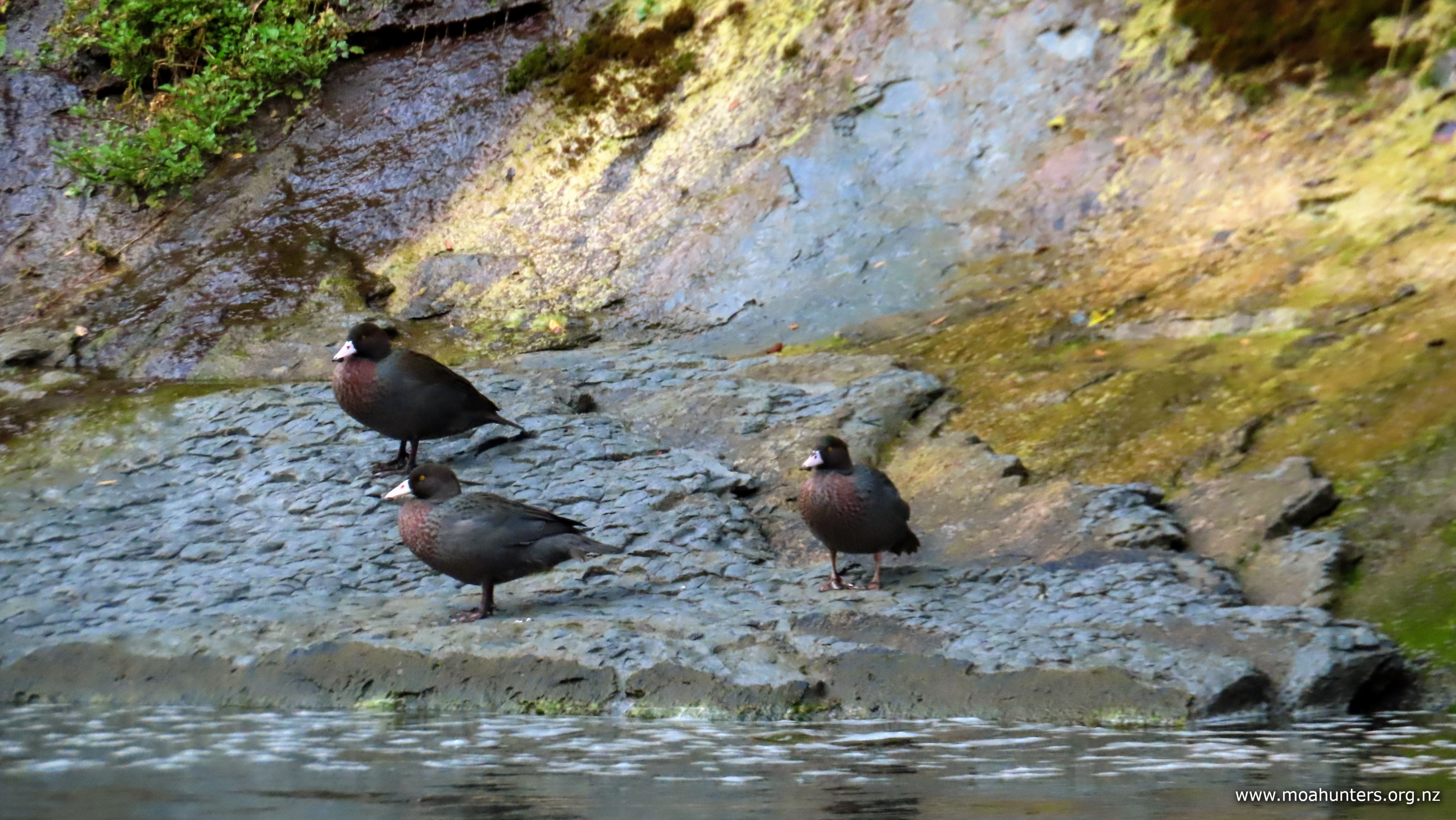
Blue Duck Station was named as such for a very good reason. Less than an hour’s paddling down the river from Whakahoro, we spotted a group of our endangered whio (blue duck) friends standing together on the river bank. As we passed, one of them flapped off, scolding us soundly for so rudely interrupting their morning gossip.
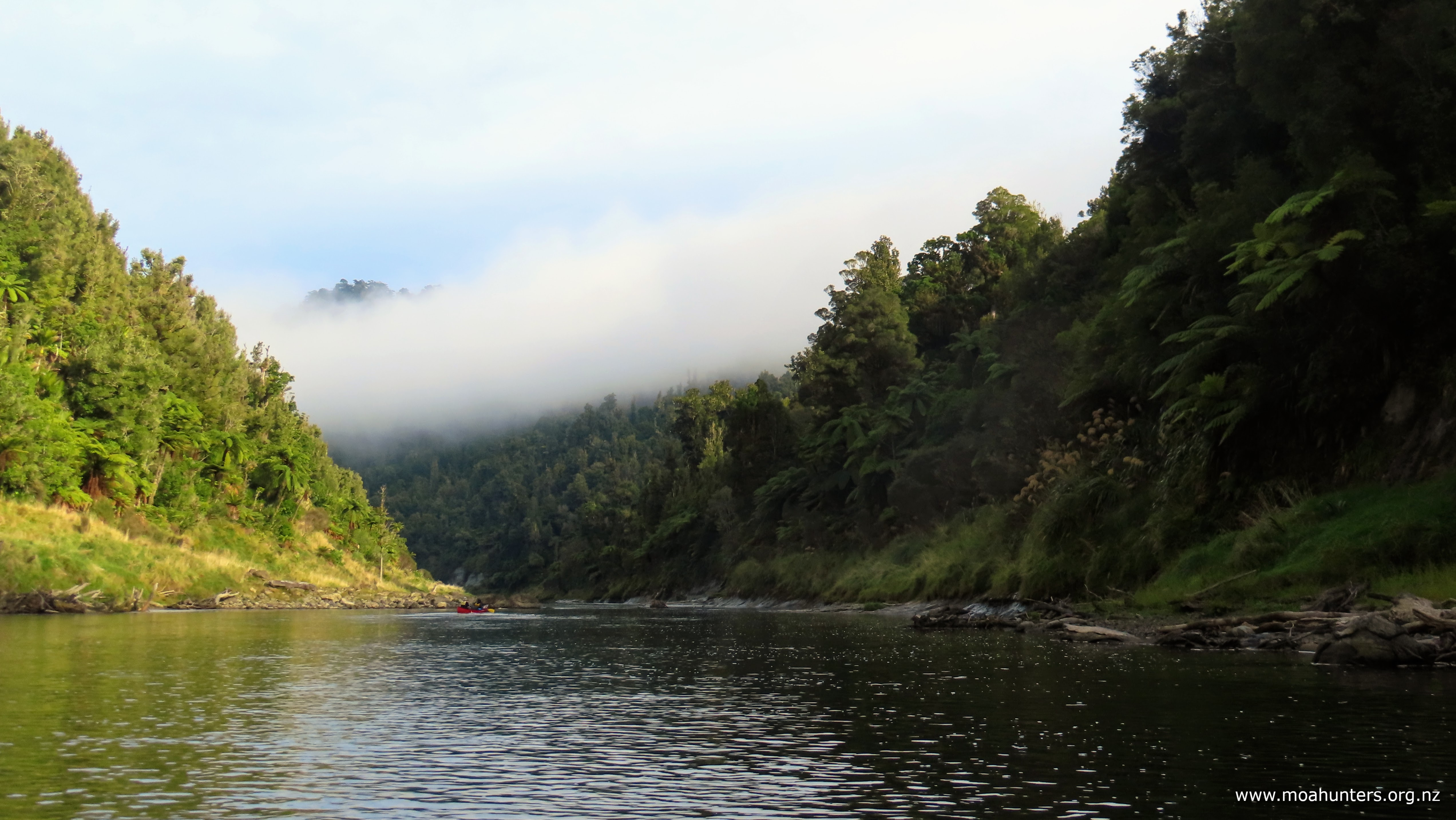
It was a cool, misty and perfectly still morning. We all enjoyed watching the fog slowly lifting off the surrounding hills as we meandered down the river. Being in no particular hurry today, it was surprisingly relaxing and peaceful gently propelling our boats down the Whanganui.
We encountered plenty of interesting rapids throughout the morning session. By now we were all feeling comfortable navigating our way through them. In fact, we enjoyed the challenge and variation they brought to the day, looking forward to the next set.
Third rule of the rapids: Stay straight
There’s a very good reason for this: On each side of the wave train (which is often fairly narrow), water swirls back and forms eddies. If the bow (front) of your canoe goes off course into an eddy where the water is static, it will slow down suddenly dragging the front of the canoe sideways. The stern (rear) of the canoe will still be in the fast flowing water, rotating the canoe further sideways as it pushes past the bow. You are now perfectly setup for bad things to happen. If you are lucky, you will simply get spat out into the eddy. If you are unlucky, you may overbalance. Either way, it all happens very quicky!
At 10:30am we came upon a conveniently located shingle beach and slid our canoes up for a scroggin break. By this time the day was pleasantly warm and the mist had dissipated to reveal another overcast sky – perfect conditions.
Scattered logs left by the last flood event provided us with convenient seats, which most of us politely declined as we were glad for some time to be not sitting! With scroggin munched and backs straightened out, fifteen minutes later we bent them up again and slid back into our canoes.

All morning the valley had been getting tighter, and just prior to lunchtime we floated into the jaws of a steep gorged section. On both sides of the river near-vertical bush covered rock faces towered over us. It was a spectacular place to be on a lovely day. Probably less so if the river was rising rapidly! Jono had mentioned in his presentation that we would be paddling past the thickest bush in the country. Looking at it from our canoes, it was hard to argue otherwise.

Lunch was taken on another convenient shingle beach beyond the gorge. As always, we enjoyed the chance to soak up the beautiful surroundings and compare notes on the rapids we had encountered so far. By this time, any doubts in our heads that canoeing might be dull had been silenced. We were all loving the new experience.

Ohauora campsite came into view shortly before 3pm and we took the opportunity for another break. The chance to refill drink bottles from the water tank at the shelter was not to be missed as we were all getting a bit thirsty. It’s surprising how dehydrated you can get sitting down! We were all conscious to keep our fluid intake up.

As we left the Ohauora, Adam took the opportunity to snap a few photos of the troops shooting a small rapid.

As he was taking his pics, the school group rounded the corner, giving a chance to say hello again as they all floated on past. We spent the next half hour paddling our way through their group. We are slightly more persistent paddlers than they were, which made us ever so slightly quicker.
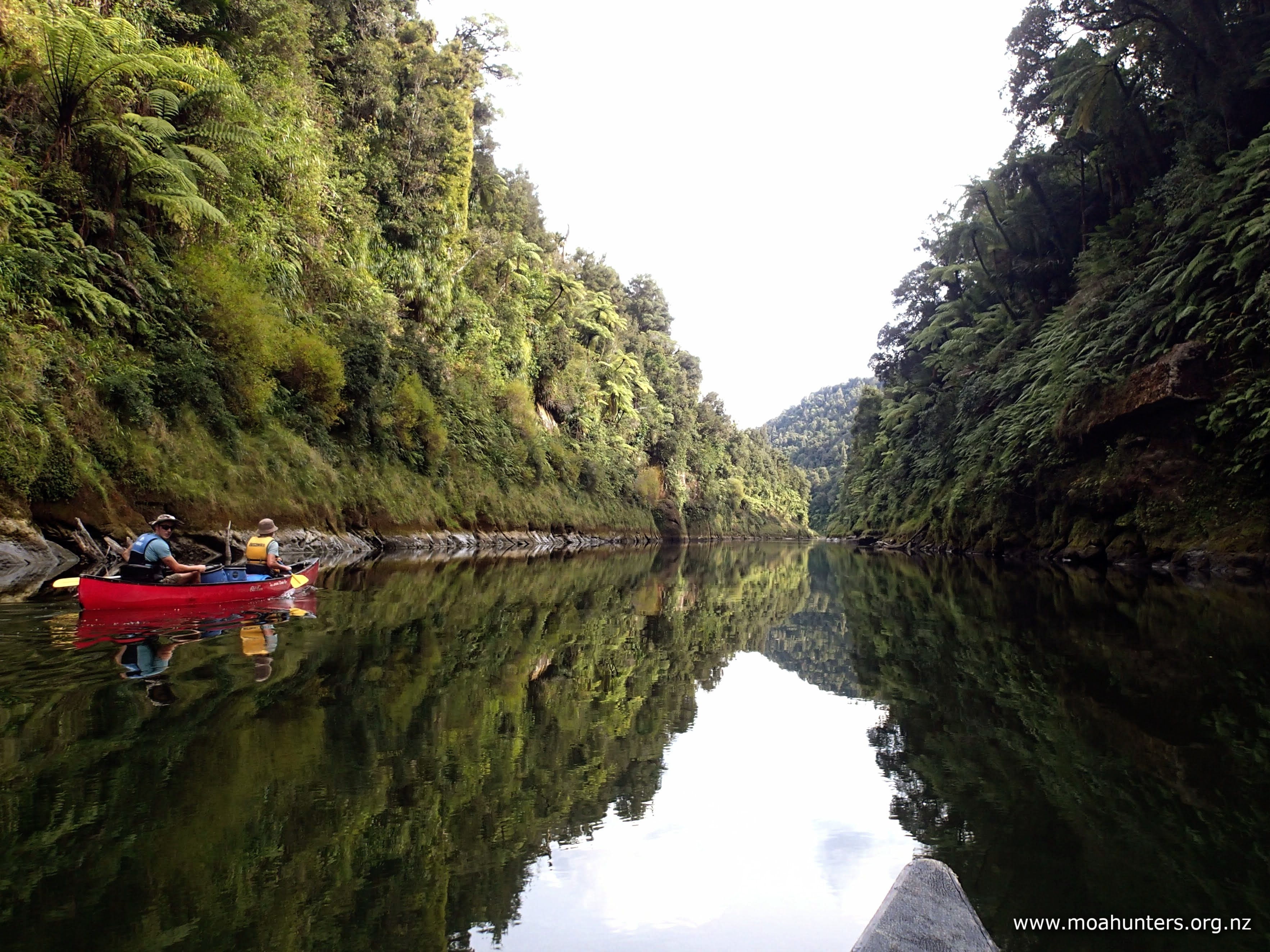
To make life a bit easier on Richard’s arms and shoulders, Chris and Lewis offered them a tow. After a long day yesterday and many hours on the paddle today, Cooper had run out of gas on this long flat section. With a rope between the two canoes, life was much easier. Surprisingly it wasn’t so much being towed that helped – simply being close to the boat in front and taking advantage of the forward moving water it created made for much easier paddling.
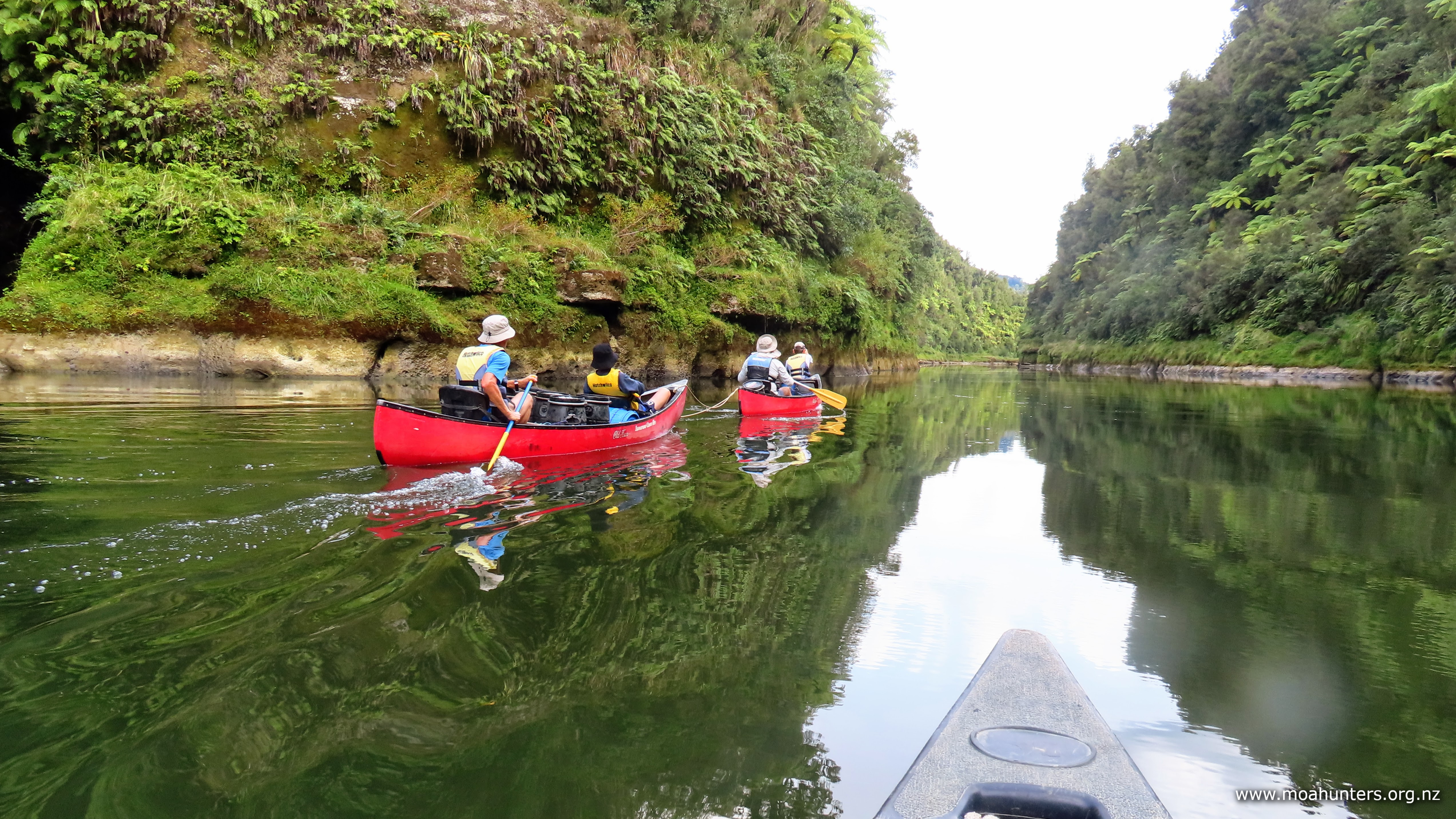
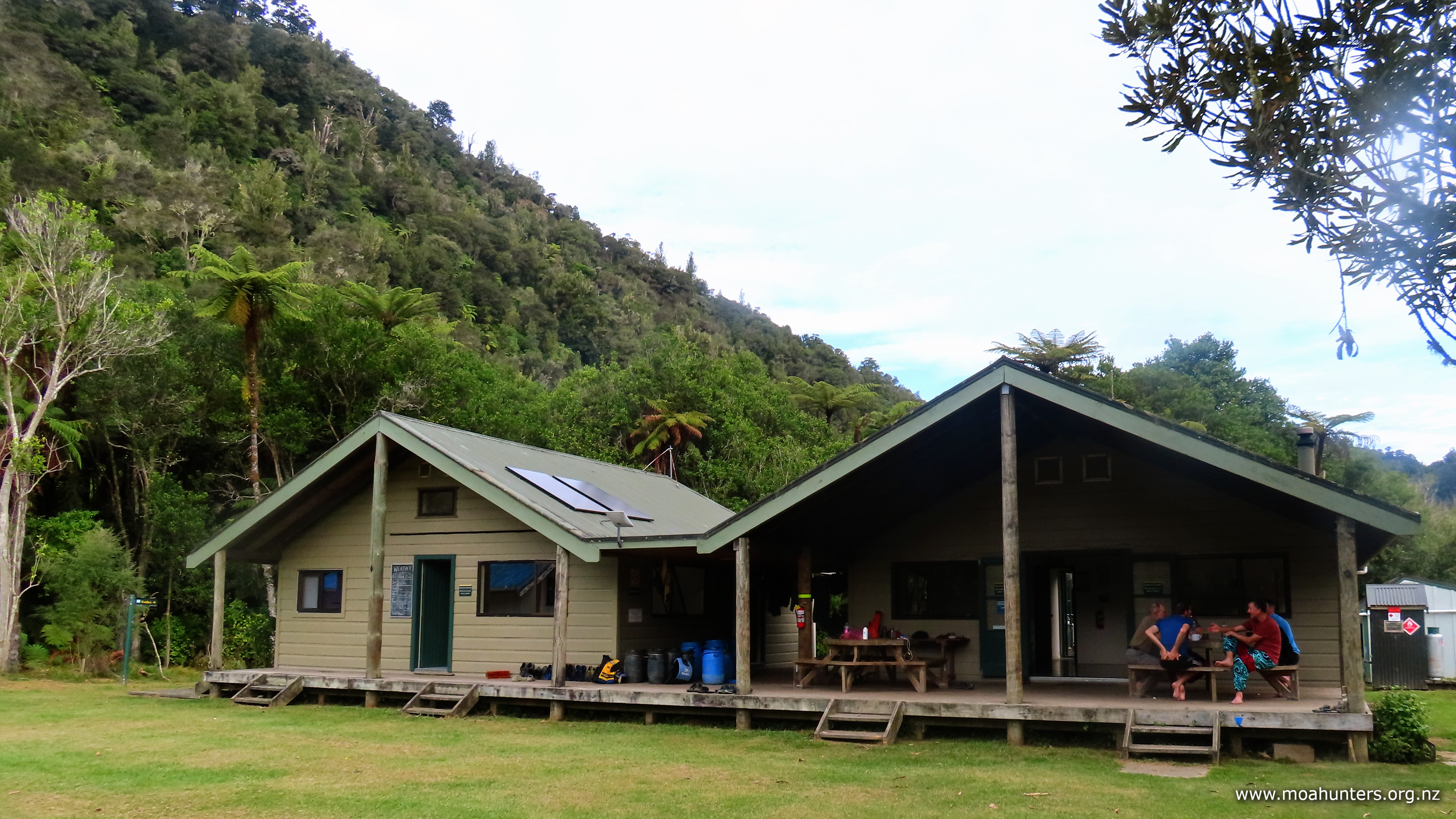
By the time we reached John Coull hut (or as we preferred to call it, the Cool John hut) at 4:45pm, the school group were quite some distance behind us. The warden there welcomed us, and outlined the ground rules. In particular, no shoes of any sort to be worn in the hut, which was an easy one to comply with, given the mild conditions and lack of any nasty biting bugs.
There is a lovely verandah outside the hut with plenty of seating and space for lots of barrels, if you happen to have any. Which we did. Inside the hut is spacious, with plenty of bunks and room to spread out. The kitchen has gas hobs and running cold water at the sink.


It had been a long day on the water, but we were all feeling good. I think we expected to have aching arms, shoulders and backs, much like your legs complain and feel beaten up after a hard day tramping up and down mountains. Surprisingly this wasn’t the case. Our upper bodies certainly felt like they’d done a decent days work, but nothing more. The main area of discomfort during the day was aching and numb bums – a result of the hard plastic canoe seats. And a bit of lower back niggle from being seated for long periods.
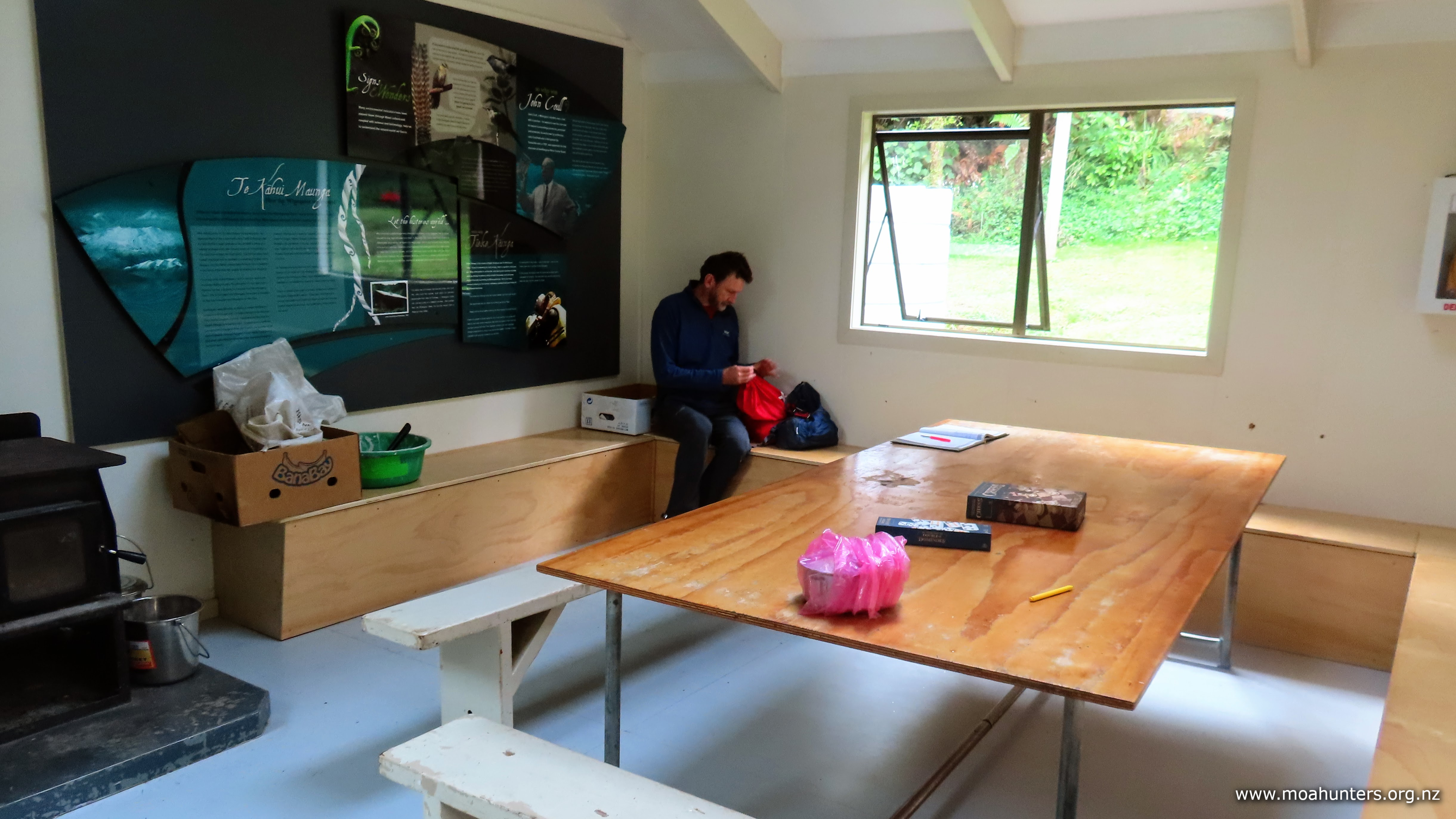
While Magnus prepared hot chocolates for the team, Chris and Paul busied themselves getting dinner going – a traditional Moa Hunter curry, followed by posh instant pudding. (posh because it had crumbled meringue and chocolate in it).
Day 4
TuesDay 1st April – John Coull hut to Tieke Kainga Marae

Tuesday dawned misty and calm, the hills surrounding John Coull hut cloaked in low cloud. The air was cool and fresh, but not overly chilly. After a hearty porridge breakfast, we started the now familiar process of packing barrels. After two days on the river, we each had worked out a system for what to pack in each barrel, and what to keep accessible on top.
For those into photography on their trips, I recommend either a fully waterproof camera, or a really good dry bag. For this trip I bought a high quality 2-litre capacity bag with a shoulder strap. Being able to grab the camera out of it regularly to snap photos was essential, as was having a bag I knew would protect it if we were tipped out of the canoe.
After two seven hour days on the river, today we had just five hours to Tieke Kainga marae. With a planned side trip to the Bridge to Nowhere, we did make sure we were on the river fairly early. It wasn’t too long after 8:30am that we pushed off the shore and continued our journey south.


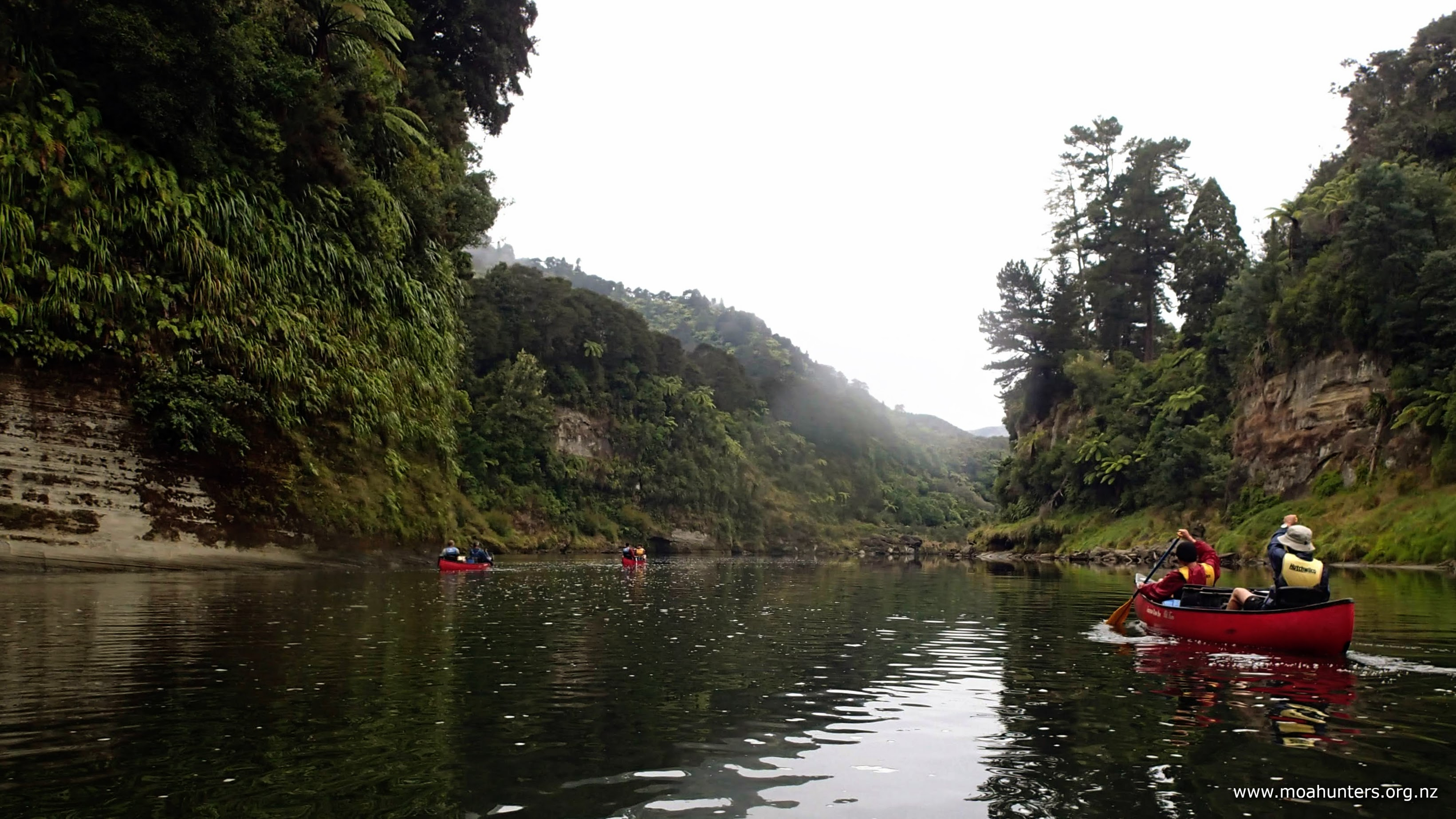
Much of the morning was spent in stunning surroundings. The Whanganui river has sculpted an impressive path through strongly delineated layers of sedimentary rock. Bush-clad vertical rock faces rise up like the walls of an ancient castle.
We judged from the sparse vegetation on the lower rock faces that the river generally runs higher than the days we paddled it. These sections of rock had the appearance of being under water regularly.

Jono had told us during our day one briefing that during heavy rain the river level can rise a metre an hour, and has been known to rise a total of 14 metres during torrential rain events. Scary stuff. Fortunately for us, the weather forecast for our trip was ideal, with very little precipitation expected.
The low river flow on our trip was something of a double-edged sword. On the bright side it creates more fun rapids. On the less bright side, low flow means more paddling effort is required.
The walls on either side of us were gorgeous. Eroded rock faces with varied green and brown mosses, ferns and algae reflected in the mirror-like water created a beguiling and beautiful kaleidoscope of shape and colour for us to enjoy as we glided down the river.
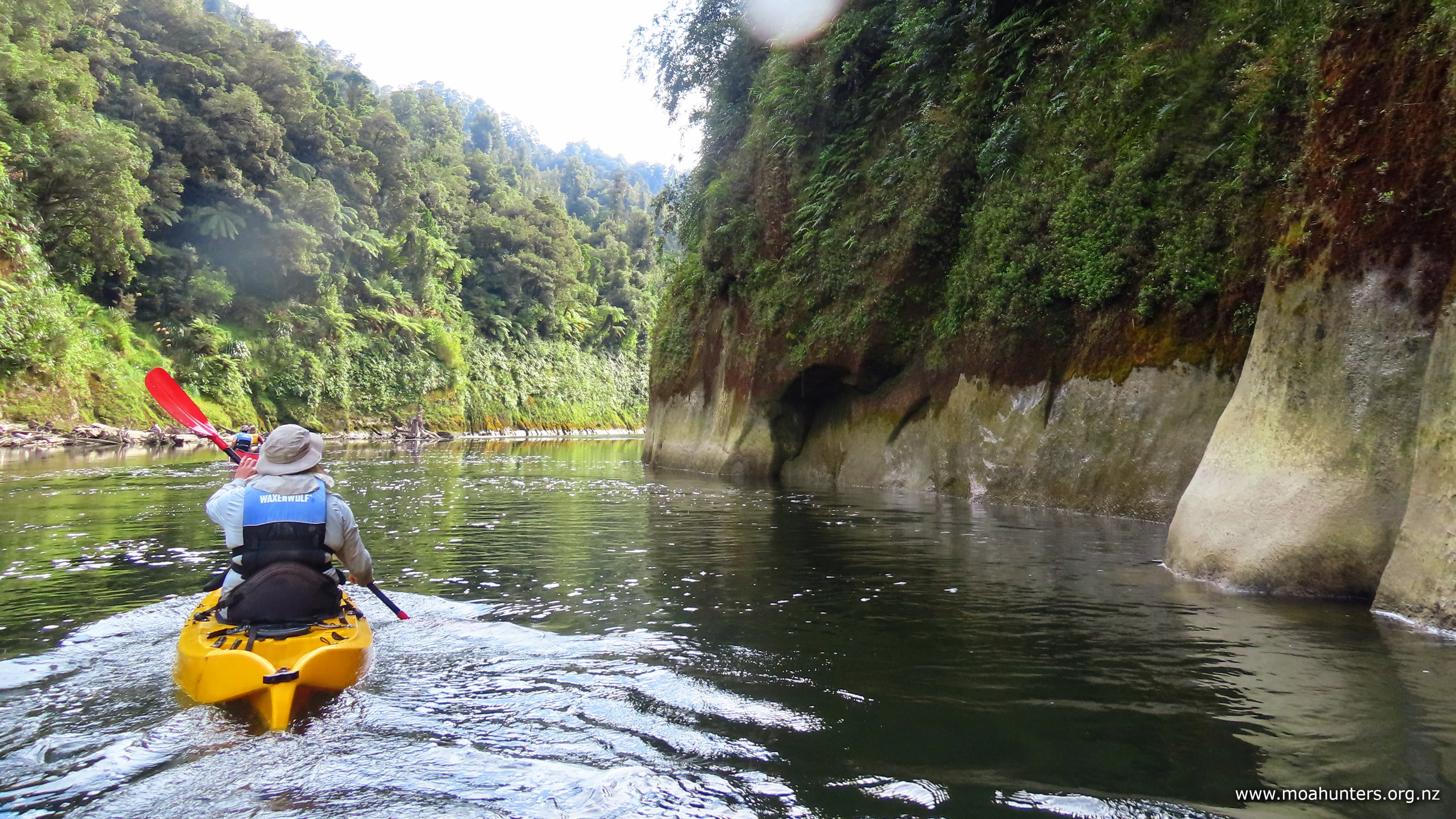
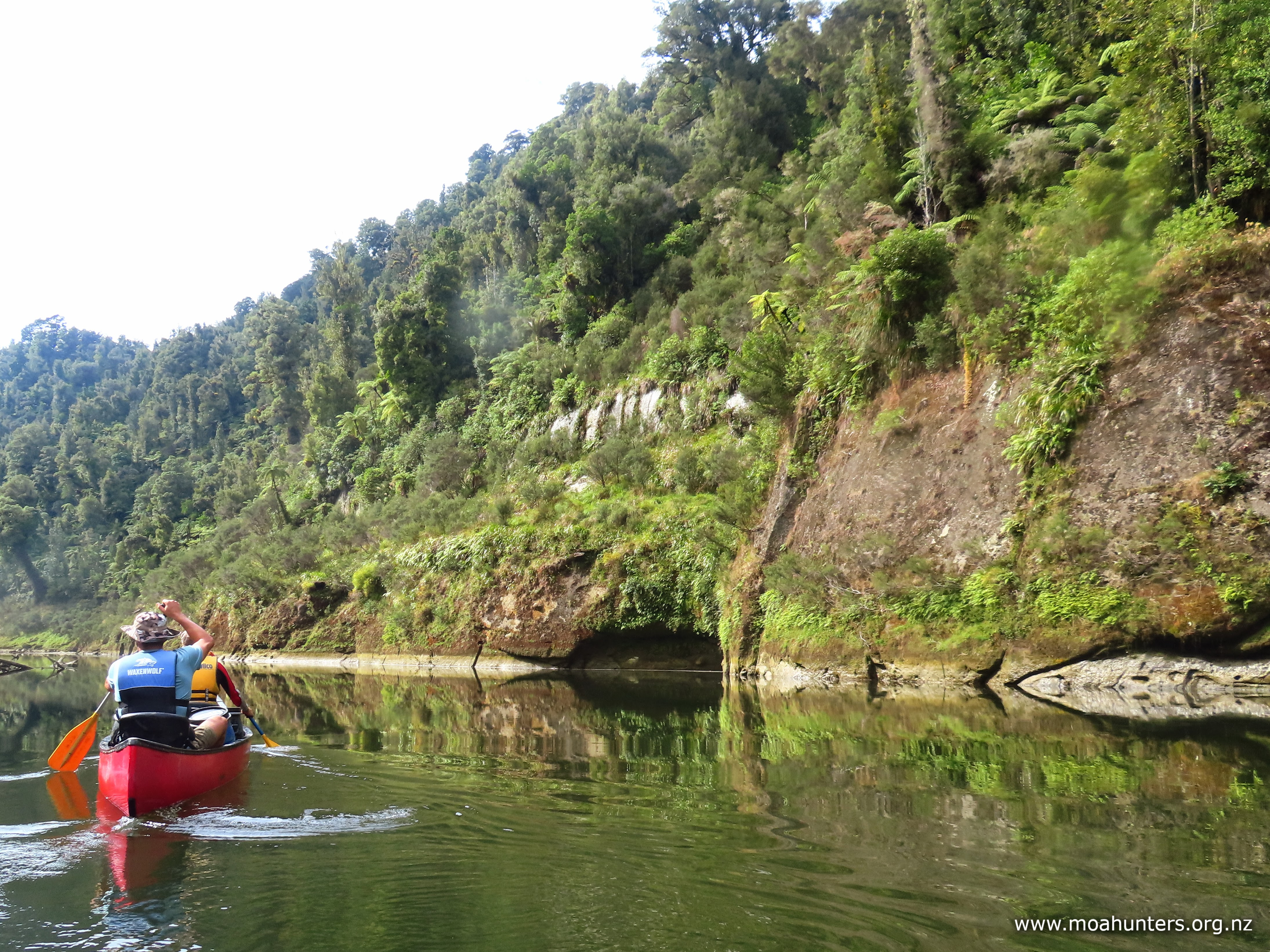


We arrived at the Bridge to Nowhere landing right on lunchtime. The landing is an awkward slippery steep rock face with greasy footholds. There is a flat terrace above, but organising food and clothing out of barrels from the canoes up to it would not be fun, safe or easy. Fortunately for us, the river has thoughtfully deposited a convenient long pebble beach on the opposite bank – the perfect spot to pull in for lunch and get organised.

With lunch eaten and the world’s political situation dissected, we stowed some clothes and snacks into day packs and paddled across to the landing.
Care needs to be exercised getting out of canoes and climbing up to the terrace. It is steep, slippery, and more than a little treacherous.
With no trees growing conveniently along this bank, lengths of rebar have been hammered into the rock for tying up canoes.

It was a pleasant change to be walking rather than sitting. Signage suggested we would have a 40 minute wander to the bridge. Even with a stop at a small shelter to read information boards, we easily knocked it off in 30 minutes.
Quite unexpectedly, we met a fairly large group of retirees walking in the opposite direction along the well formed track. Having spent the last two days in the river feeling like we were miles from any civilisation, seeing day trippers clutching handbags was a bit of a culture shock! They had arrived by jetboat, and would be leaving in the same manner.


If you are wondering whether the bridge is worth the walk, the merits are easy to weigh; The walk is short and the bridge is spectacular.
Constructed in the 1930’s, it spans the Mangapurua stream and was intended to provide a link to farming allotments for WW1 returned servicemen. However, the advent of World War II and then a realisation that the land beyond the bridge was too remote to be farmed practically led to it being orphaned. Connecting roads were never built, and it was abandoned… a bridge to nowhere.

At 40 metres above the stream, higher than it is long, and surrounded by lush native bush, it is a surreal and beautiful spot that has become the most visited site in the Whanganui National Park.


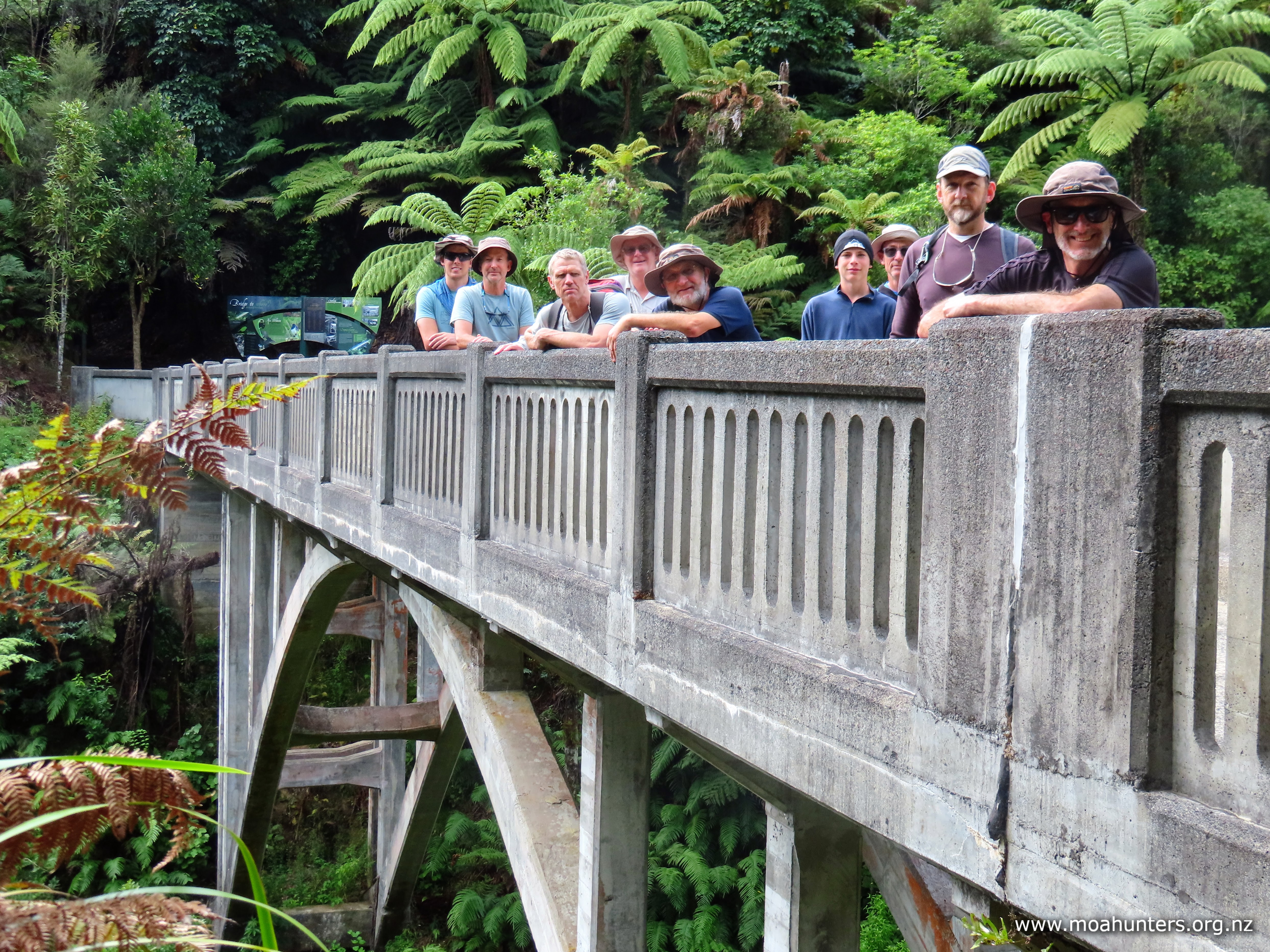
Beyond the bridge, the Whanganui provided us with more beautiful scenery to enjoy. Interesting rocky banks reminded us of photos we have seen of steep sided islands in Thailand. In other places, the eroded river bank looked like the fossilised remains of ancient tree roots disappearing into the rivers depths. It was just as well the river is so pretty in this section, because it is also very flat. There were long periods of paddling with no rough water or rapids to break up the afternoon.

Late afternoon we pulled into the beach below Tieke Kainga marae. Barrels were untied and carried the short walk up to the marae entrance. Aside from the Te Araroa crews that had arrived a little earlier than us, there was nobody about.
We had read that there is sometimes an official welcome with a powhiri, then responses from visitors. With the school party also arriving today, we thought there would be a powhiri. However, when they arrived we discovered that nothing had been arranged. It seemed there would be no welcome, which was slightly disappointing – it would have been a nice thing to experience.
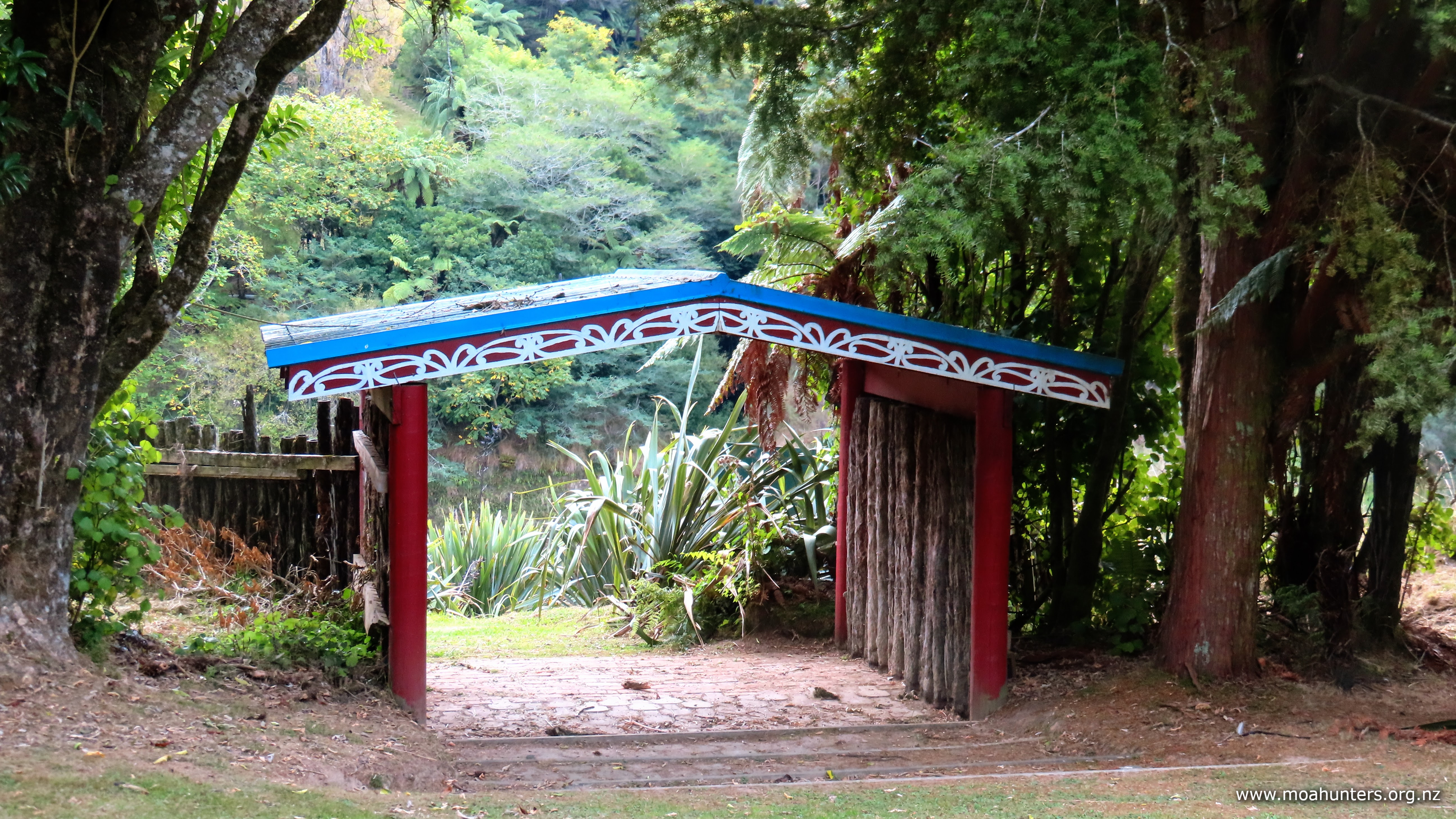

With no-one but us using the accommodation area that night, we made ourselves at home, spreading out across the two bunkrooms. The kitchen is well appointed with gas cookers and indoor sink with foot-pumped cold water. Outside on the large deck two hexagonal picnic tables were a nice place to sit and chat as the afternoon made way for a cooler evening.
After we had eaten dinner, Chris – ever the socialite – popped down to the school camp and invited the three adults from the school group inside to share dessert with us. They happily obliged and enjoyed demolishing the trifle with us while we chatted.
They were a very relaxed team, but had to leave after a short while to check their students were all happily in their tents. Apparently on their first night at Whakahoro, the young’uns had complained about their early 9:30pm bedtime. The following night after seven solid hours paddling the river, when 8:30pm came and they were wearily requesting an early bed time!

Day 5
WednesDay 2nd April – Tieke Kainga Marae to Pipiriki
Waking up at the marae, it felt like our river adventure had flown by. How could it be our last day already?! But weirdly, it also felt like a long time ago that we were all in the mini-van driving to Taumaranui…
The morning was busy down on the rivers edge, with everyone prepping their canoes at the same time. All groups had similar pick-up times at Pipiriki, and nobody wanted to be running late. Our arranged pick-up time was 1:00pm. With 4.5 hours paddling ahead, we wanted to be on the river by 8:00am or shortly after. Needless to say, we all had a fairly early start!

It was great to be back on the river. The beautiful scenery kicked in straight away, with high bush-clad cliffs flanking the river, deep cuts carved in them by small side streams that appeared as pretty little waterfalls along the way.


Over the course of our river journey, we had all independently learned the value of ‘bubbleators’:
Water exiting rapids often forms currents of faster flowing water running along one or both banks of the river. Streams of bubbles carried by these currents are the telltale sign that a liquid travelator is present and ready to be hopped onto. Keeping the canoe tracking down the middle of these ‘bubbleators’ creates a short free ride and noticeably easier paddling.
Around the middle of the morning we had our first change in the weather for the trip. Heavy grey cloud had descended on the hills around us and light rain was falling. We had been on the river for well over an hour and were keeping a watchful eye for suitable spots to pull in for a break. However, we were in steep country and there had been no beaches for quite some time.
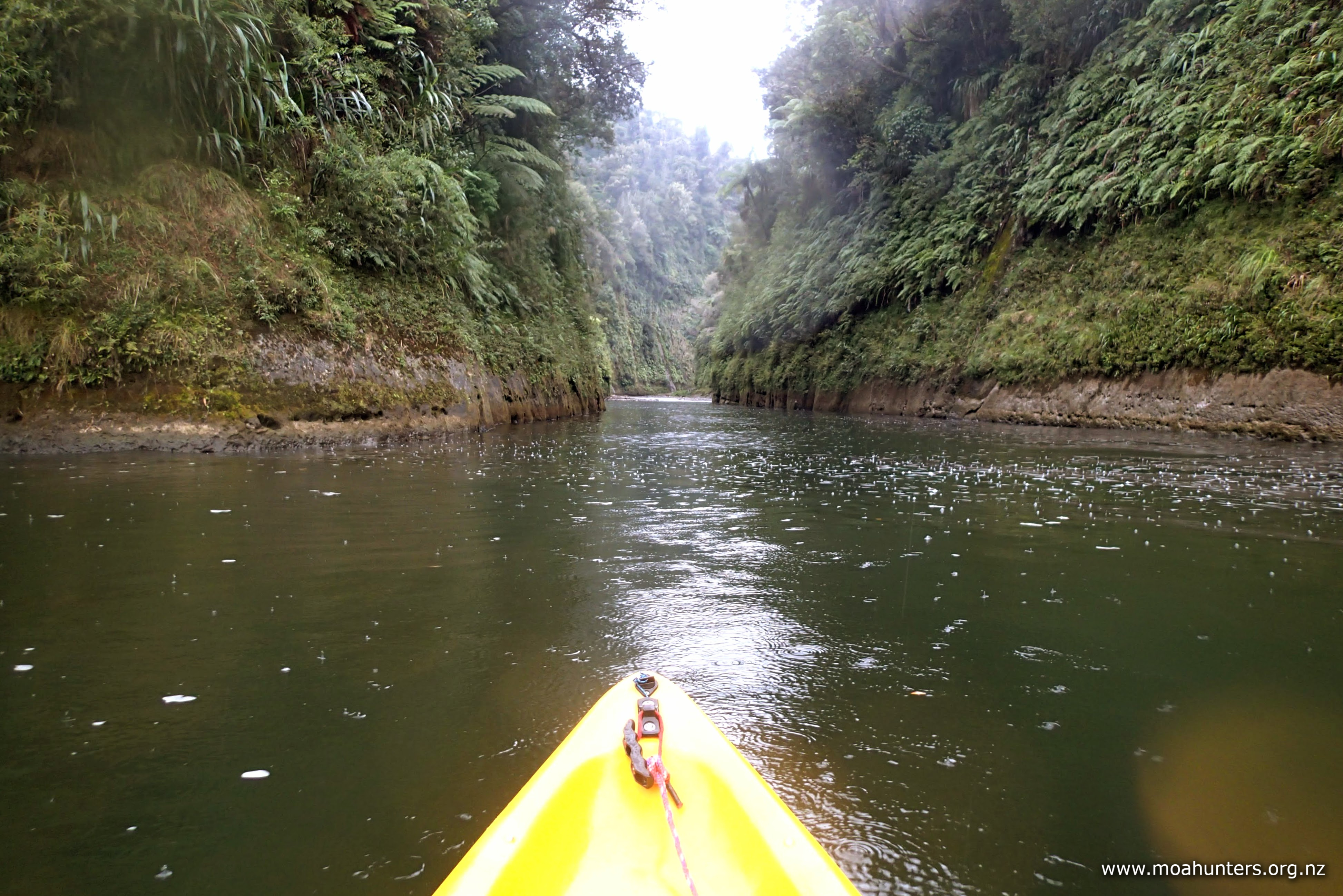
When we finally found at a nice spot, the weather decided to join us. Light rain transitioned quickly into a solid downpour. This was no longer a pleasant dribbly shower, forcing us to rummage into the bottom of our barrels for decent jackets.
Interestingly, the rain brought with it a noticeable chill – the first time we had experienced anything but pleasantly balmy temperatures the whole trip. Standing around munching on scroggin, we started feeling a bit cold. Without the need for discussion, we cut the break short and dropped back into our boats to get paddling and warm up.
As you can probably guess, no sooner did we get underway than the rain eased back to light showers again.
This is all a good segue into what clothes you might need if you do this trip. We did our trip in early autumn. Your weather conditions will be different, so keep that in mind:
Clothing
The provided life jackets generally keep your torso toasty warm. In the overcast mild conditions we experienced, tee shirts and shorts/togs were all we needed. Choose lightweight fast drying fabrics.
Take a variety of thin thermals you can layer on if the temperature drops. Bulky jackets are too hot and uncomfortable under a lifejacket. A lightweight waterproof anorak is a handy item.
If your hands blister easily, consider fingerless gloves made from a fabric that doesn’t mind getting a bit wet.
Footwear
Crocs or old sneakers are equally good choices for footwear in the canoes. Crocs have the advantage that they dry out quickly, but can be a little more sketchy on slippery rocks.
Sun Protection
In a canoe you are fully exposed to the sun, so wear a brimmed hat. Remember to get sunblock slapped on before you start paddling. You don’t want to be messing around applying it when out on the water.
Beyond our beach break was a long run of flat water. Having discussed upcoming river conditions with the guide taking the school group, we knew this would be the case. He had told us to expect an extended vanilla section of picturesque but unchallenging river before our arrival at the much anticipated 50/50 rapid.
According to Jono during our day one briefing, all rapids on the Whanganui Journey between Ohinepane and Pipiriki are grade one… except the 50/50 rapid which sneaks in as a grade two. As the name suggests, there’s an even chance the it will tip you out. However, in low river flows, such as when we paddled the river, your odds of getting properly soaked are even higher!
We had all been looking forward to testing ourselves on the rapid. After a couple of hours paddling and with the rapid in sight, we pulled onto a beach to stow away cameras and batten down the hatches.
Adam and John were first to ride the mighty 50/50. They bounced through 80% of it staying nicely on course down the centre of the wave train, but took on too much water. One of the final waves rolled them slightly. The weight of water sloshing to one side of the canoe was unstoppable and capsized them fully into the drink.
Richard and Cooper following behind, triumphantly making it all the way through They then proceeded to (accidentally) run over Adam and John’s canoe, adding some amusing insult to their injury.
Luke and Paul met the same fate as Adam and John. They looked like they had made a successful run through, but sank in the last metres of rapid due to the amount of water taken onboard.
Magnus and Chris also sank, but did so in hilarious fashion still upright and paddling through the waves with their canoe nearly fully submerged below them.
It was all excellent fun and once we had swum our canoes to the bank, we were buzzing with excitement. By this time the school group had arrived and were one by one entering the rapid.
Spoiler alert #1 – If you want to get through the 50/50 rapid and stay dry, simply avoid most of it! It is possible to pull off to the right after the first half dozen large waves. You just need to remember to lean right as you swing out the swift water into the eddy. This is what the school group did – they had obviously been advised to take this approach.
We (perhaps more foolishly!) had agreed that if you’re doing the 50/50, you do the whole thing! In for a penny, in for a pound, as they say…
Spoiler alert #2 – Lighter crews have a better chance of success. The heavier the crew and cargo, the lower the canoe sits in the river, and the more water it will take on as you traverse a rapid, and the greater chance you will sink.
We would have liked to all go through for a second attempt without the barrels onboard, but time was running out. Luke and Paul squeezed in one frenetic high speed attempt that saw them pitched out the canoe in spectacular fashion on the first few waves.
Cooper took a turn on the kayak and paddled through like a champ, making it look very easy.
The last half hour of paddling to Pipiriki saw the surrounding countryside flatten out and farm buildings make an appearance on the rolling hills. We were on the doorstep of civilisation again.
The final landing was easily spotted from up the river, and we were all sliding our canoes up onto the concrete boat ramp right on 1:00pm. We had timed our run perfectly.
Jono was there to meet us with freshly baked chocolate muffins. What a legend, what a service! We changed into dry clothes and helped get the barrels and canoes loaded onto the trailer. With the large school group hard on our heels, we did our best to get out of their way quickly.

The van trip back to Taumaranui from Pipiriki takes an hour and a half. It was mid-afternoon when we finally rolled up to the Taumaranui Canoe Hire base, and our tummies were a tiny bit hungry. Fortunately for them, Jono had convinced us to order wood-fired pizza for lunch on our return. It hadn’t taken much to convince us, and we were not disappointed.
The pizzas are amazing and come highly recommended. It seemed like the whole family was helping out with putting them together. We really enjoyed sitting chatting to our hosts as our late lunch was carefully prepared and cooked.
The dough bases are handmade and fermented over three days, then stretched just before cooking. A special Italian sauce is spread on them, then a spicy pepperoni, topped finally with chunks of mozzarella sourced from Costco Auckland. They are cooked right in front of you in an impressive steel pizza oven. And needless to say, they are absolutely delicious!

Taumaranui Canoe Hire is a family run business, well worth your support (and yeah, nah – we aren’t related and don’t get any kickback for saying so!)
It had been a wonderful four days on the river. The scenery is simply gorgeous, and the paddling experience ticked every box. The tranquility and peacefulness experienced gliding over millpond water flanked by towering bush-clad cliffs are memories we will long cherish. Bookending the sedate sections, the challenging sets of rapids provide pulse-quickening counterpoints that were a ton of fun.
If you are a tramper wondering whether the Whanganui River Journey is a worthwhile diversion from the usual walking in the hills – it most certainly is.
Another year, another failed attempt to find a moa. We are undaunted, and will be back on a track in 2026, looking once more for the elusive big bird…
 The Moa Hunters