

In 2024, for just the second time in Moa Hunting history, we ventured out in April rather than our usual January or February. Hoping moa prefer cooler conditions, we made our way to the beautiful Nelson Lakes to see if we could spot one.
Walking the hills in autumn was predictably a little more damp and cold than we were used to, but also offered up a few nice surprises…
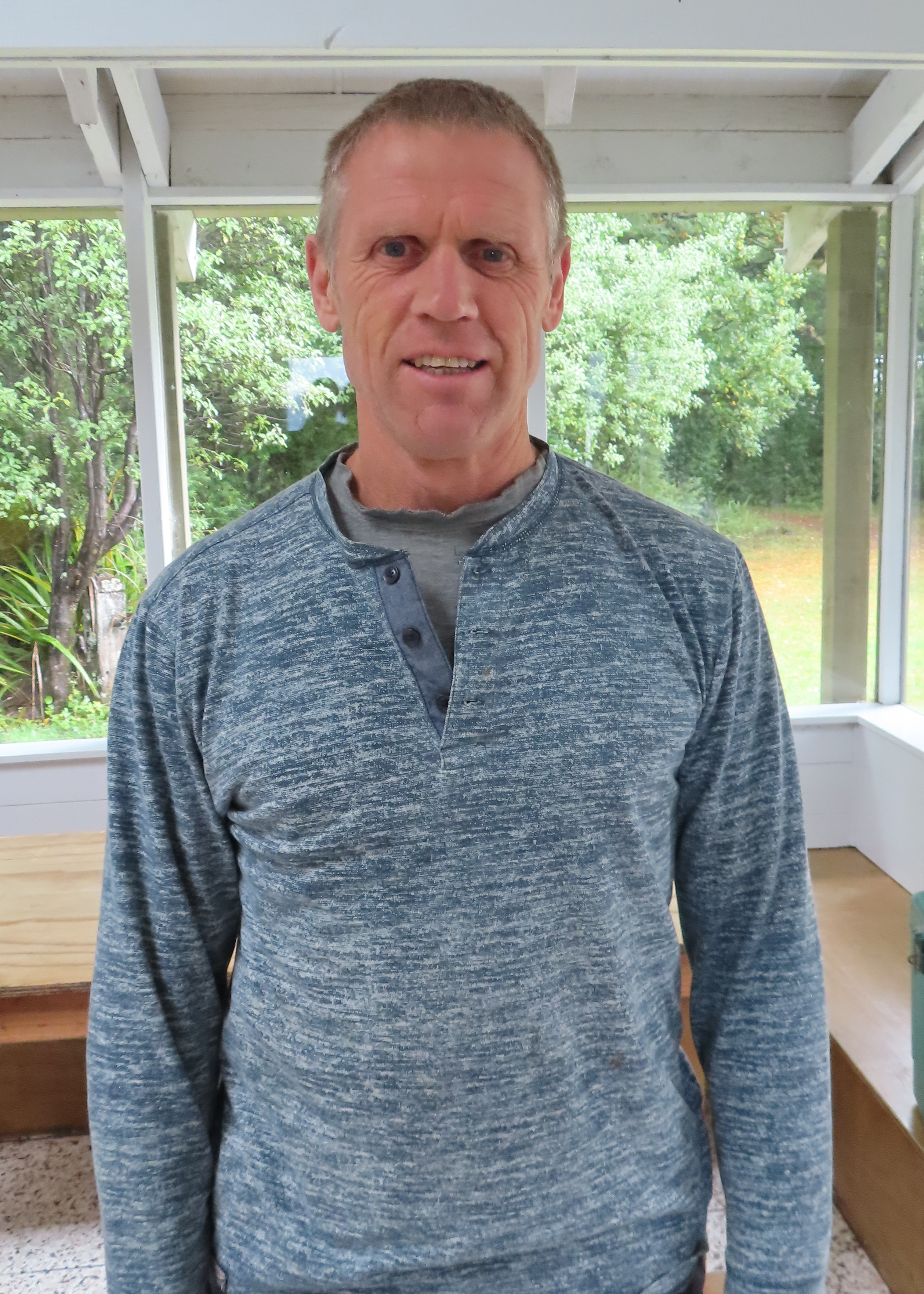
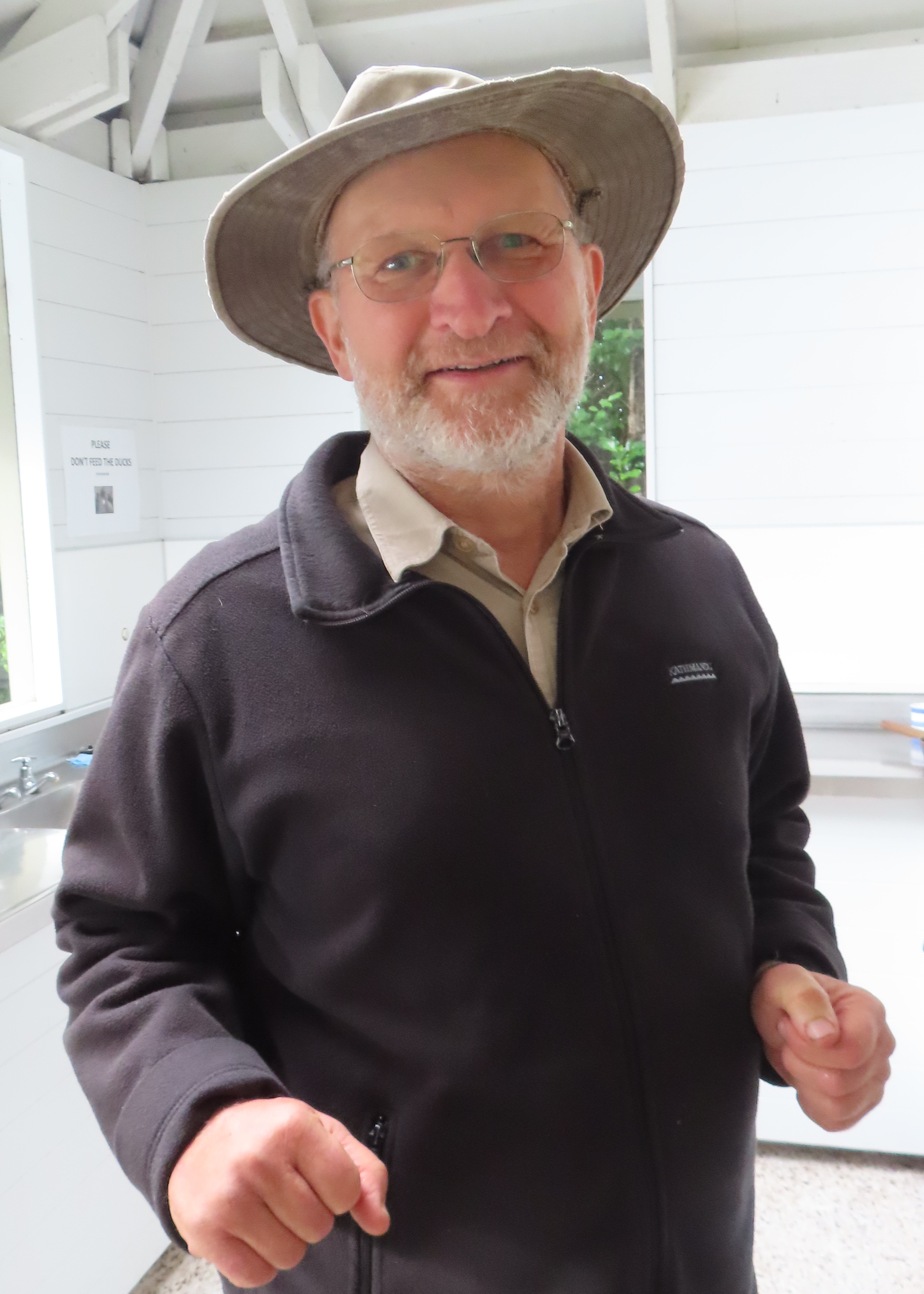
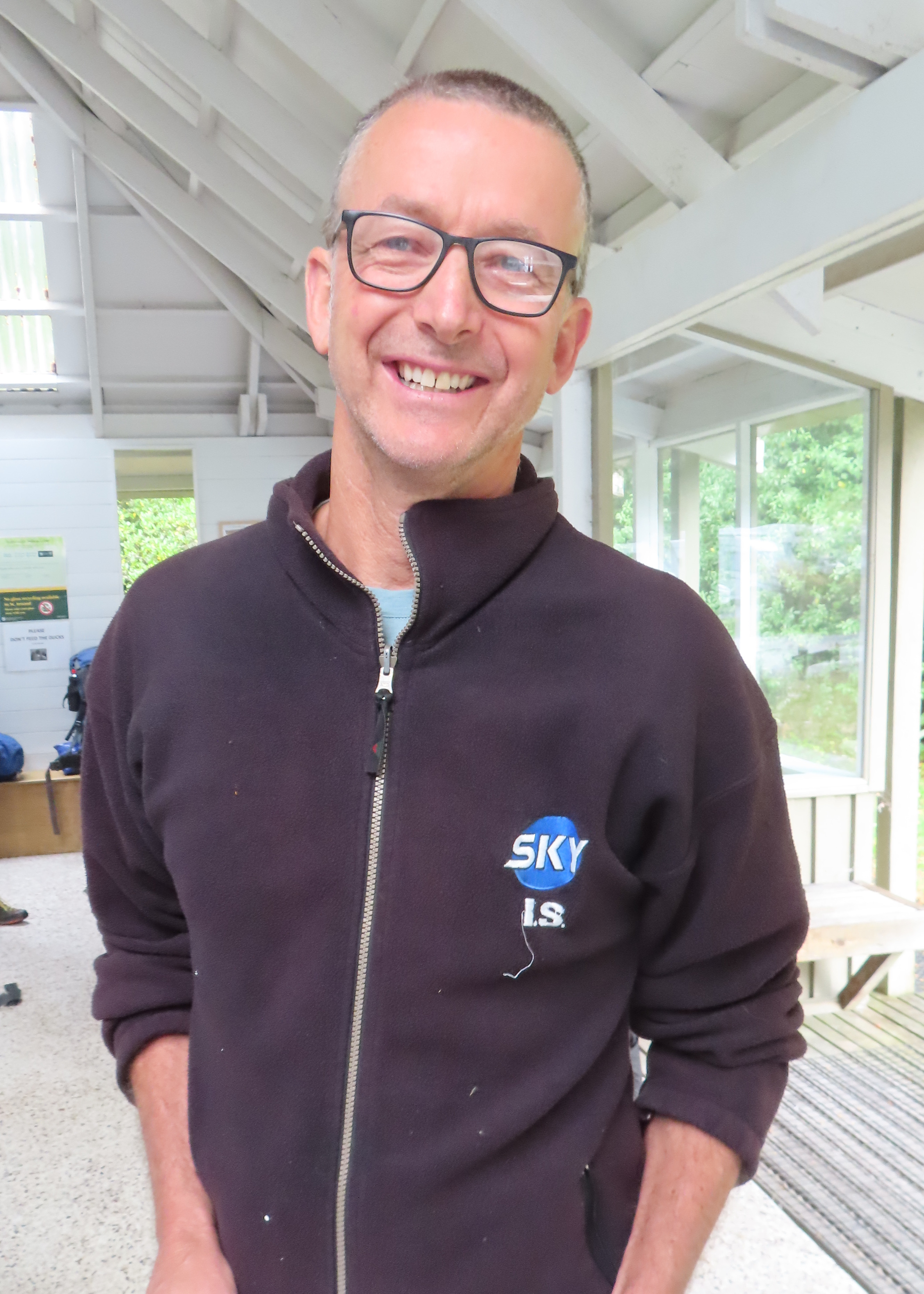
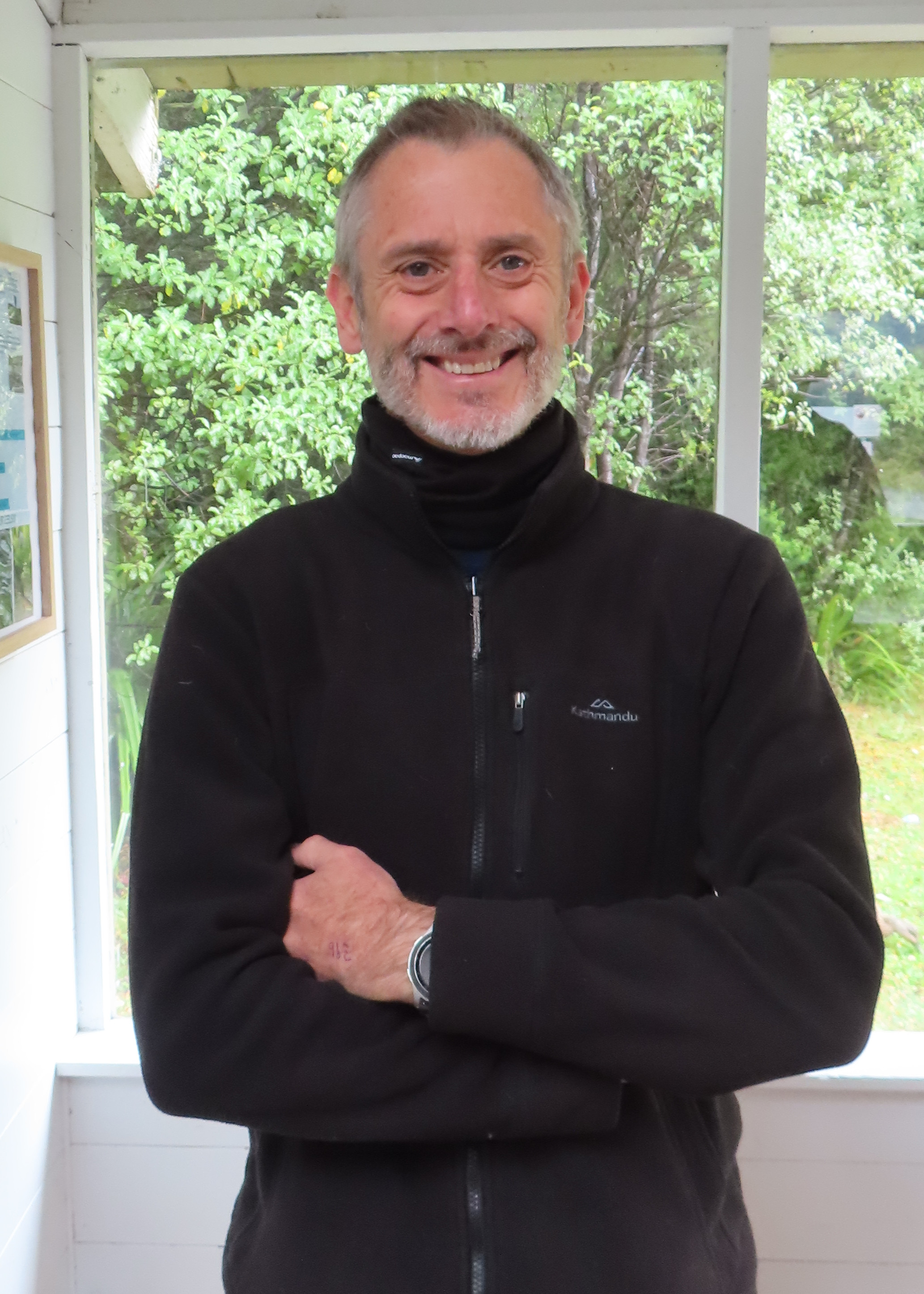
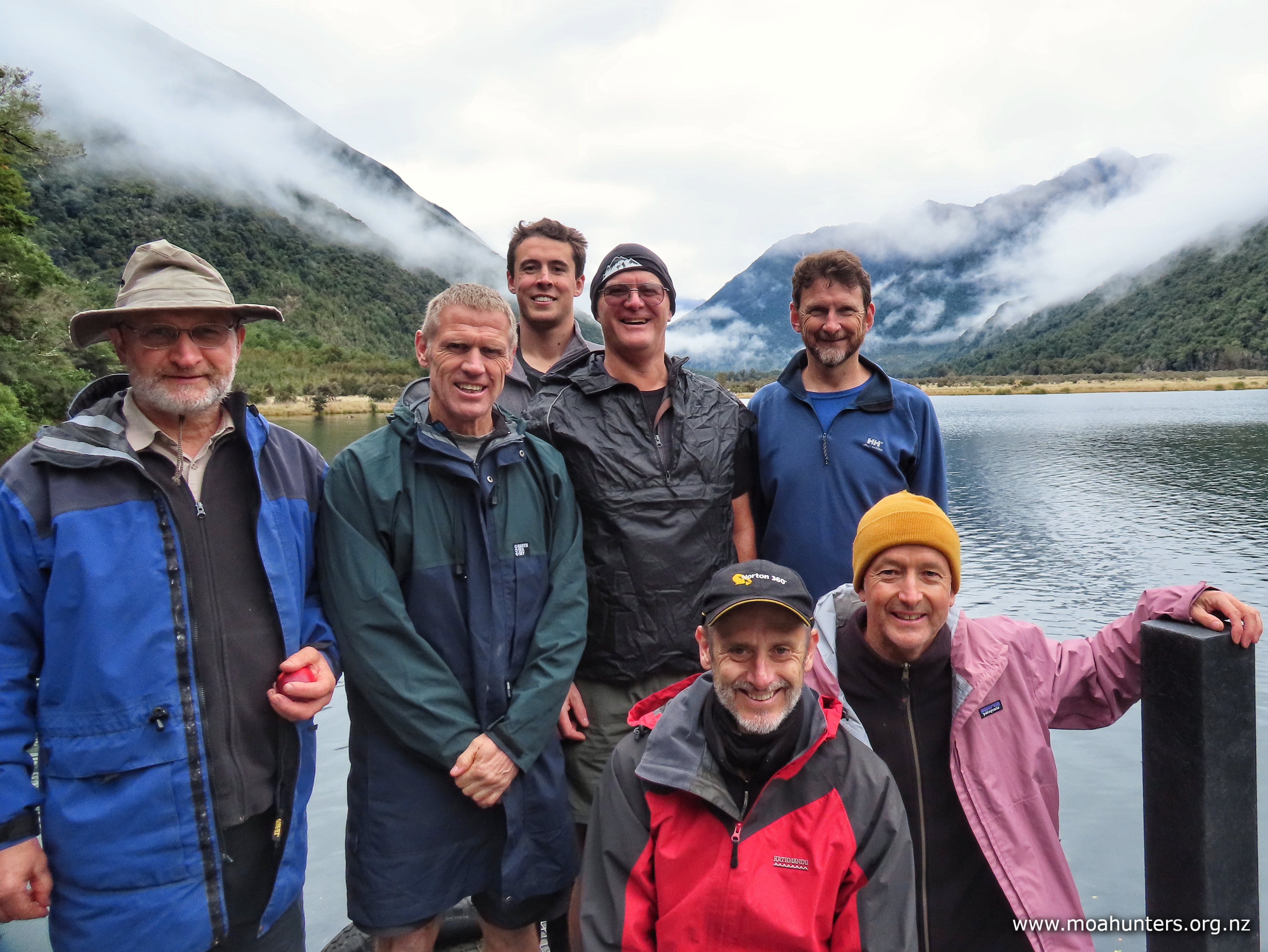
Moa Hunters on this trip: John, Lewis, Luke, Magnus, Paul, Adam, Chris.


The Trip:
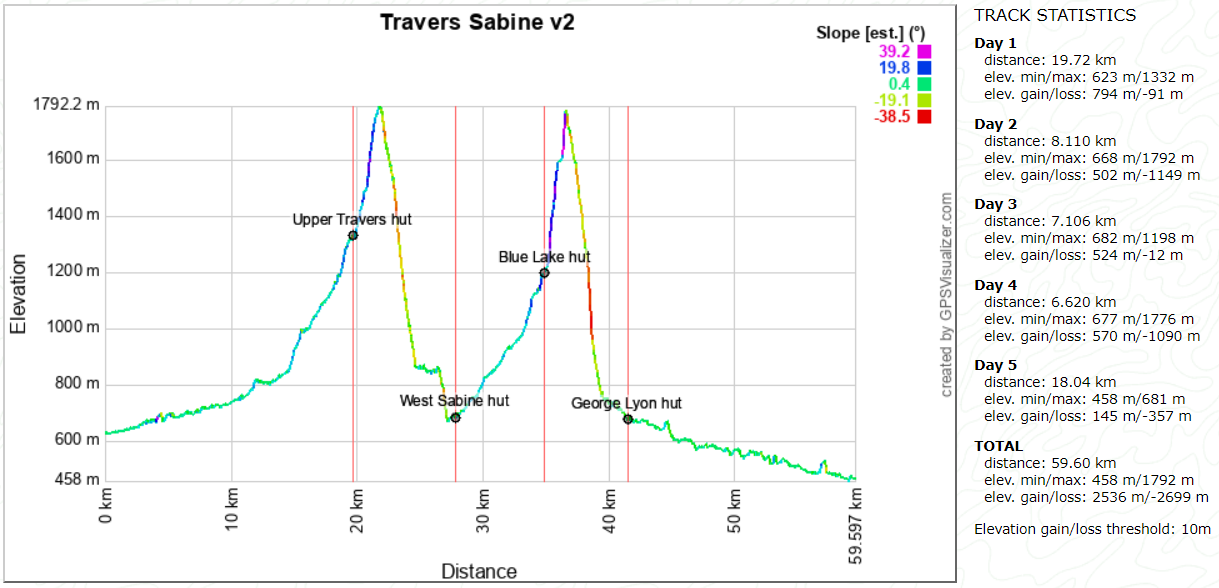
Day 1: Lakehead hut to Upper Travers hut
Day 2: Upper Travers hut to West Sabine hut
Day 3: West Sabine hut to Blue Lake hut
Day 4: Blue Lake hut to George Lyon hut
Day 5: George Lyon hut to D’Urville hut


Day 1
SaturDay 13th April – Lakehead hut to Upper Travers hut

Despite this trip starting and finishing at the southern end of two different lakes, transport logistics were surprisingly straightforward.
Lake Rotoroa Water Taxi have accommodation suitable for large groups snugged in the small settlement at the top of Lake Rotoroa. Six of us had a comfortable stay there on Friday night. Bright and early next morning, we drove the 40 minutes to St Arnaud to meet Magnus for an over-indulgent fry-up breakfast at the Kerr Bay campsite.

With our bellies bulging with way too much deliciousness, we boarded the Lake Rotoiti Water Taxi, bound for Lakehead jetty at the southern end of Rotoiti.
From there we would spend the the next five days walking the Nelson Lakes, our final waypoint being the D’Urville hut jetty, where Dudley from Lake Rotoroa Water Taxi would pick us up. Once back at the north end of the lake, Charlene would shuttlebus us back to St Arnaud. Easy peasy, lemon squeezy!
But hold on! Back up the truck a little…. all that is getting way ahead of ourselves.
Let’s turn back time to Saturday morning, when the affable Hamish from Lake Rotoiti Water Taxi’s welcomed us onto his boat and wedged our seven heavy packs into the luggage area at the bow.

It took just twenty minutes for him to run us down the lake to the Lakehead jetty. We all soaked up the surroundings, enjoying the scenery and Hamish’s commentary along the way.
Standing on the jetty, we all felt the tingle of anticipation. Another moa hunt was beginning. Five days in beautiful back-country Aotearoa awaited us. If you are a regular tramper, you know that feeling.

Weather conditions were cool and overcast. Low cloud clung to the sides of the ranges like stretched lambs wool. Overhead the clouds looked heavy. Rain would not be a surprise, but none of us really cared. It felt great to be standing at the start of a new adventure.
Breathing in the distinctive musty sweet smell of the beech forest, we thanked Hamish, then marched up the track towards Lakehead hut, a mere fifteen minutes away.
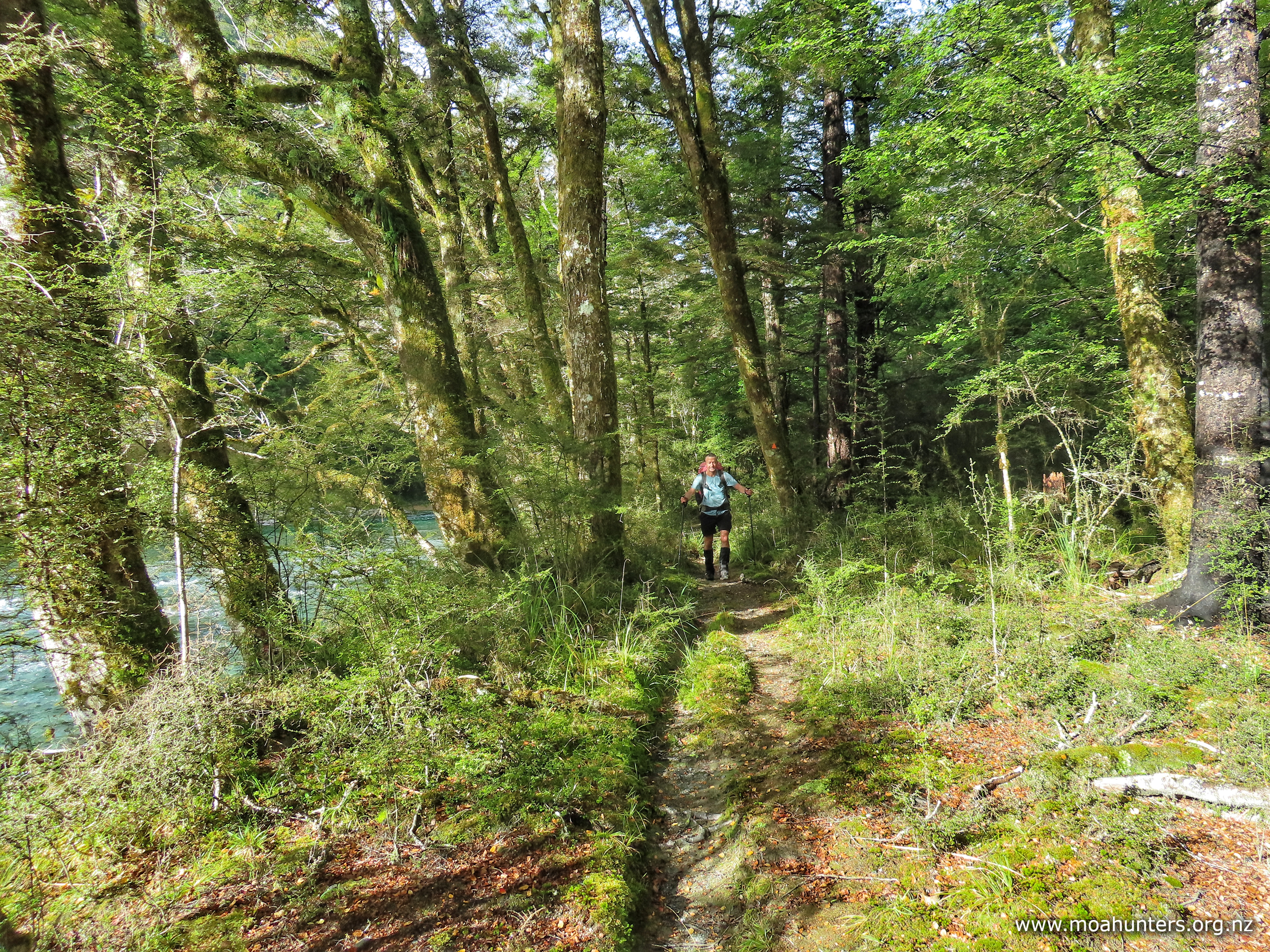
Near the lake, Travers valley is wide and flat. The track meanders across open expanses of straw coloured grasses, occasionally ducking into damp beech forest where it is lightly carpeted in fallen leaves, turned golden by autumn’s cool hand.
We anticipated the track may be a bit wet. The Nelson lakes had received very little rain over the summer. But earlier in the week, a low pressure system that drenched the west coast didn’t spare the Nelson / Tasman area. Quite a bit of rain had fallen onto fairly dry ground. We wondered if streams may still be running high. Beside us the Travers river was lively, but not swollen. Perhaps the rain had already washed through to the lake?
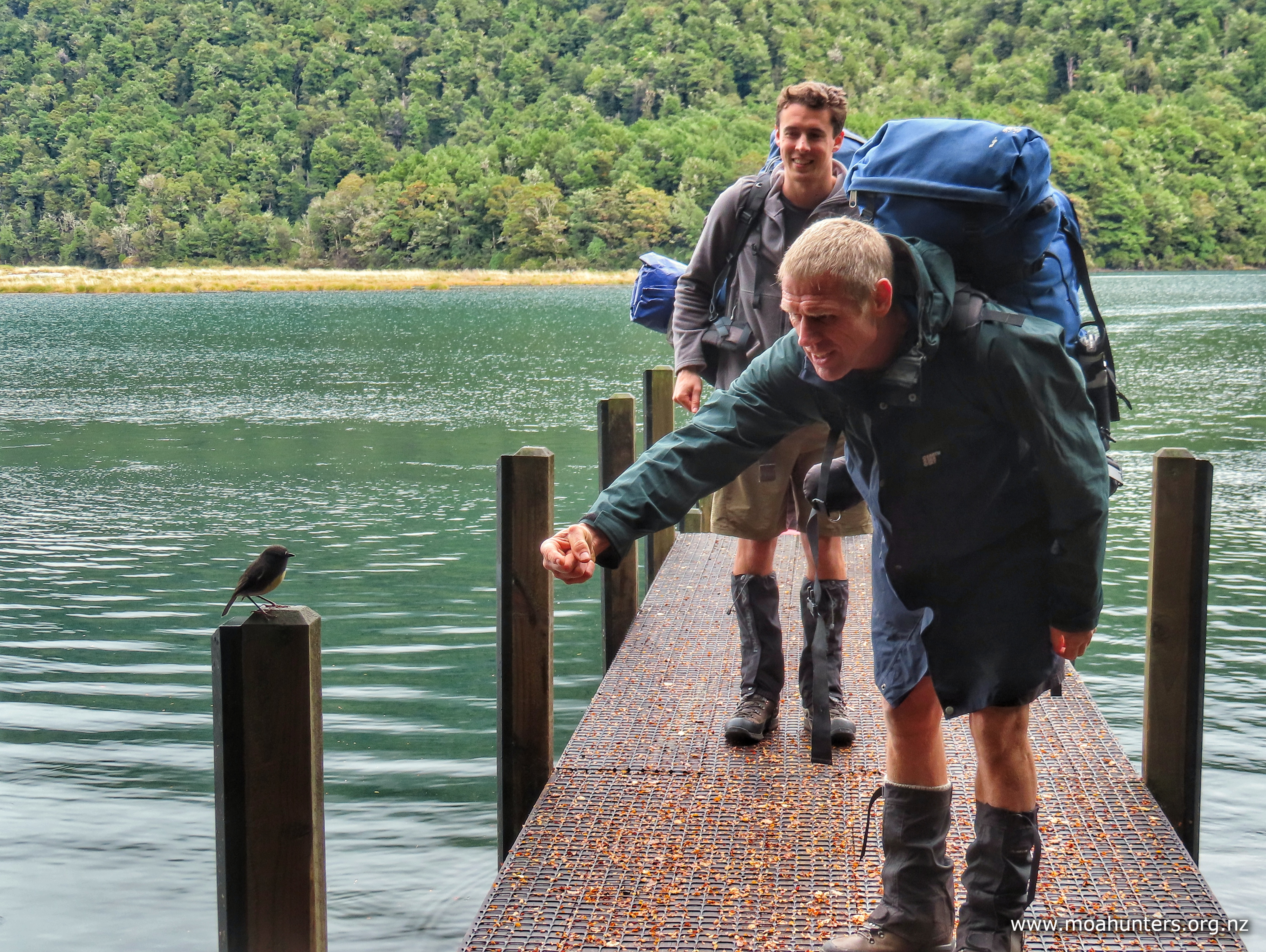
As we walked, the first thing we noticed was the abundant bird life. Bellbird song rang out through the forest from all directions. Fantails looped and dived acrobatically, tweeting excitedly as we passed. South Island robin flitted from branch to branch, deftly shadowing us as we walked the track. A MASSIVE thumbs up to the Friends of Lake Rotoiti and DOC for all their mahi, setting and clearing predator and wasp traps in the area.

We paused briefly at Lakehead hut to check it out, before continuing up the easy track that weaved pleasantly through a mix of grassy flats and damp beech forest.
At these low levels near the lake, damage from wild pigs was quite evident. Significant chunks of grassed areas beside the river had been rooted up and damaged.

Due to the enormous breakfast enjoyed earlier that morning, we were not especially hungry when we stopped for a break on a convenient grassy terrace beside the Travers river. It was 1:30pm, and just a few mouthfuls of scroggin was all any of us needed to keep going. While we sat there, a light drizzle started falling, which was a little irksome. We hefted our packs and marched onward.
By 3:00pm however, our stomachs finally informed us we had earned a proper feed. The moa men congregated inside the spacious John Tait hut for lunch, enjoying a well earned break.

With three hours walking ahead and daylight hours in short supply, that happy break was sadly not a long one. With our bellies full again, we were quickly back on the track.
There are predator traps placed along the length of the track from Lakehead to Upper Travers hut. Each is labelled with the track section and a number. We worked out they are around 100 metres apart. Trap JT1 is 100 metres from the John Tait hut, and JT24 would be 2.4 kilometres from the hut.
Seeing the trap numbers as we walked was a double edged sword. Sometimes it’s nice to know how much walking you have ahead and how much you had done. Other times, when the number is large, you’d prefer blissful ignorance!
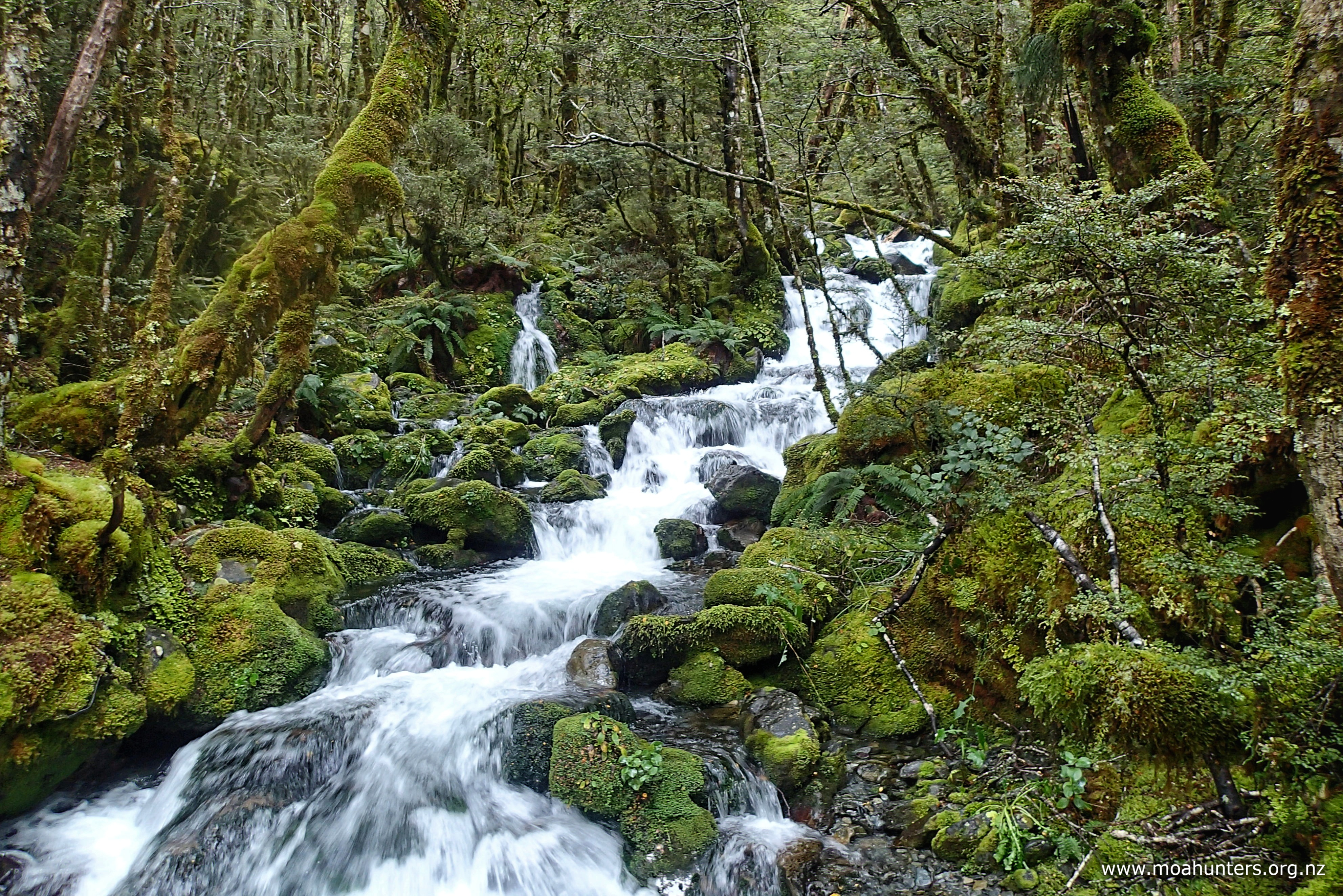
Pushing on from the hut, we followed the Travers river through pleasant beech forest until we came upon a junction. The main track continues steeply uphill to the right. To the left, it snakes down to Travers falls… Given the large amount of rain the area had received in the past week, we knew it would be a travesty to omit the five minute diversion to check out the roar below. We were not disappointed.

Not far up the track from the falls we reached a side stream, which was once bridged. The river in flood has completely destroyed the DOC structure, sweeping the mangled remains aside, mounding tons of mud and shingle on them. Fortunately for us, the stream was easily crossable, despite the recent rain. Given the rust on the remains of the bridge, it had been that way for some time. There is a sign saying a replacement bridge exists upstream about 15 minutes..

Over the next hour, daylight faded. By 6:00pm we had our headlights on, and save for their light, the last hour to Upper Travers hut was walked in darkness.
The track gets a little gnarly before the hut. The valley becomes tight, rocks are large and slippery as the track skirts close to the river. Darkness and fatigue accentuated the trickier conditions, making the last section feel more challenging than it probably was. When we rolled into the hut sometime after 7:00pm, the moa hunters were feeling more than a little bit knackered.
Dinner was prepared as we got to know the other occupants of the hut: Grant and Herbie were there – a pair of similar aged blokes to us, with a similar route plan. The resident warden gave us the increasingly nice weather forecast for the next few days. An American/Aussie couple popped in, but were tenting on the peaceful grassy flats below the hut. Another couple inside seemed to be hut wardens in-training.
Upper Travers hut has two separate sleeping areas – ten bunks each side. Grant and Herbie had suggested to the other occupants that we be allocated the one on the right, with everyone else on the other side.
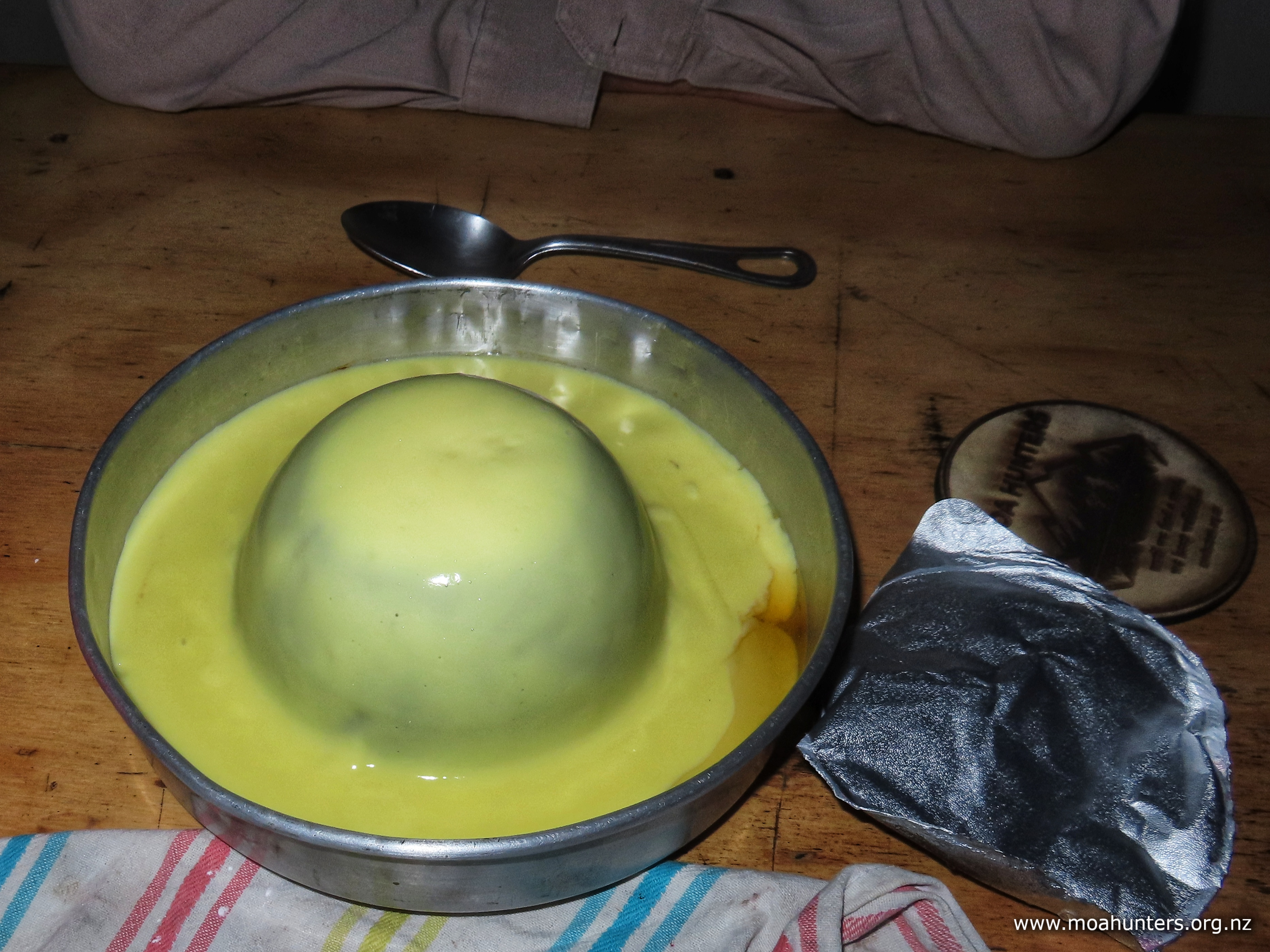
After a warming Christmas pud dessert, we climbed into our sleeping bags. It was nearly 10:00pm, and were all asleep within minutes. It had been quite a long and tiring day for a bunch of (mostly!) old moa hunters…
Day 2
SunDay 14th April – Upper Travers hut to West Sabine hut

Not too many clicks after 6:00 am, the first moa men were stirring. Paul was busy heating water for coffee. Adam wandered past slightly bleary eyed.
Quite a few of us had experienced leg cramp overnight, particularly in the calves or hamstrings. This was usually when attempting to exit sleeping bags for a nighttime visit to the long-drop. We all agreed extra electrolyte drinks would be on the menu today!

Grant and Herbie were also up bright and early. As Grant walked out the bunk room, he plopped an amazing old relic down on the floor beside the door.
You don’t see many packs with external frames still in service… you see even less with a retrofitted hip belt made from the seat belt of a 1982 Ford Laser, or similar! What an awesome piece of kit. While it is not the world’s most comfortable pack, it is definitely one of the most quirky and unique.
Outside, the weather was a mixed bag. Thick low cloud clung to the surrounding hills, but overhead patches of bright blue sky were evident – enough to sew a pair of pants for a sailor, apparently (ask Chris!).
Paul and Chris awarded Upper Travers hut the auspicious and much sought-after “hut with the best water pressure, ever” accolade. Rather than being fed from a rain-filled tank, water from a stream above is piped directly to the hut, generating a pleasingly strong flow-rate from the taps inside. (Engineers like Paul and Chris are easily pleased)
Shortly after 8:30am, the hut warden gave us an updated weather forecast: Mostly cloudy, occasional drizzle, but steadily improving over the next few days. Still good, and good enough for us!
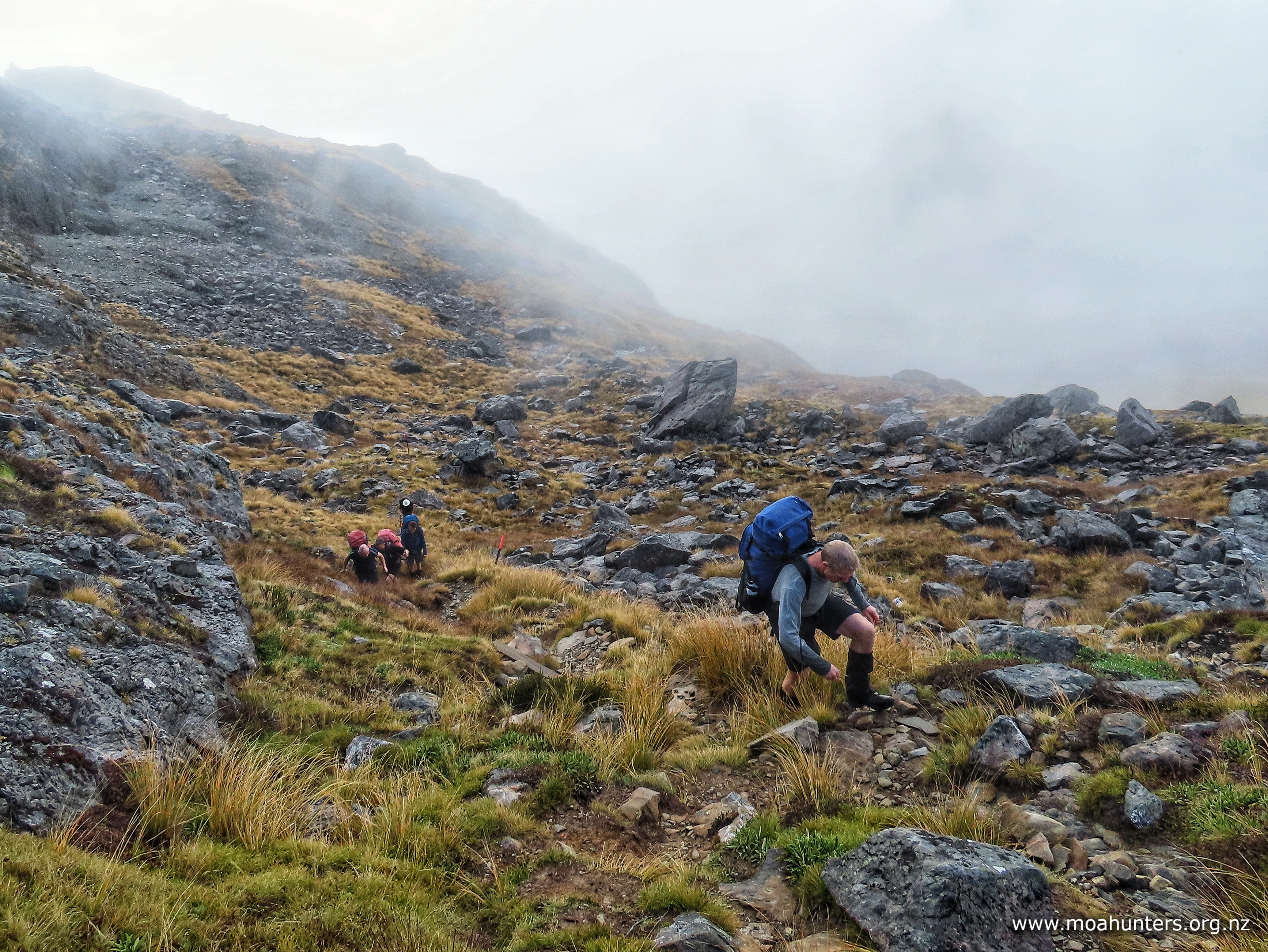
We heaved our still weighty packs onto our backs, and set off from the hut, knowing we had another big day ahead. Above us awaited the 450 vertical metre climb to Travers saddle. Beyond the saddle, we had an 1,100 vertical metre descent into the Sabine valley. My knees hurt just typing that.

Quickly above the bush line, the track led us out onto a lovely dew-soaked alpine meadow environment. Weaving a pleasant path through medium sized rocks, flax-like astelias, tussock, hebe bushes and the occasional spaniard grass, we all enjoyed the start of the climb.

Almost as if scripted, the low cloud played its part perfectly, creating atmospheric drama all morning. Swirling slowly across the hills it obscured the terrain around us, occasionally thinning enough to offer tantalising glimpses of what might lie ahead.

Looking back, we were briefly shown the steep flank of a mountain looming large out of the mist. Some kind of optical illusion made it look impossibly high, the summit hidden by yet more cloud.
At 9:30am we had gained enough altitude to notice the vegetation thinning out, leaving us treading a path through the remaining snowgrass, tussock and low scrub in increasingly rocky terrain.

Half an hour later we were breathing a fair bit harder. We had entered the final steep section of the climb. To be fair, we have grunted up much harder climbs, but this was enough to bead a brow with perspiration despite the cool morning air.
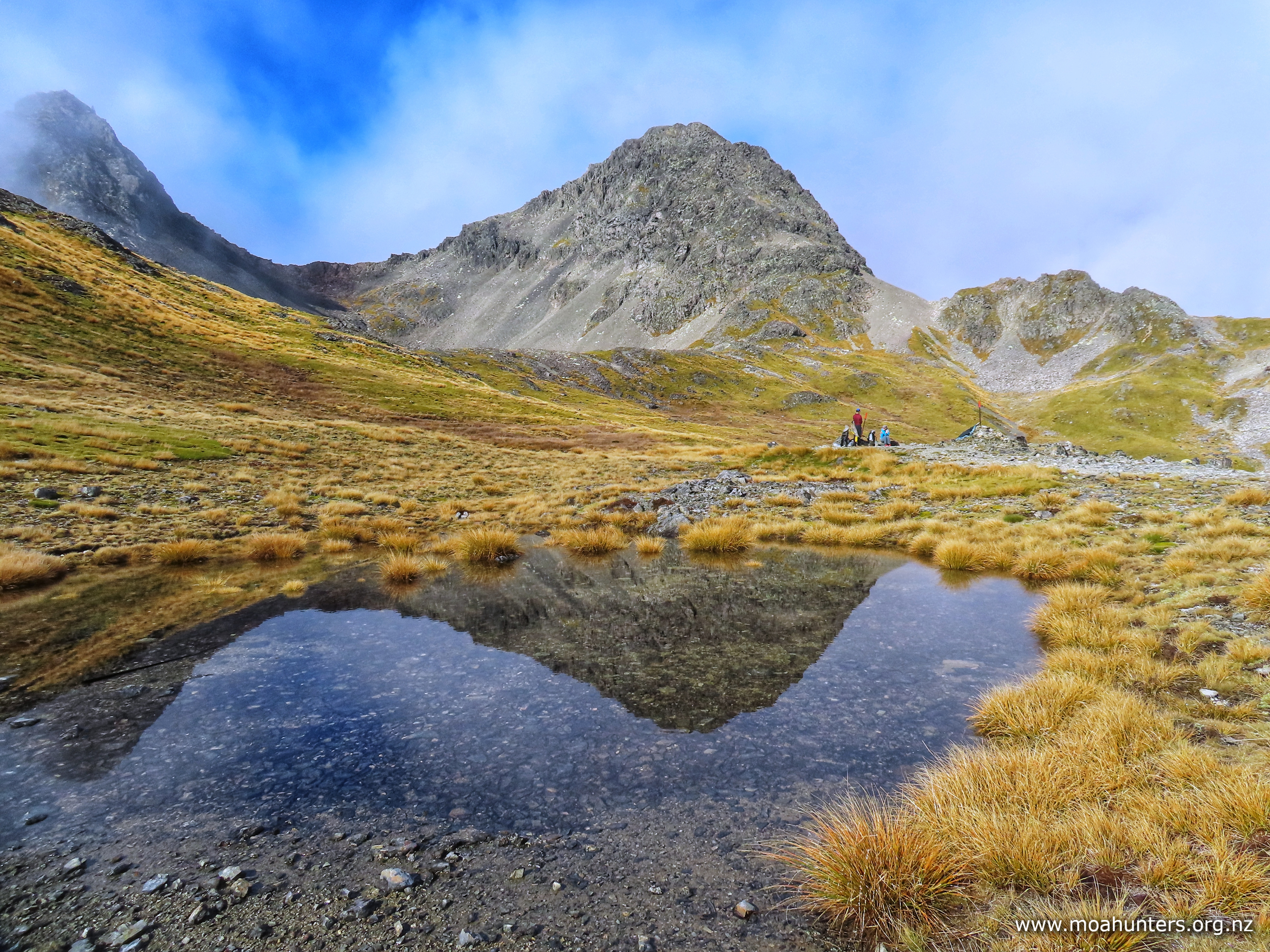
It was 10:15am when we reached Travers saddle – approximately 90 minutes after departing the Upper Travers hut. There was a shallow tarn in a basin just below the saddle. We wondered if in summer it would be nothing more than a dry bowl.
There was no massive panorama to enjoy from the saddle, but it was still a lovely spot to have a nibble of scroggin and take a drink of cool tarn water. Paul and Luke scampered up the rocky knob to the right of the saddle for a higher vantage point.
As we relaxed on the grass, cloud steadily lowered until a damp mist was swirling around us, dropping the temperature quickly and considerably. That signalled time to start our long descent to the Sabine valley below.
From the saddle, the track drops into a small but interesting valley. One side is completely covered in rocks and rubble that ends in a weirdly uniform curve at the valley floor. It looks for all the world like someone has collected any stray boulders from the valley floor and arranged them tidily.

Beyond the boulder slide, a poled route leads down easy grassed slopes onto what becomes a prominent ridge that heads leads into the bush. It was around 11:30am when we entered the beech forest once again, knowing we still had a very long descent ahead of us.

Through misty conditions, Paul and Luke led the way, with the rest of us making our way down at our own pace. The track descends steadily down the sharp ridge through the forest for quite some time. After roughly an hour, it hooks right at a rocky outcrop and drops off the ridge into a much steeper section.
Note that our topo map shows the track following a stream down to the Sabine. This is not the case anymore. The track runs down a ridge some distance to the true-left of the stream, dropping back in the direction of the stream at the rocky outcrop. However, the track doesn’t actually meet the stream, so you should carry some water for this descent in hot conditions.
With the odd spot of drizzle finding its way through the beech canopy, we picked our way down the increasingly gnarly track. Awkwardly long step downs, slippery beech roots, occasional muddy patches and greasy rocks made for slow going. Slipping on a root and ending up firmly on one’s arse was not an uncommon occurrence.
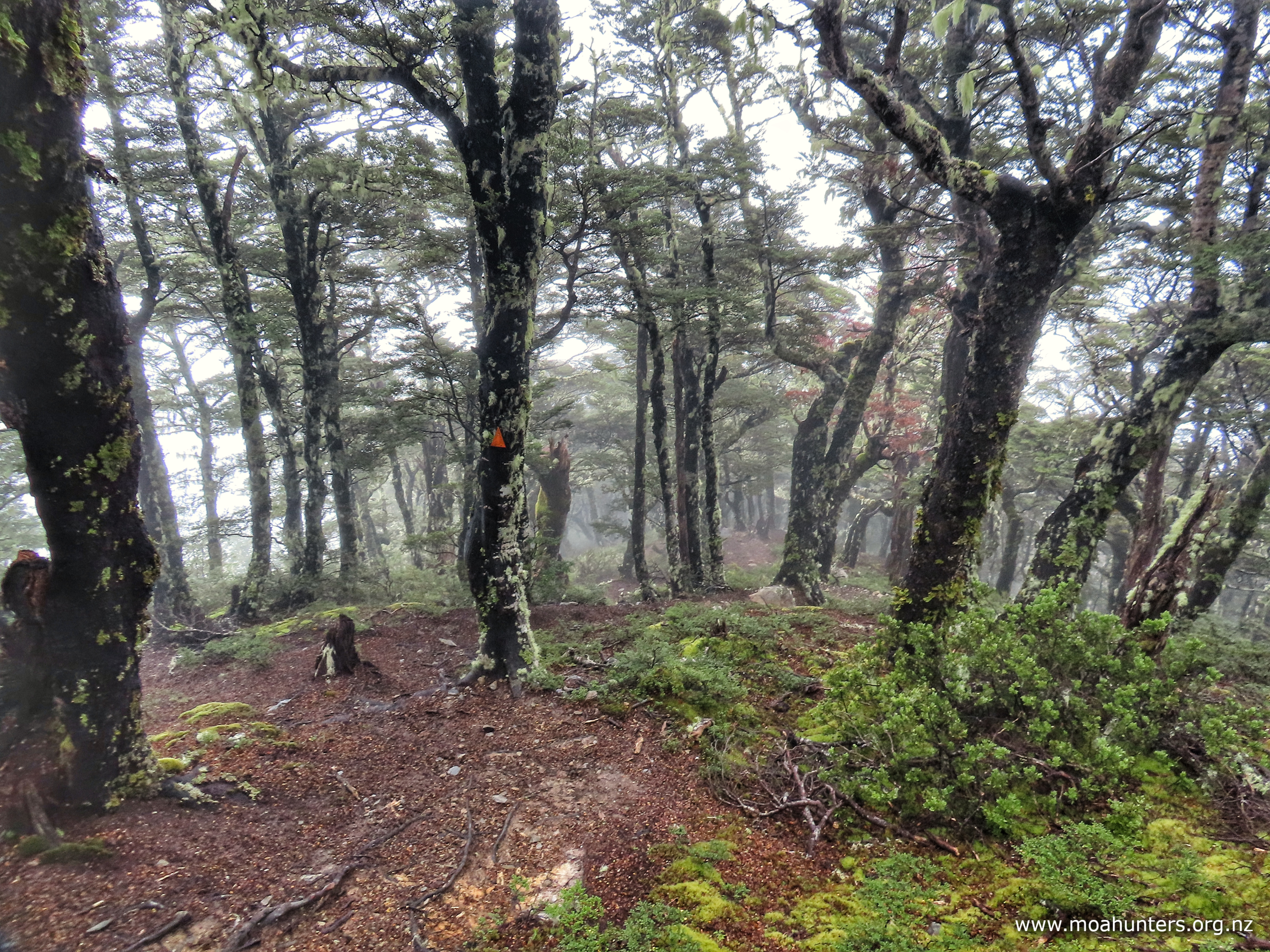
From a branch above us, we received a stern and prolonged scolding from a Bellbird. It was clearly very unhappy with us passing through its territory, and made that displeasure loudly known. Perhaps we had ruined a love-song serenade to a potential partner? Usually these pretty green birds have a delightful resonant song, but this was most definitely an expletive-filled rant!
Sadly, in general we noticed much less bird song on this side of the saddle. Also, no predator traps – almost certainly a link there…
It is a long descent, and after an hour we were all feeling quite fatigued. Far below we could hear the Sabine river. To our right we could discern the distant babbling of a stream. We kept walking in the hope the track would meet it at a pleasant place for lunch break.
Finally at 12:50pm, we gave up on hitting the stream and stopped for a well-earned break. Paul did a quick check to see if the stream was close enough to the track to grab a water bottle refill. Unfortunately, it wasn’t.

Despite no water, we enjoyed a very pleasant rest and refuel. A South Island Robin came by to say hello. It spent a happy minute hopping on and off the toe of Luke’s boot, before very deliberately pooping on it, then flitting off.
With plenty of time available to get to the hut, we were in no rush to get started again. For those who enjoy tramping in a group, these are cherished times. Resting against the trunk of a tree, sharing the experience of a challenging descent, enjoying every aspect of our surroundings, laughing and chatting about everything and nothing.
From our lunch stop we walked another hour, then took another break. The downhill by now wasn’t overly difficult, but it felt relentless. Old knees do not like big downhills. To combat a building fatigue, we took more regular breaks – tired legs make more mistakes.
Along the way we crossed a short wooden bridge that spans a surprising and impressive chasm. It is not until the middle of the bridge that you realise you are above a narrow and startlingly deep rocky slot with the river quite some distance below.
We rolled up to the West Sabine hut around 4:00pm, very pleased to finally be there. Lewis sparked up the wood stove while Paul set about getting dinner organised. Magnus prepared seven cups of steaming hot chocolate, generously topped up with whisky. Just the tonic after a solid day wandering in the hills…
Chris parked himself at a table and busied himself assembling his famous ‘grog log’: Gingernut and chocolate-chippie biscuits are dipped in whisky, then stuck together with whipped cream. The whole lot is covered in more whipped cream and decorated with crumbled flake chocolate. And if you are wondering, yes it does take quite a lot of effort to hand whip cream!

The West Sabine hut sees plenty of action. Being on the Te Araroa trail, hundreds, possibly thousands of walkers either stop by or stay in it over the warmer months. April is a little late for T.A. walkers to be in the Nelson Lakes, so we didn’t meet any this trip, but the hut book was 3/4 full after just four months use!
Grant and Herbie arrived at the hut around 5:00pm. We offered them some hot water for a cuppa and left them space to get settled in.

West Sabine hut is the “one big space” design. No separate bunkrooms like Upper Travis. We took the large platform of bunks at the rear, leaving Grant and Herbie their own area on the smaller sleeping area. We enjoyed chatting with our two hutmates – a couple of good blokes.
The Aussie-American couple arrived a little later and spent some time in the hut with us before heading out to camp the night in their tent. We enjoyed hearing about their travels and learned about tramping and tenting in Australia. Apparently it is actually possible to do this without being killed by local wildlife…
That evening, John made an interesting observation: “Moa Hunting is a bit like child birth – you forget how much your legs hurt last time, and keep doing it all again!“
With that sage thought still in our heads, and our bellies full of curry and grog log, we pulled ourselves into sleeping bags. The hut went quiet just a tad before 9:00pm.
Day 3
MonDay 15th April – West Sabine hut to Blue Lake hut

According the DOC, the walk from West Sabine hut to Blue Lake hut is just four hours. Given we only had half a day of walking and a full day to knock it off, the moa hunters eased lazily into day three of the Nelson Lakes v2 adventure.
While we enjoyed a hot breakfast seated at one of the large tables in the hut, Grant and Herbie prepared (with quite a bit more urgency than us) to hit the track. Their plan was a ‘there and back’ mission to Blue Lake hut. With lightweight day packs, they said spotya later, and were out the door before the last mouthfuls of moa hunter porridge were gone.
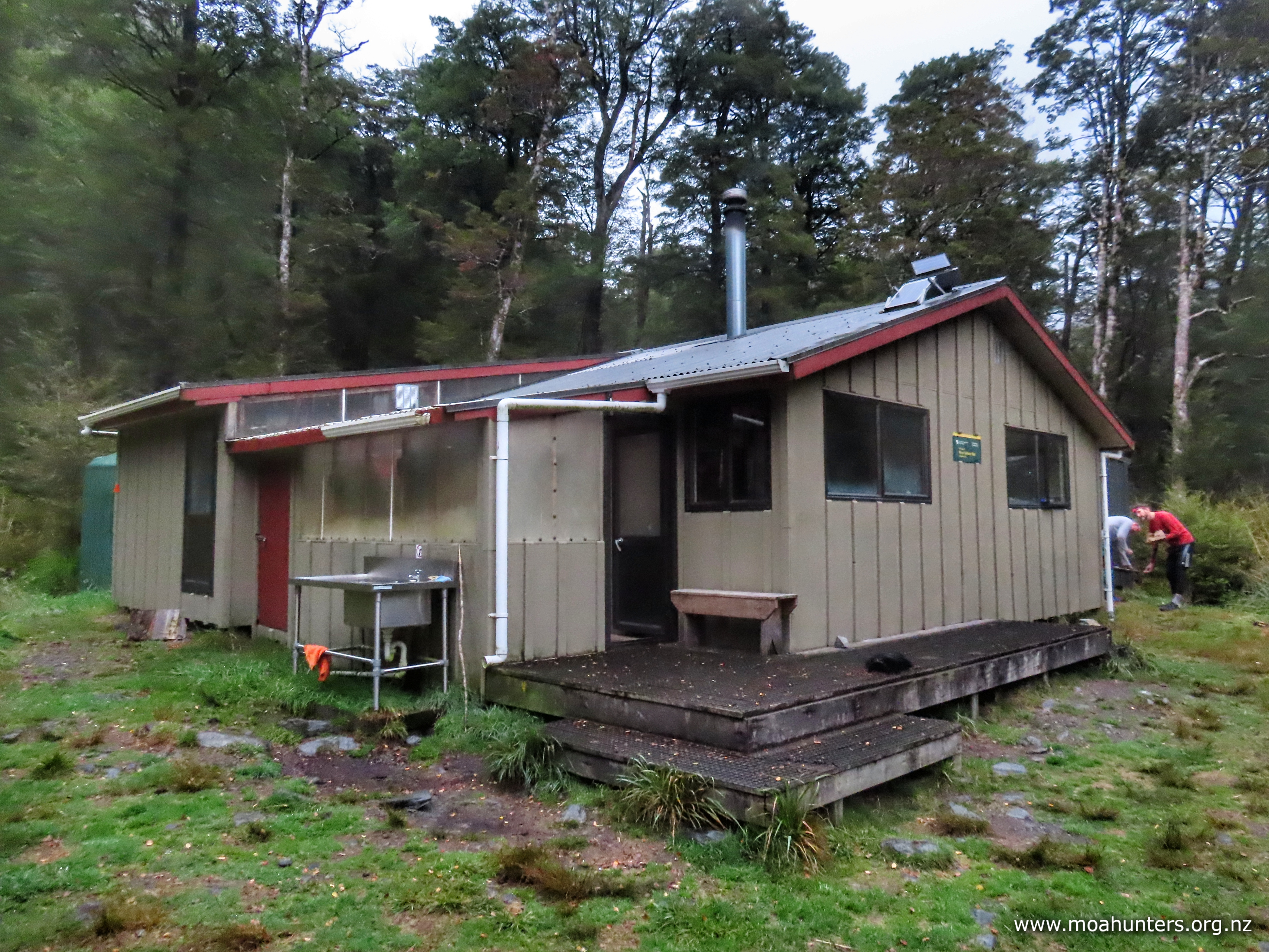
We were in no particular hurry to leave our breakfast table. The world had many problems to solve, and we had some time on our hands…
Comfortable in each others company, even potentially contentious political issues are not off limits. It is nice to be part of a group where all opinions are respected and heard. That said, we all seem to stand mostly on the same side of the political divide.
Having solved climate change, current world conflicts and future energy requirements, we set about solving a more immediate crisis: getting the hut ship-shape and spick and span. Floors were swept, benches wiped, bunks tidied and windowsills cleaned. Many months of dead sandfly accumulation on the sills leads to a nasty pile of mouldy muck. We did our best to leave the hut in great shape for the colder months ahead.
Outside, Chris and Lewis attacked the woodshed. Lengths of wood cut by DOC had been left in the shed, but they were protruding out the door and getting wet. These were cut into burnable lengths and stacked back out of the weather. Back inside, the wood burner was tidied and prepped for future duties.
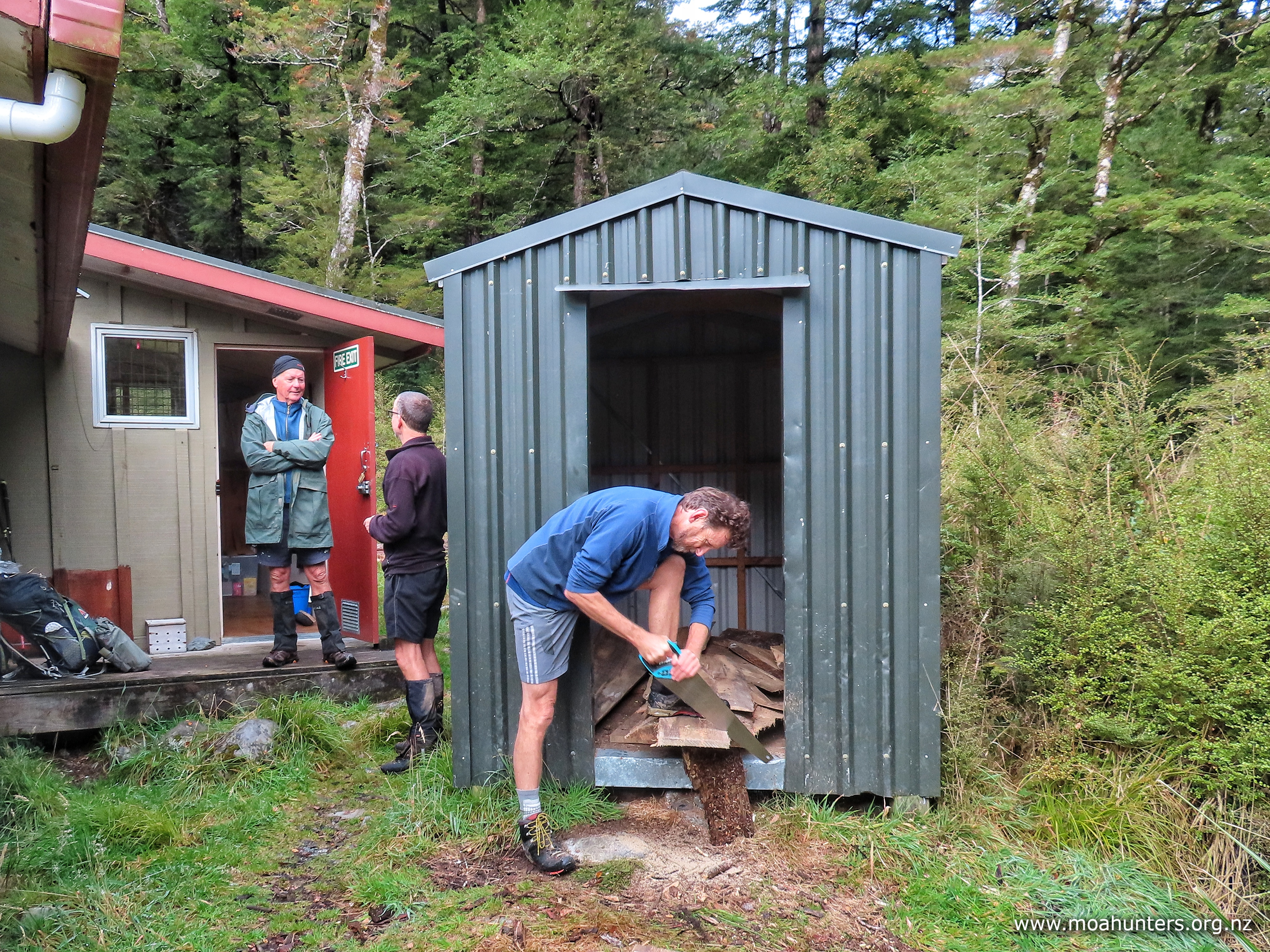

Being outside West Sabine hut in April is a more pleasant experience than during the summer months, for one specific reason: the lack of sandflies. Where they all go when it gets cold, none of us knew or cared. We were just very pleased to be outside with no repellent on, being hardly bothered by the little biters.
West Sabine is a nice hut, but has an unbalanced design in terms of utility. There is sleeping space for thirty people, but just one stainless steel corner bench. If the hut was packed, which likely happens often in summer, occupants would definitely need to use the wooden tables for food preparation and cooking. Not ideal, really.

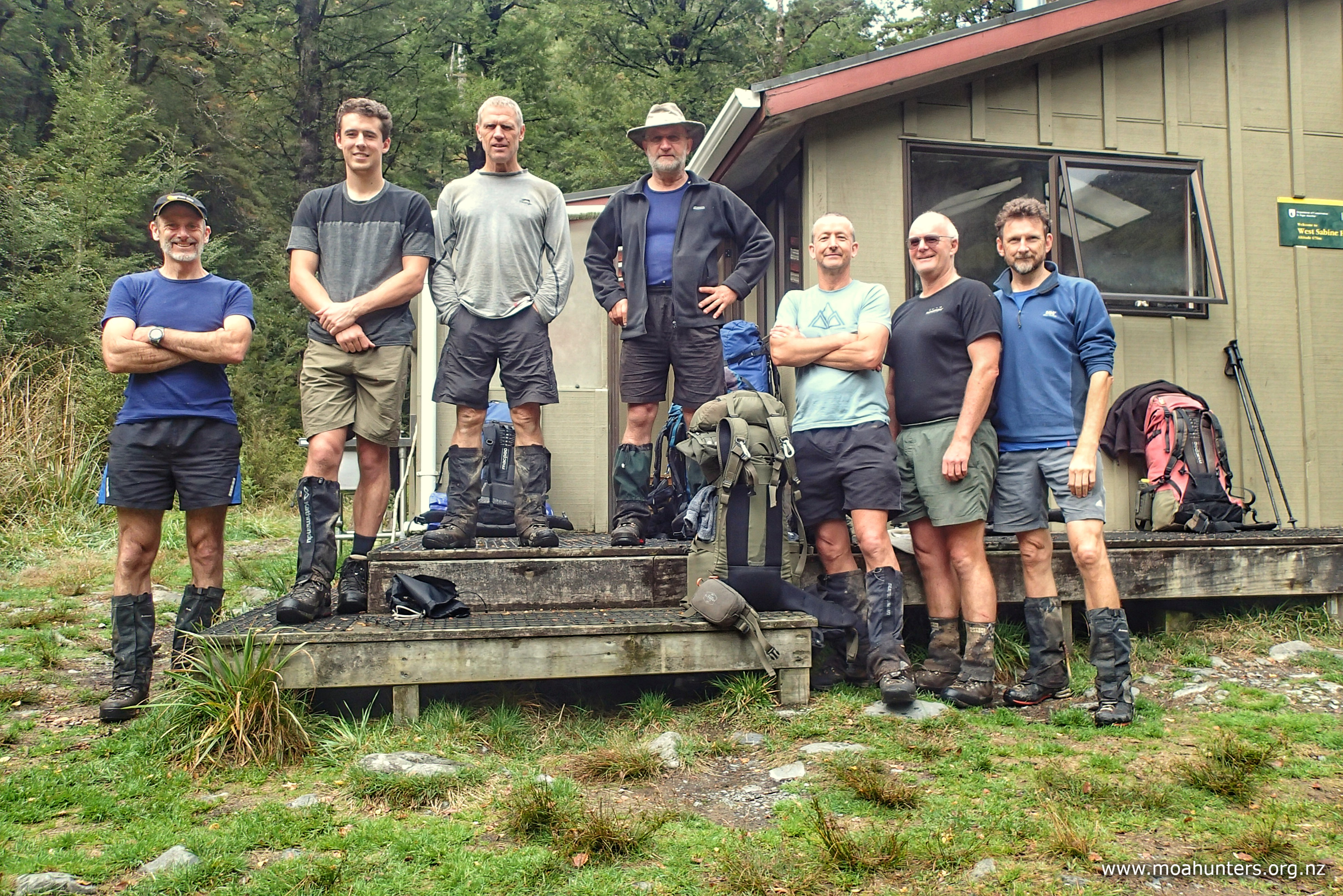
Our aim was to depart the hut at precisely mid-morning, and we absolutely nailed it. Shortly after sometime around a bit after ten o’clockish, we were striding through the beech forest, bound for Blue Lake hut.
Unfortunately the day didn’t start well for Chris. Not far from the hut, Adam at the front of the group noticed wasps exiting from between the roots of a large beech beside the track. The wasps noticed Chris, and he received three nasty stings for being in the wrong place at the wrong time.
If there’s any kind of silver lining to wasp stings, the sharp pain does make you forget the other aches you may have. Hmmm – perhaps that’s more of a cheap tin foil lining…
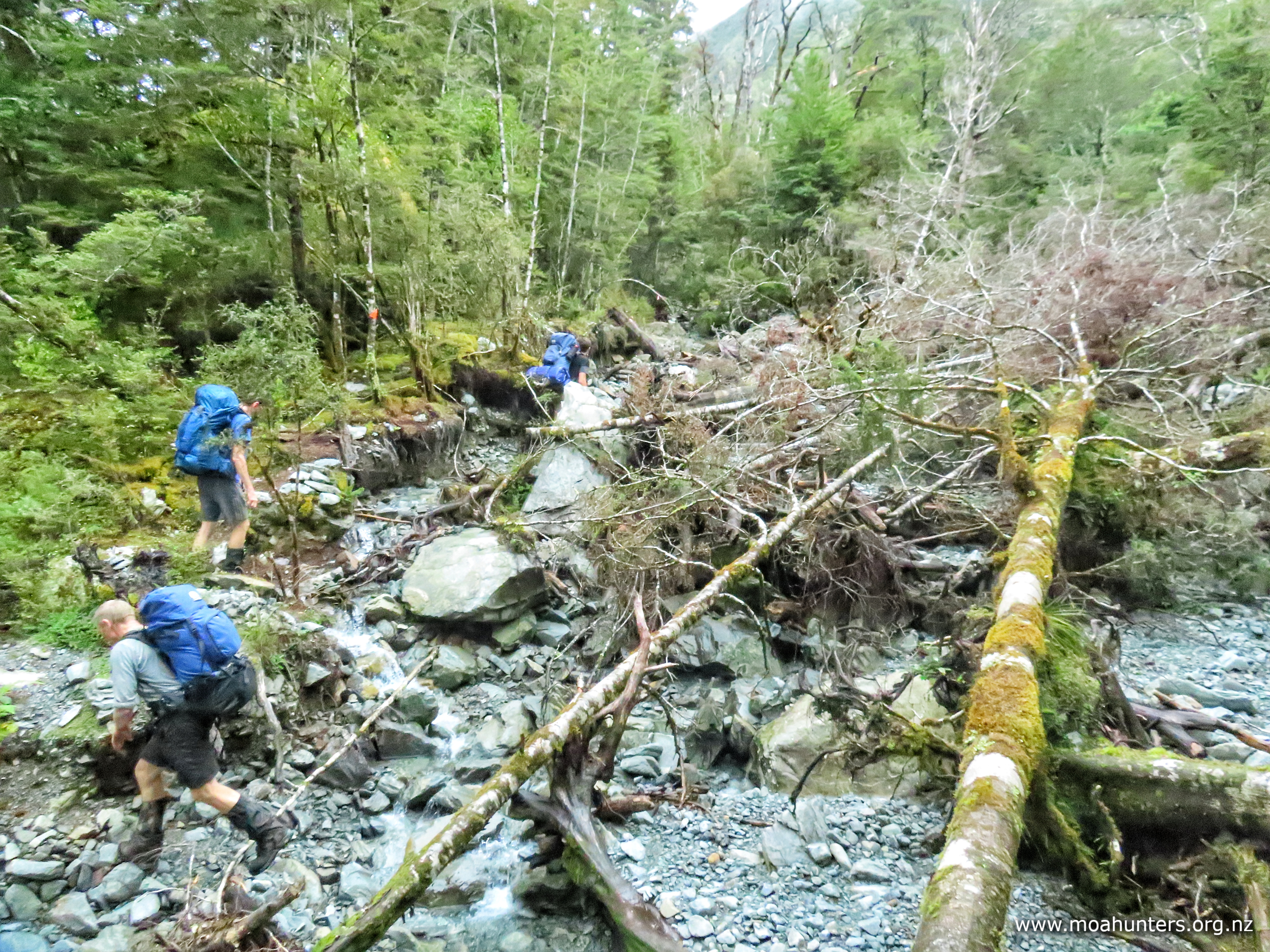
Between the hut and our first scroggin stop an hour later we encountered quite a bit of track damage. Washouts and tree falls made for interesting times along what would usually be a fairly benign section of track.
Thick moss covering everything painted our surroundings with a surreal vivid green. Aside from yellow and brown fallen leaves, the forest was a gorgeous fifty shades of green.
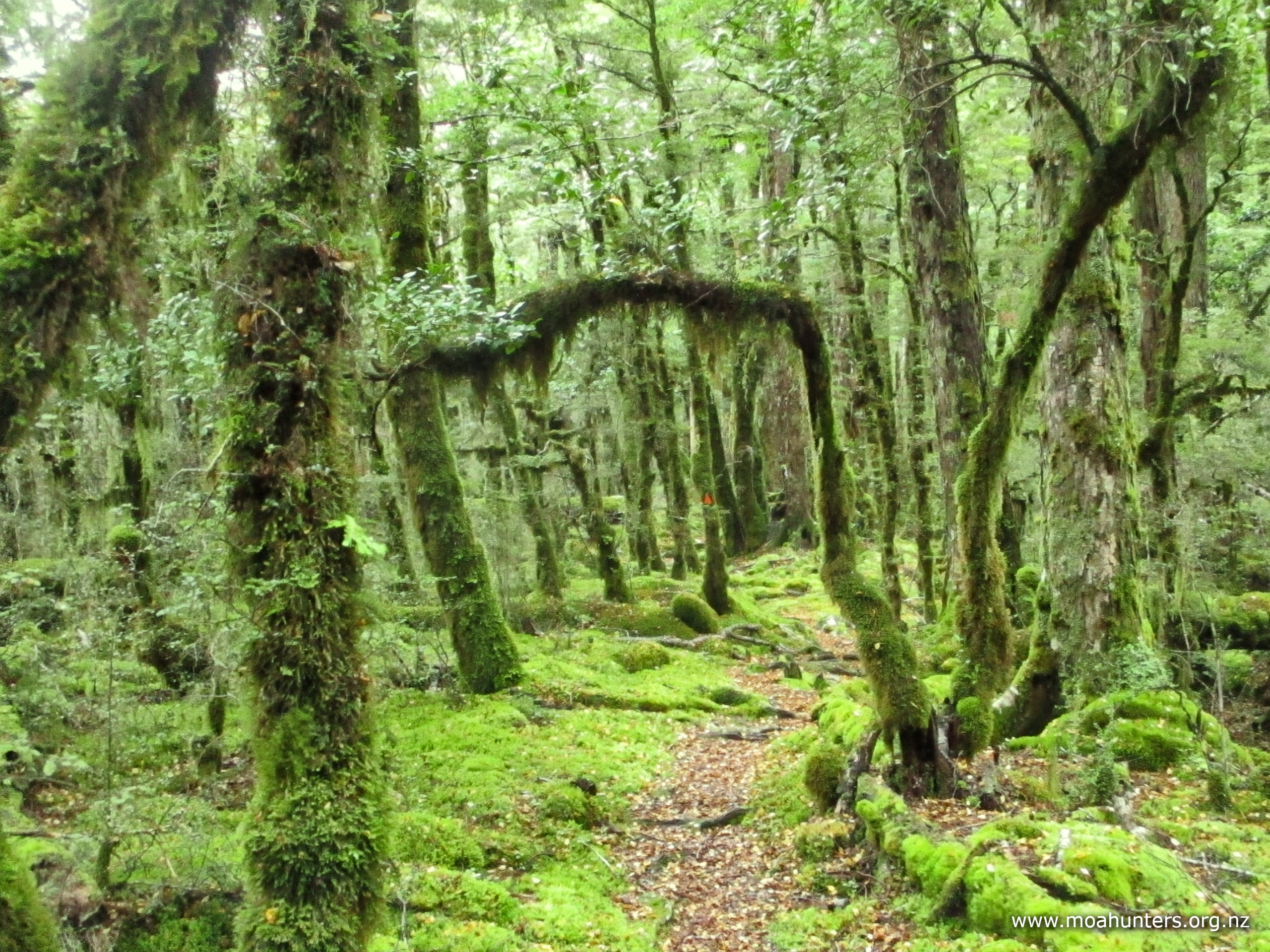
Farther up the track, the valley was filled with enormous rocks. An impressive avalanche had obviously pummelled the area many many years ago. Nature has mostly healed the scars, with moss and vegetation now working hard to cover and hide the rocks completely. It would have been an immense event to have witnessed – but best from quite some distance!
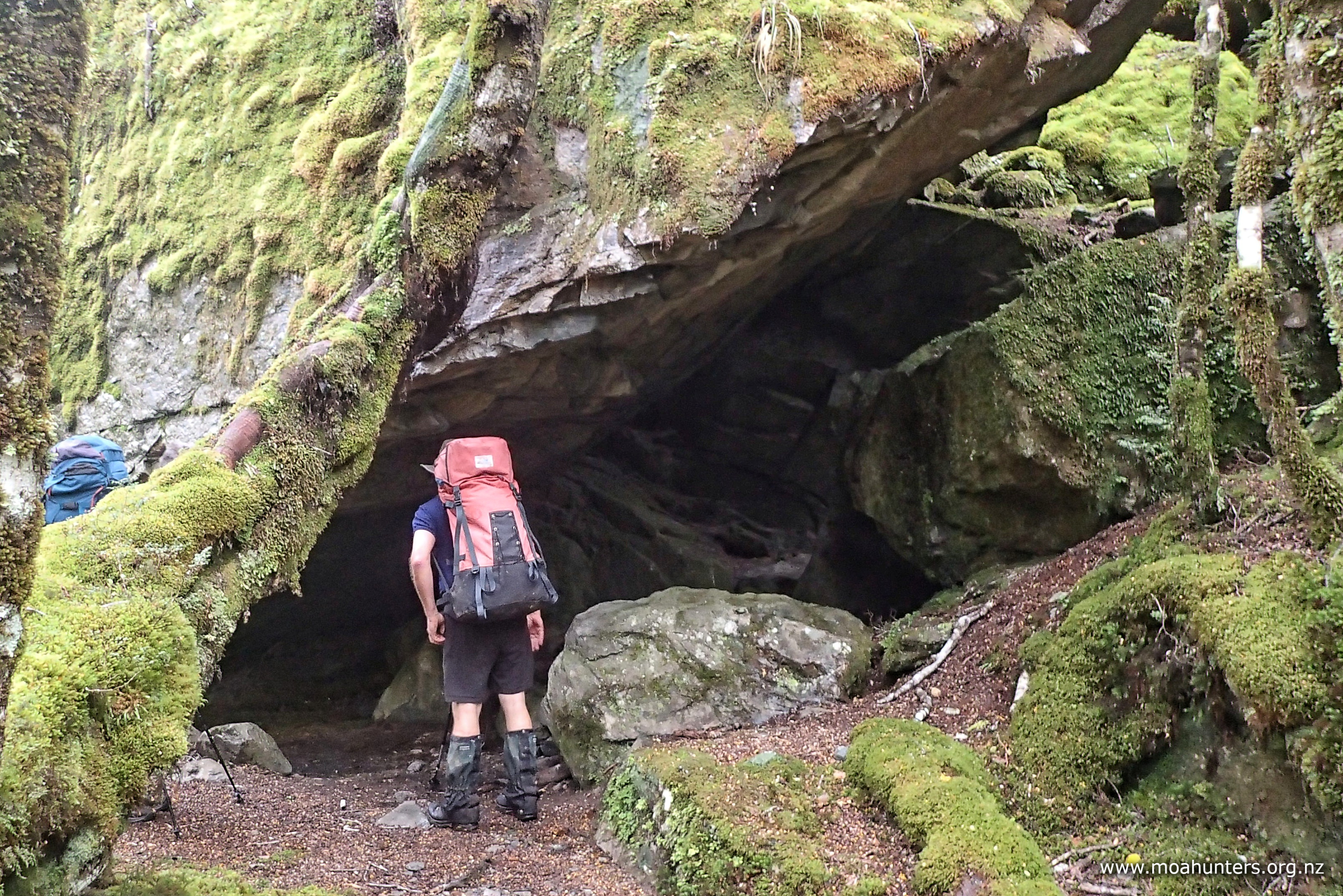
There is also an impressive rock shelter along the track. Impossible to miss and well used, it would make for a nice dry refuge in bad weather. That said, no doubt there are plenty of people have slept under the gigantic rock slab in clear weather just for the experience. We briefly poked our noses in before wandering on. Many of us had previously seen and explored the shelter when we walked this bit of track (in the opposite direction) on our 2020 Lewis Pass to St Arnaud adventure.
Our pre-departure plan was to stop for lunch along the way, preferably at an idyllic spot beside the river, where we would enjoy a long languid lunch. Unfortunately, whoever is in charge of the weather had different and rather irksome ideas. Misty low cloud became light drizzle, deteriorating to heavy and very wetting drizzle. With no discussion or debate necessary, we all walked the track in our own little worlds, knowing lunch would be had at Blue Lake hut.
As the valley narrowed and the hillsides became steeper, a few rock slides had to be traversed. They make a nice change of pace from the beech forest, but the extra exposure to the elements did prompt a few moa hunters to stop and take a moment to fit waterproof pack covers. It felt too warm to wear jackets, but preventing old-school canvas packs getting waterlogged and heavy is always a worthwhile time investment.
Below the lurking mist on the steep hillsides above us, we spotted numerous fairly large waterfalls. Fuelled by previous heavy rain and lightly topped up by recent precipitation, they were impressive despite mischievous swirling cloud doing its best to hide them.

The last 45 minutes before the hut is an intriguing mix of terrain. For a while things get a bit steep. The Sabine river is boisterous through here as it tumbles down the valley, fighting its way past large rocks in its path.

Above the rapids, the track leaves the river. There is a short, sharp, and quite steep climb from there onto some absolutely gorgeous flats beside a now sleepy Sabine. Easy sections of boardwalk spanning sections of boggy ground and spongy sphagnum moss seemed a good indicator the hut was close by.
But don’t be fooled, the hut is not just round the corner… There is a final ten minute climb through the forest to the hut. To be fair, nothing onerous on a very short day. But if I was writing the script, the hut would have been back on those lovely river flats. Just sayin’!
Outside the hut, we dropped packs and began stripping off wet gear, muddy boots and gaiters. A young woman wandered up the track from the direction of Blue Lake.
As is almost always the case with people we meet on the track, she was a friendly like-minded tramper out enjoying the beauty of Aotearoa. That morning she had walked over Moss pass from George Lyon hut in just five and a half hours, and was continuing on to West Sabine hut. Wow. We thanked her for making us old fellas feel even more inadequate than usual, and wished her well for the onward journey!
Grant also showed up from the direction of the lake. He asked if we had passed Herbie as we walked up. We had not, and Grant immediately looked a little concerned. Herbie’s knee had been getting quite sore during the morning, so he wisely elected to turn back rather than push his luck. Somehow we had missed him as he walked back to West Sabine. Grant learned later that Herbie had been sighted close to West Sabine hut. No doubt he was very relieved to have that news as he set off back.
With plenty of the afternoon ahead of us, we enjoyed some leisure time at Blue lake. Lunch was eaten inside.
Despite persistent light drizzle, Blue Lake itself was still a surreal place, well worth the wet wander down to take a look.
A game of Pass the Pigs whiled away some time, as did sparking up the log burner and enjoying some idle chitchat or a snooze on a bunk.

Later than afternoon, another solo tramper arrived at the hut. Judging by her accent, Rachel was from the UK. We got the vibe that spending the night in Blue Lake hut with seven moa hunters was probably not her ideal scenario, so we did our best to make her feel as welcome and at ease as possible.
We cleared space for her at the tables and on the drying rack above the logfire. She was also very accommodating, and sat chatting to us in the evening.
Dinner was a three course meal – hooray for Chris! Shiitake mushroom soup followed by a well seasoned cottage pie were headline acts. Sweet Tiramisu dessert drizzled with decadent Glayva was the triumphant finale of a mighty feast. Surprisingly, this extraordinary menu was all dispatched before 7:30pm.
Not many minutes before 8:00pm we were snugged up in our sleeping bags with lights out. Luxury!!
Day 4
Tuesday 16th April – Blue Lake hut to George Lyon hut

We woke to a very cold Blue Lake hut. Outside, there was slightly more than a hint of white frost on sheltered patches of grass, explaining why we could clearly see our breath inside. We all rugged up with plenty of thermal layers. Knowing we had damp firewood and a long lead time before the wood stove would warm the hut (even with dry wood), we decided not to spark it up.
Hot porridge this morning was especially welcome, along with a steaming cuppa. While we understand that many trampers like to travel light, sacrificing heated food and drinks to go ultralight is a step too far in our book!
Once we were packed and the hut tidy and swept, we nipped down the track to check out Blue Lake on a better day with no rain falling.
It really is an amazing body of water. Vivid stripes of lake weed and algae create bright bands of colour, visible with amazing clarity through the glassy water. Vivid green in the shallows transforms to gently glowing blue in deeper water.
We wandered up the length of the lake taking plenty of photos we knew would not do it justice.
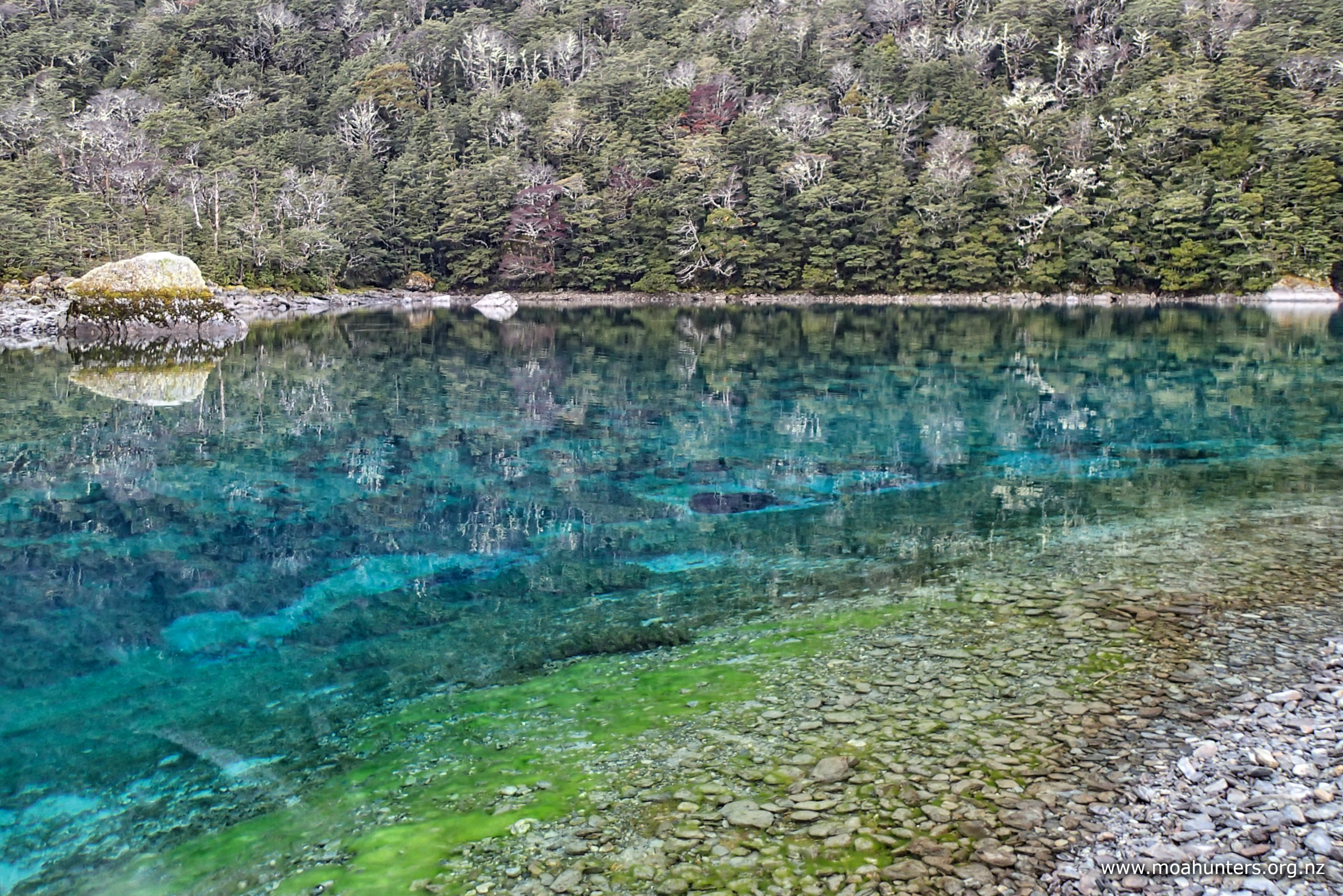
According to a DOC notice in the hut, some plonkers had been playing Frisbee near the lake, and unsurprisingly an errant throw had landed in the water. To the credit of those involved, they heeded all the signs and stayed out of the water rather than going in to fetch it. DOC must have devised an environmentally and culturally acceptable way to retrieve the Frisbee, because we saw no sign of a plastic disc.
We wondered how much that little rescue mission had cost the taxpayer… Perhaps it’s best we remain ignorant.
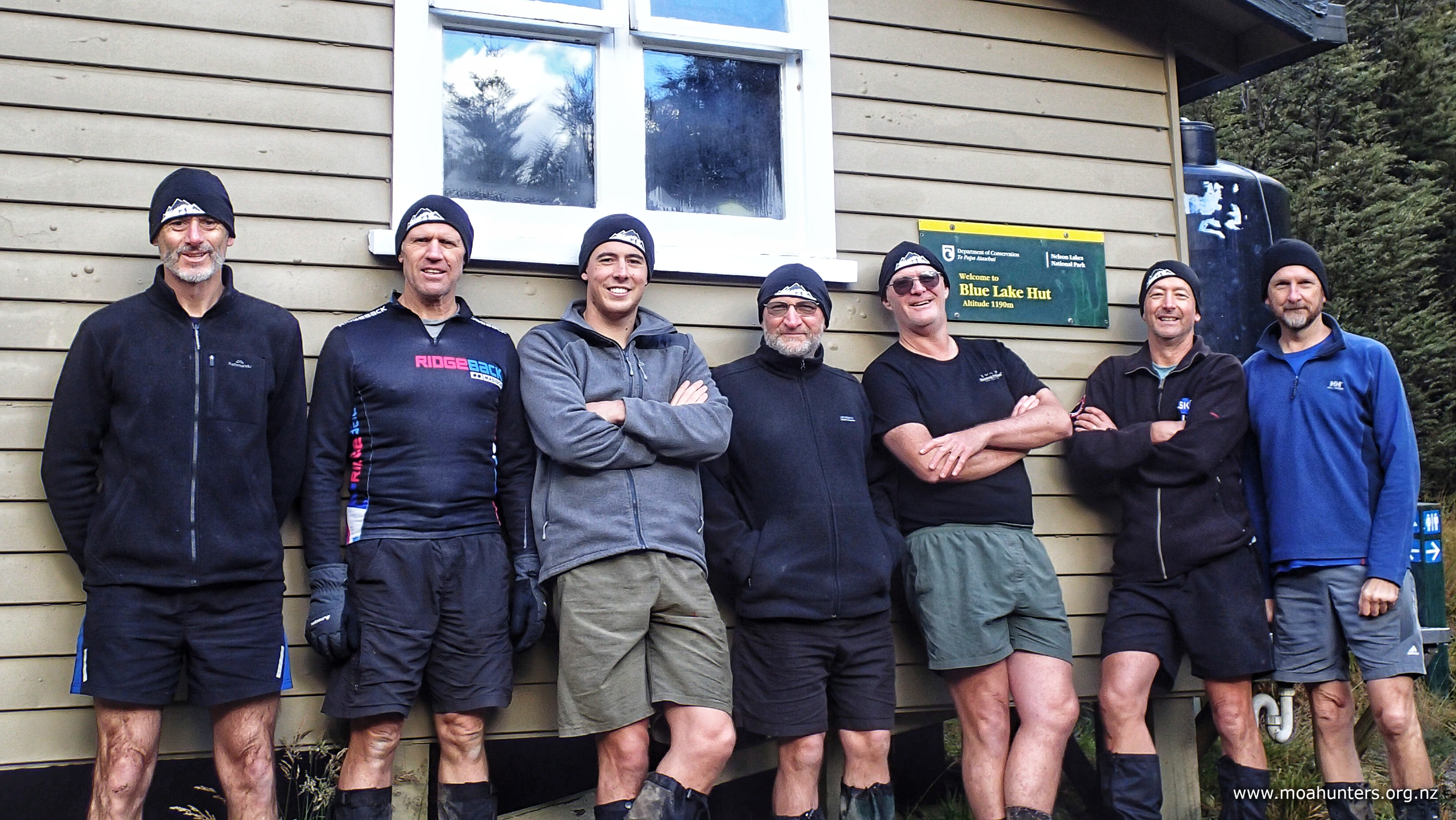
From Blue Lake hut, the track enters a short section of beech forest then emerges onto steep open scrubby snowgrass country. The day had not warmed up much, and we were all well rugged up with thermal layers. But twenty minutes of solid ascent had us unzipping polarfleeces and stripping down.
Behind us, increasingly epic views back to Blue Lake opened up. We took plenty of opportunities to pause and enjoy them… and catch a quick breather! Cloud clung to ridges in the valleys well below us, confirming we had indeed been climbing.
Taking in deep breaths of the icy fresh mountain air reminded us we were very much alive. There’s something magic about being on the tops, focusing on your senses one by one to really experience the moment. Inhaling the sharp cool air, feeling its chill in your lungs. Hearing a distant bird and casting your eyes out to the valleys and peaks where it might be… then looking in close, noticing the delicate alpine plants beside your boot.

An hour into the climb there are some nice spots to take a break. We dropped our packs at one of these pleasant flats and spent some time checking out the view below and the route above. We could now see rocky Moss Pass awaiting us at the top of a steep shingle strewn climb.
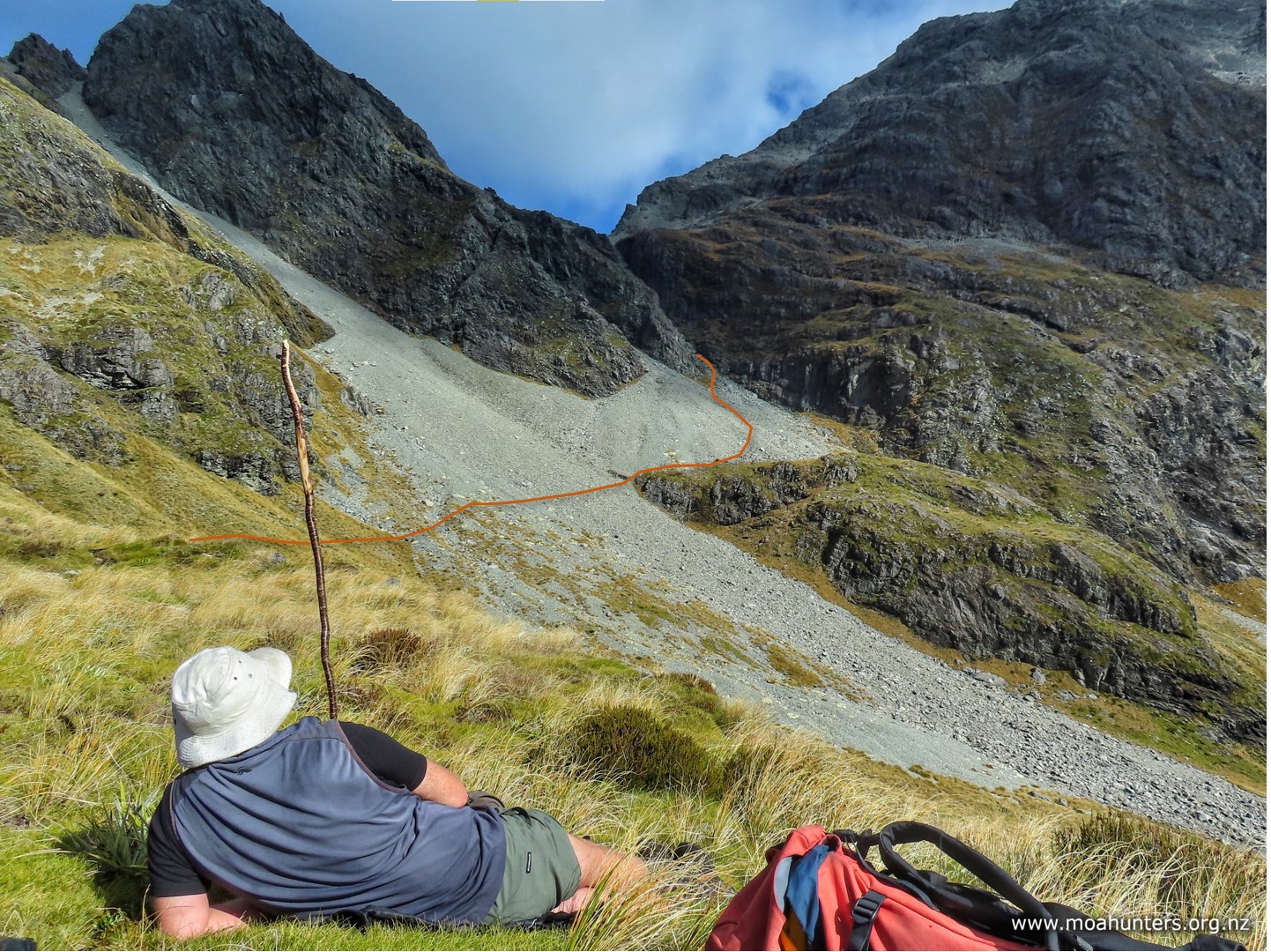
From our scroggin stop we made our way across a shingle fan and onto the upper fringe of a rocky outcrop. There are many marker poles here and choosing a route is not required – we just followed the well walked track.
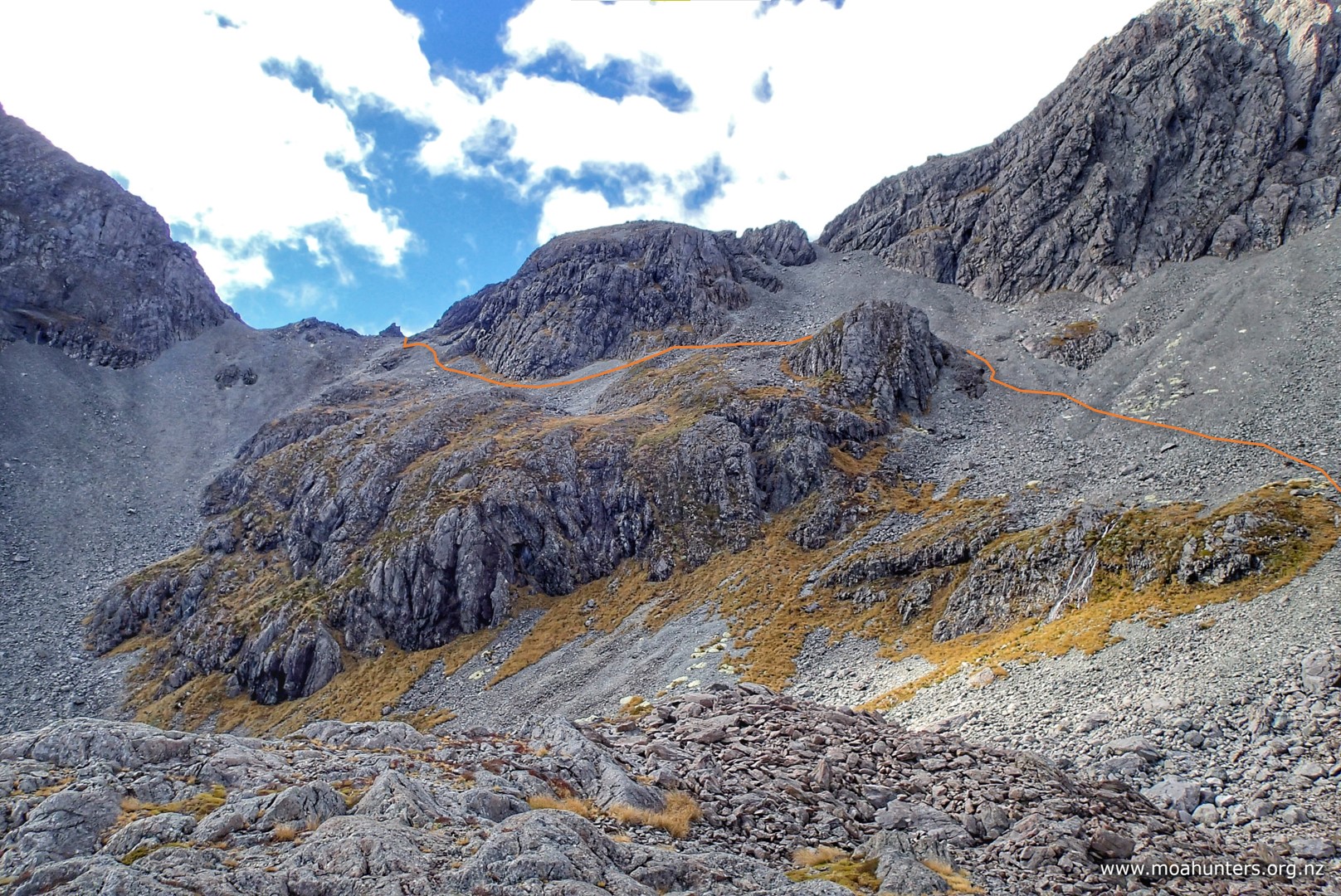
Beyond the outcrop, the track turns left and the seriously steep section begins. There are lots of photos of the Moss pass rock chute online, and we knew it would be a steep grunt up to the top. We were not disappointed.
The higher we got, the smaller and less stable the rock debris underfoot became. If you chose the wrong path up, it was one step forward, then slide one step back. Sticking very close to the rock wall on the right of the chute was a winning strategy. Locked on one side against the hard rock face, shingle tended to slide less and footholds were much more stable.

While the climb was tricky and steep, we wouldn’t rate it as particularly dangerous, provided you take your time and follow the well trod route. Walking in a large group, our main concern was accidentally dislodging rocks onto our mates below. To manage that risk, we stayed close as we ascended, maintaining awareness of those above and below at all times.


The rock chute is the highlight of the climb to Moss pass, but it is not the finale. Emerging through a narrow gap the chute leads to a comparatively flat rocky basin. Beyond that is a 10 minute grunt up a moderately steep rock-strewn face to the pass.
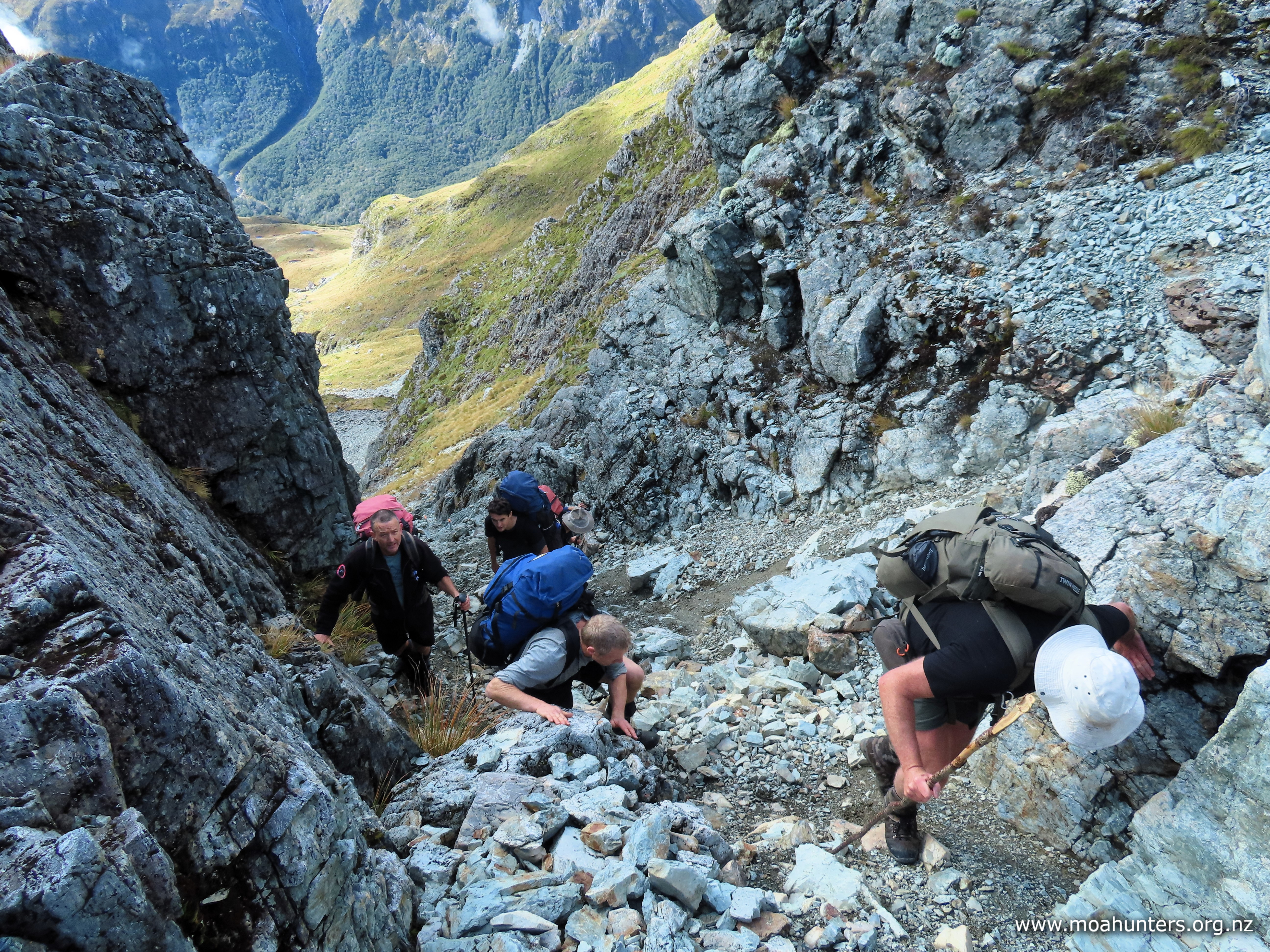


Scaling these mountain tops gave us a sense of the massive power of nature. We were picking our way through a landscape of shattered rock. The combined forces of wind, rain, sun and ice inexorably crumble mighty granite peaks to rubble.
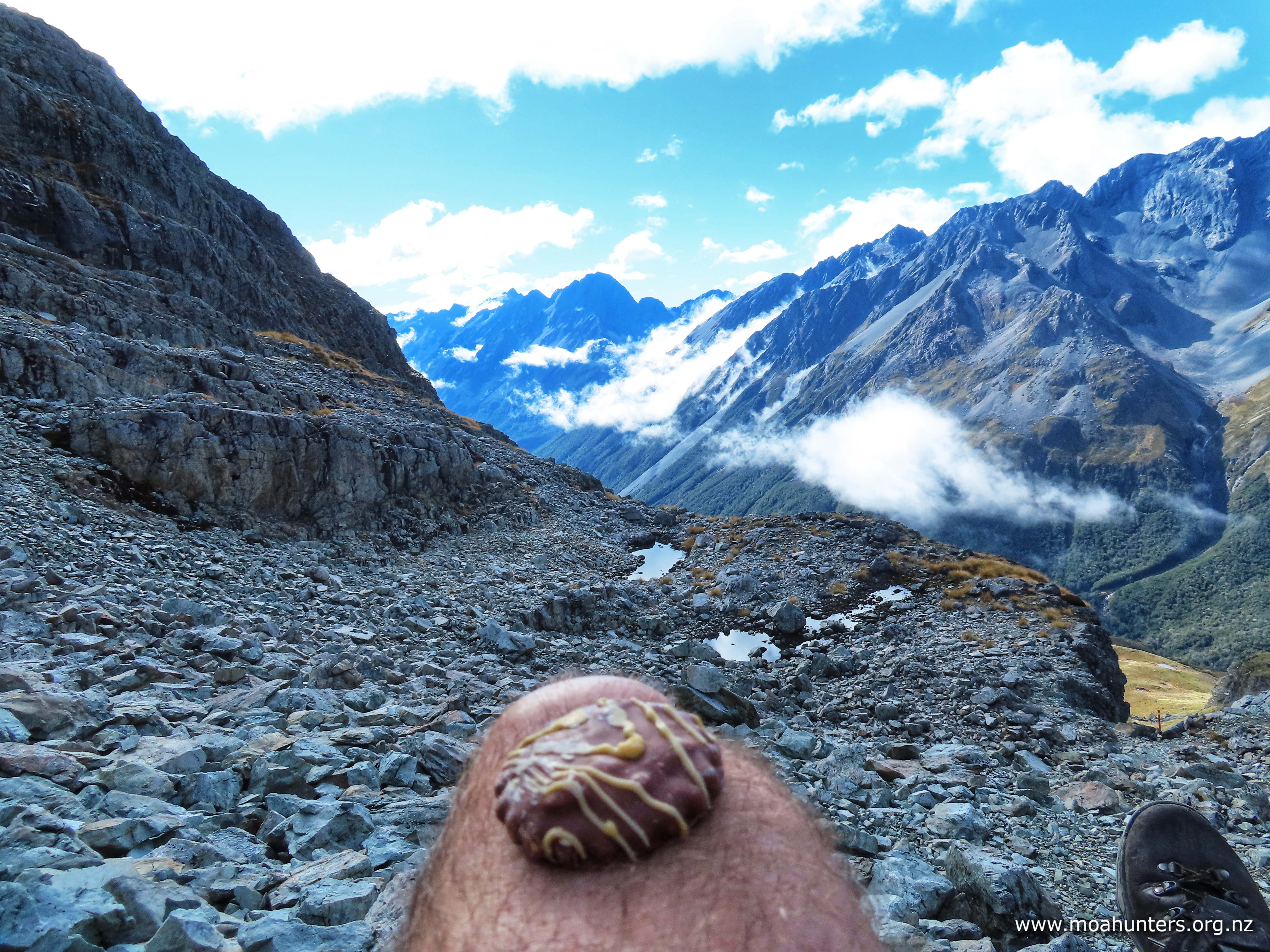
At the top of Moss pass, we took a moment to celebrate. Sitting in a long row on the rocky pass, we all enjoyed the feeling of being on top of the world. A very satisfying feeling indeed, improved immensely by scrummy squiggle top biscuits.
In what has become a very happy “top of the pass” tradition, Luke produced a battle-worn packet from the depths of his backpack, and threw a squiggle to each of us. Bliss…

Fuelled by chocolatey goodness, we dropped off the pass making our way through similar terrain encountered on our ascent – rocks and rubble. However, this soon gave way to flatter country with patches of grassy tussock.
It didn’t take an expert to pick out our ideal lunch spot. Below us lay a good sized tarn, surrounded by large rocks that would provide good shelter from the cool breeze. We made our way down, dropped packs, and settled in for a very enjoyable lunch break.
Looking back, the traverse off Moss Pass appeared more challenging than when we were walking it!
The sun made a few brief but welcome appearances, but in general it was a little cool on the tops. With annoying regularity, the sneaky breeze found ways to swirl around the rocks we had chosen to hide behind, keeping a lid on the temperature.

From our lunch spot at the tarns, the track descended fairly steeply down a grassy slope, with views across the valley of an epic, steep, water-sculpted hillside.
At our feet, damp rocks protruding from the dirt were coated with a slightly greasy algae. Alongside the well worn path, tough grasses were slippery and sometimes treacherous on the steep slope. We had to watch our step as we descended off the tops.
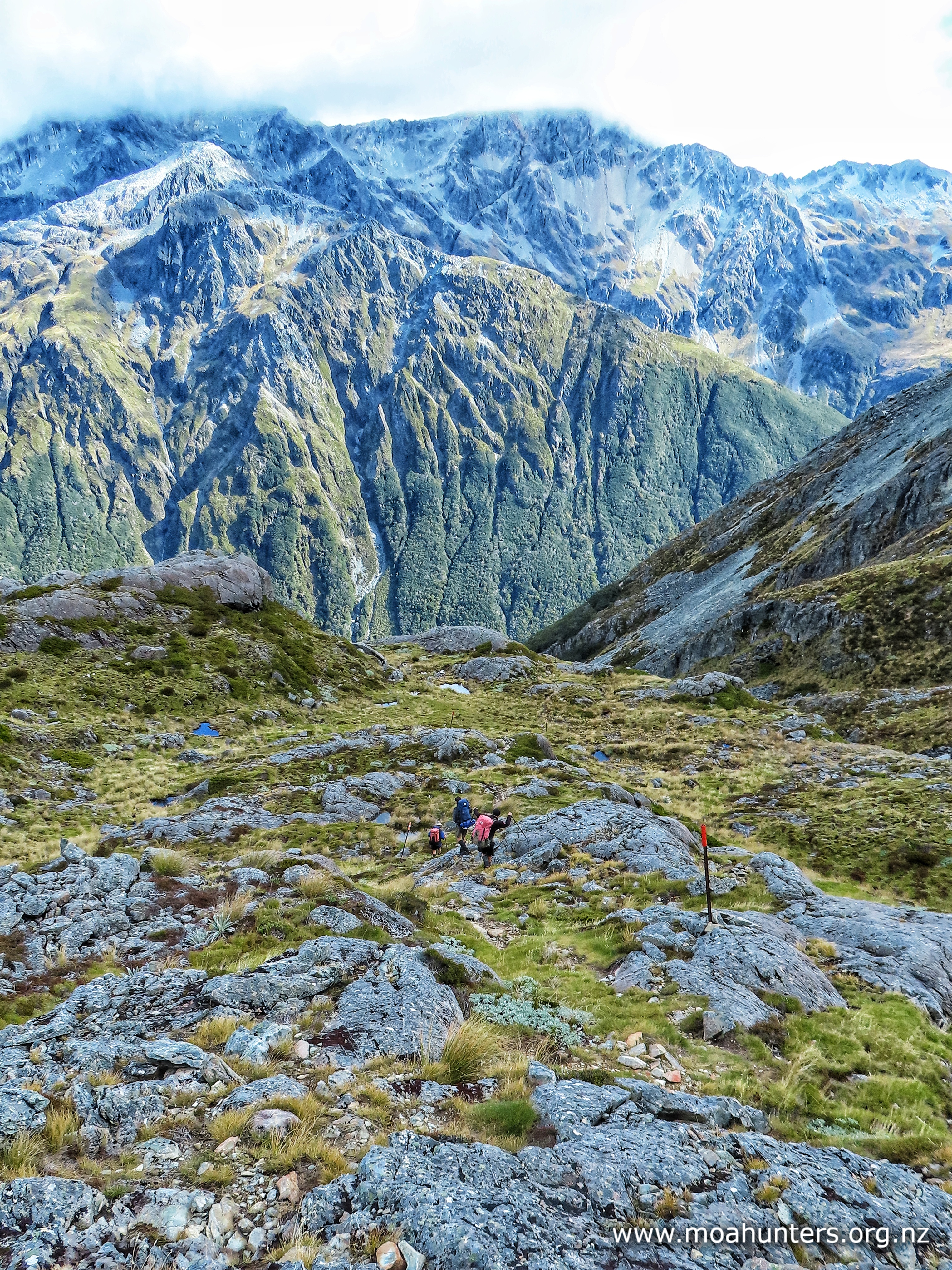

When the track heads into the beech forest, it doesn’t ease up. Just as steep as on the tops, we descended the tricky and often slippery track for an hour and a half until it eased out and we reached a stream.

Once off the steep section, the track slides round to the north through gorgeous mossy forest. We enjoyed the easier walking and lovely surroundings, arriving at the bridge over the D’Urville river at 3:30pm – bang on two hours from when we left the lunchtime tarn stop.
Between the bridge and George Lyon hut, there is a fifteen minute section where the valley gets quite tight and the track a bit harder going. Aside from that, it is a pleasant wander to the hut.
When we reached the hut, our legs were telling us we had done a solid day of walking. Not fully trusting what our legs tell us, we consulted the map. Topomap tells us we had made a 580 metre climb followed by an 1100 metre descent. That, my friends, is more than enough downhill for one day.
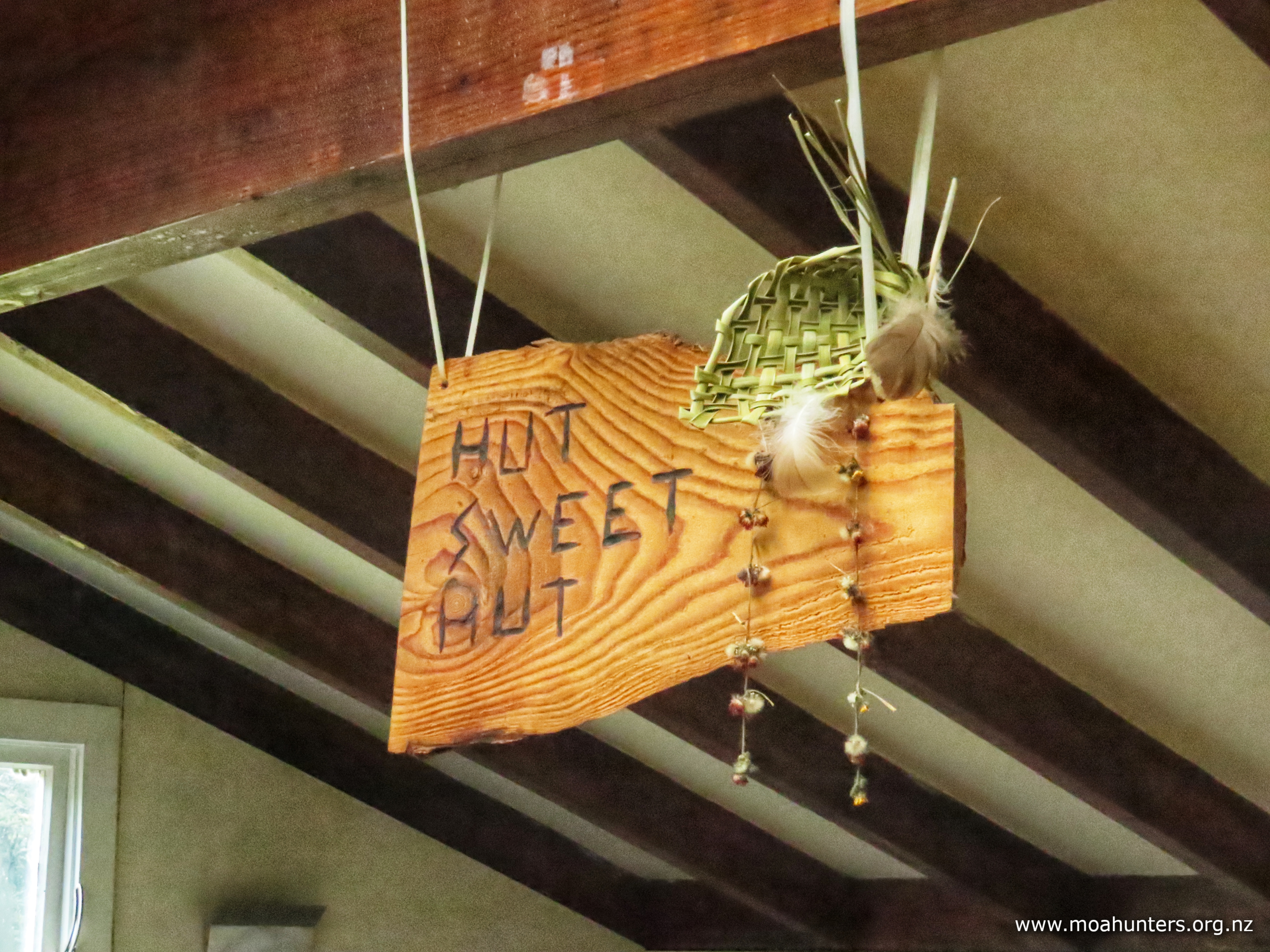
George Lyon (formerly Ella) hut is an interesting design. Two completely separate spaces are accessed left and right from the small entrance vestibule. Oddly, the two sides are not identical. One side has a small log burner, the other gets a skylight. Or maybe that’s not so odd… Anyhow, if you go there, it is worth reading the story of George Lyon at the hut. He seems to have been an influential and dedicated fella in his day.

Happily, there were almost no sandflies at this hut either, despite being at low altitude and right beside a river. For those who react in an itchy way to their nasty little bites, April is a great time of year to wander the back country.

Something to note if you do walk later in the season is the extra requirement for lighting. You will be using your headlamp and other lighting for longer periods. The sun sets early in April and many huts are gloomy inside at the best of times. Pack a few extra batteries.
The long drop at George Lyon is an interesting relic. For some reason this rickety wood and corrugated iron structure hasn’t been replaced by the modern fibreglass toilets we see at most huts these days. Still attached to a wall inside is an old metal candle holder – a fixture that hints at the venerable age of this small building. Maybe the Historic Places Trust will put a protection order on it!
Day 5
WednesDay 17th April – George Lyon hut to D’Urville hut

They say time flies when you are having fun. That definitely applies when you are out amongst it on a tramping trip. Waking up and realising this was our last day of Moa Hunting seemed unfair. How had four days gone by so fast?

As we had a long day ahead, activity in the hut started early. Not long after 6:00 am, porridge and water were already steaming on the cookers. Hearty Scottish sustenance and life-sustaining coffee are always a priority in the morning.
Our aim was to be on the track no later than 8 o’clock. The DOC sign outside the hut stated 4 hrs walking to Morgan hut, and another 4 hrs after that to D’Urville hut, where we would call our water taxi. We expected/hoped to knock half an hour off the DOC times…
The track to Morgan hut is a bit of a mixed bag. While generally flat and easy, we did encounter a few places where mother nature had other ideas.
Significant bank erosion along one section beside the river had gobbled up the track. New markers and fairly fresh scrub cutting has in parts moved the track away from the dangerously undercut bank. DOC will likely need to move the track quite a bit farther to prevent further washouts.
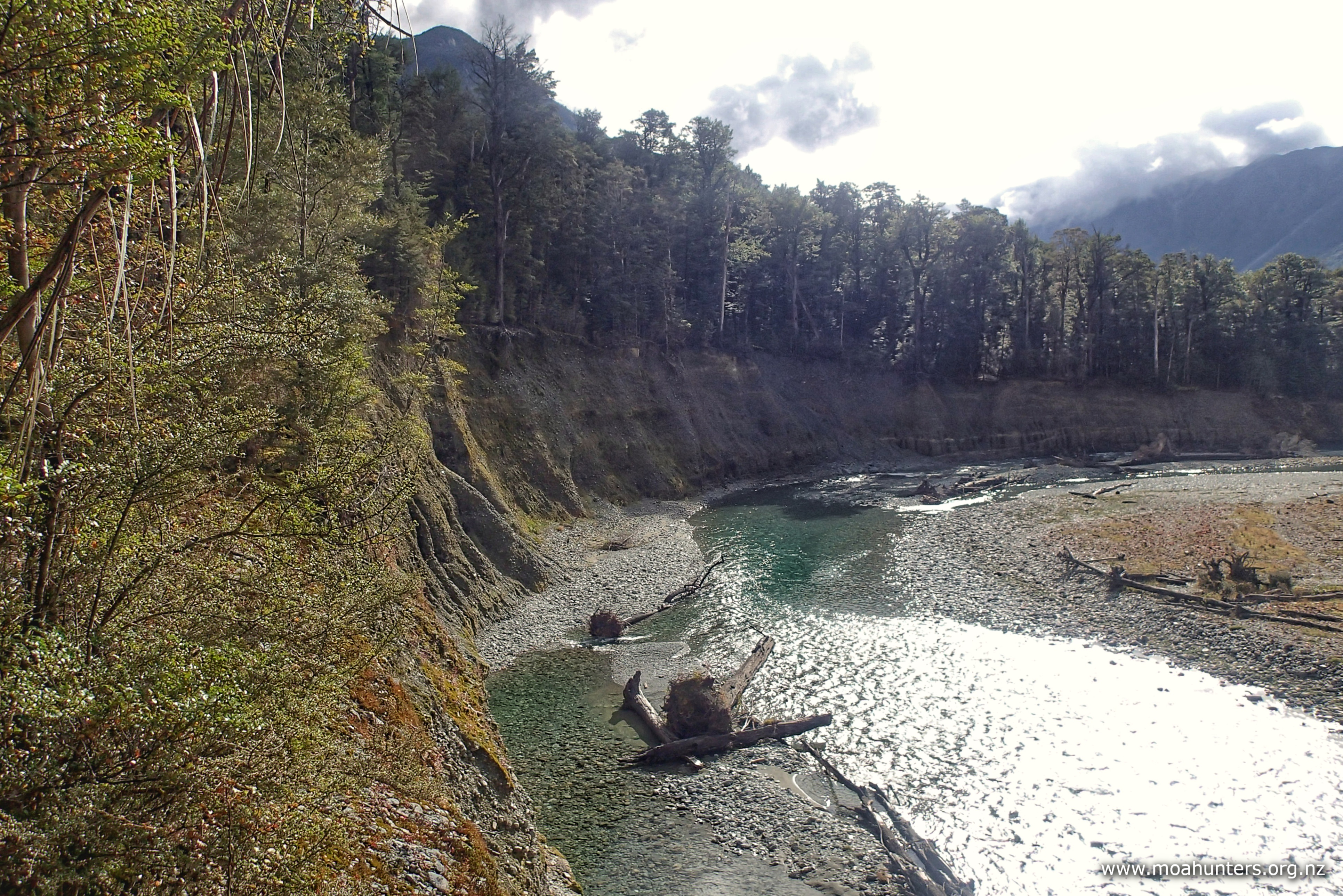
Unfortunately, about 30 minutes from the hut we ‘found’ another wasp nest. Smack in the middle of the track, it was highly inconvenient. Despite Adam spotting wasps exiting the hole without stepping on the entrance, and those behind following suit, clearly our passing had annoyed the wasps inside. By the time Chris and Magnus arrived, the wasps were seriously pissed off and out looking for trouble. Because they looked like trouble, Chris and Magnus got stung. Chris one sting, and poor Magnus copped four.
We stopped for a scroggin break beside the river, again unbothered by sandflies. Hooray for autumn weather!
Aside from those effing wasps, the track was very lovely. We enjoyed easy walking across open grassy meadows (with plenty of deer sign), beautiful mossy forest, and easy riverbed sections.

Our pace today was a few notches above the usual Moa Hunter amble. After three hours walking we rolled up to a sun-drenched Morgan hut, and for the first time this trip were welcomed by an enthusiastic team of sandflies.
Those of us who prefer to avoid being bitten retreated into the the hut for an early lunch. The rest sat outside on the deck soaking up the sun while eating their rations.

After half an hour, the outside crew joined the inside crew. Apparently a few local wasps that had been slightly pesky hanging had become persistently pesky. It seems they had got a whiff of salami and biltong, and looking to harvest protein for their nest, had become disconcertingly aggressive.
Morgan hut is frequently used by hunters, and even has a gun rack just inside the door. Shells of various gauges decorate a window sill. With a large and inviting expanse of grassy flats in front of the hut, we wondered if any hunters had been lucky enough to bag an animal from the comfort of the deck.
It was high noon when we left Morgan hut to complete the last leg of our Moa Hunt. Destination D’Urville hut.

Walking across the grassy flats was a very pleasant experience. The sun was shining and winds were light. Inevitably the track did enter the forest, where we were treated to probably the best array of fungi we had seen on the trip.
Being autumn, amazing fungi were growing everywhere. We enjoyed spotting toadstools of all shapes, sizes and colours growing along the track. It was certainly a mycologists paradise.

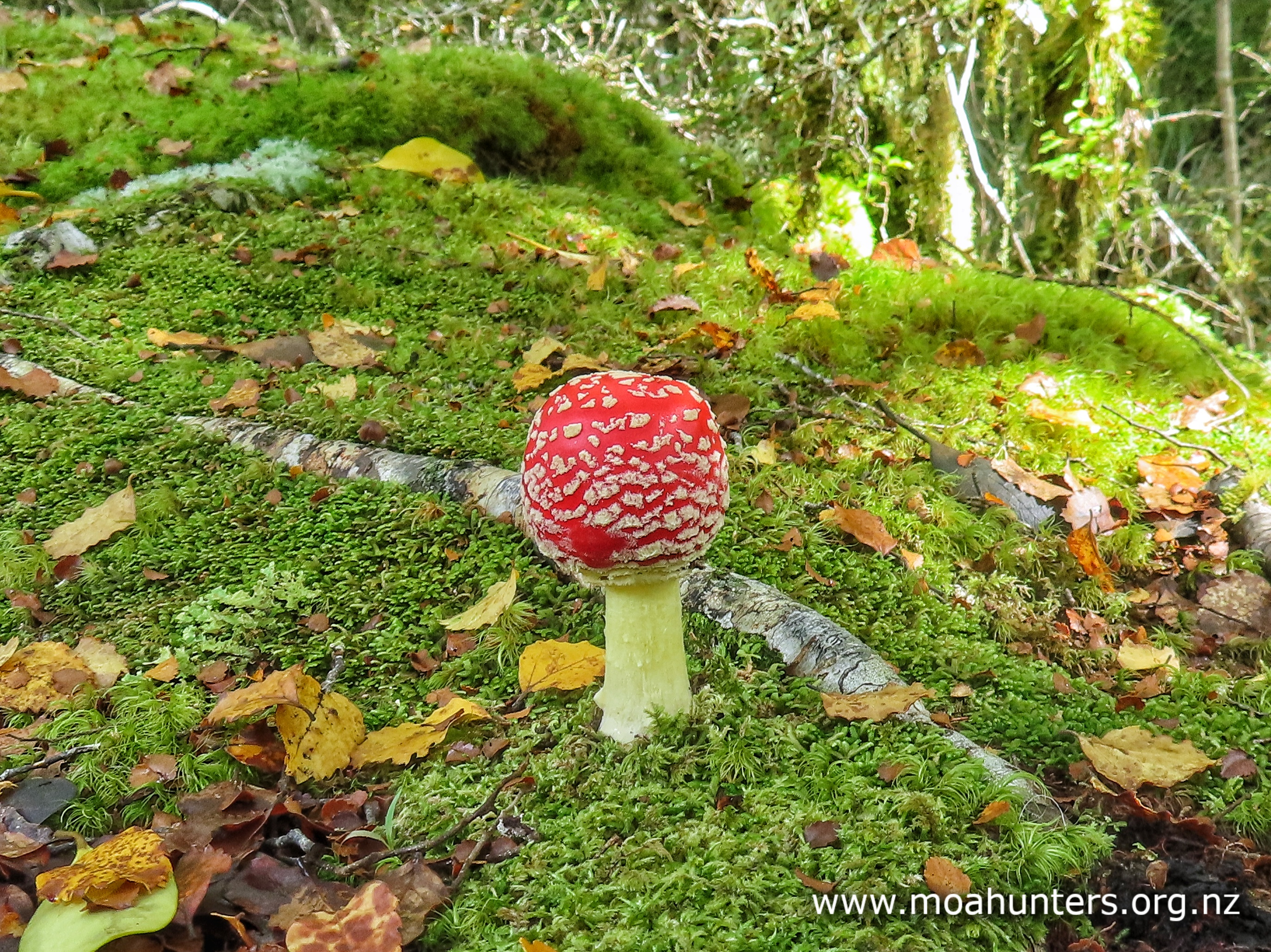
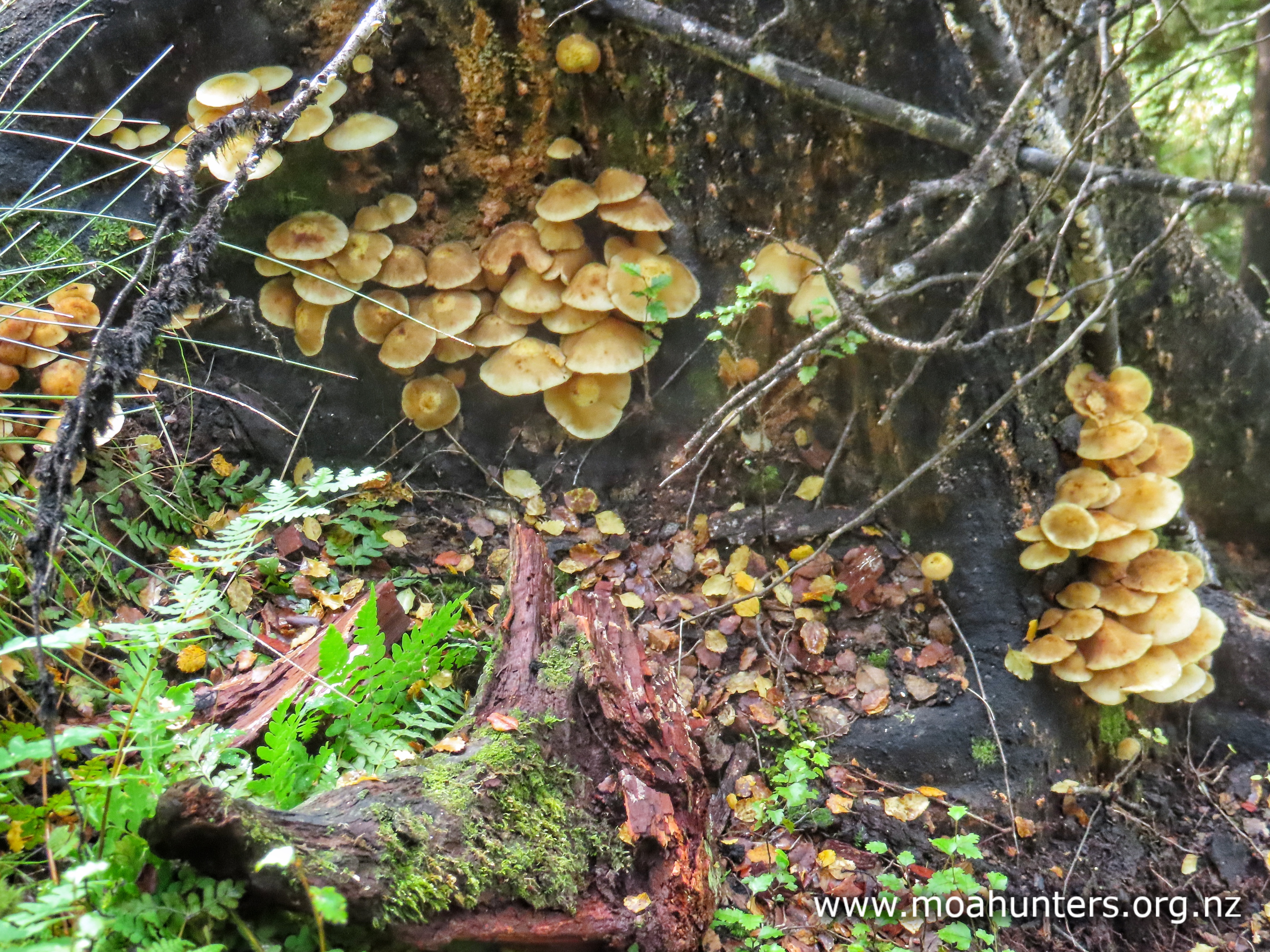
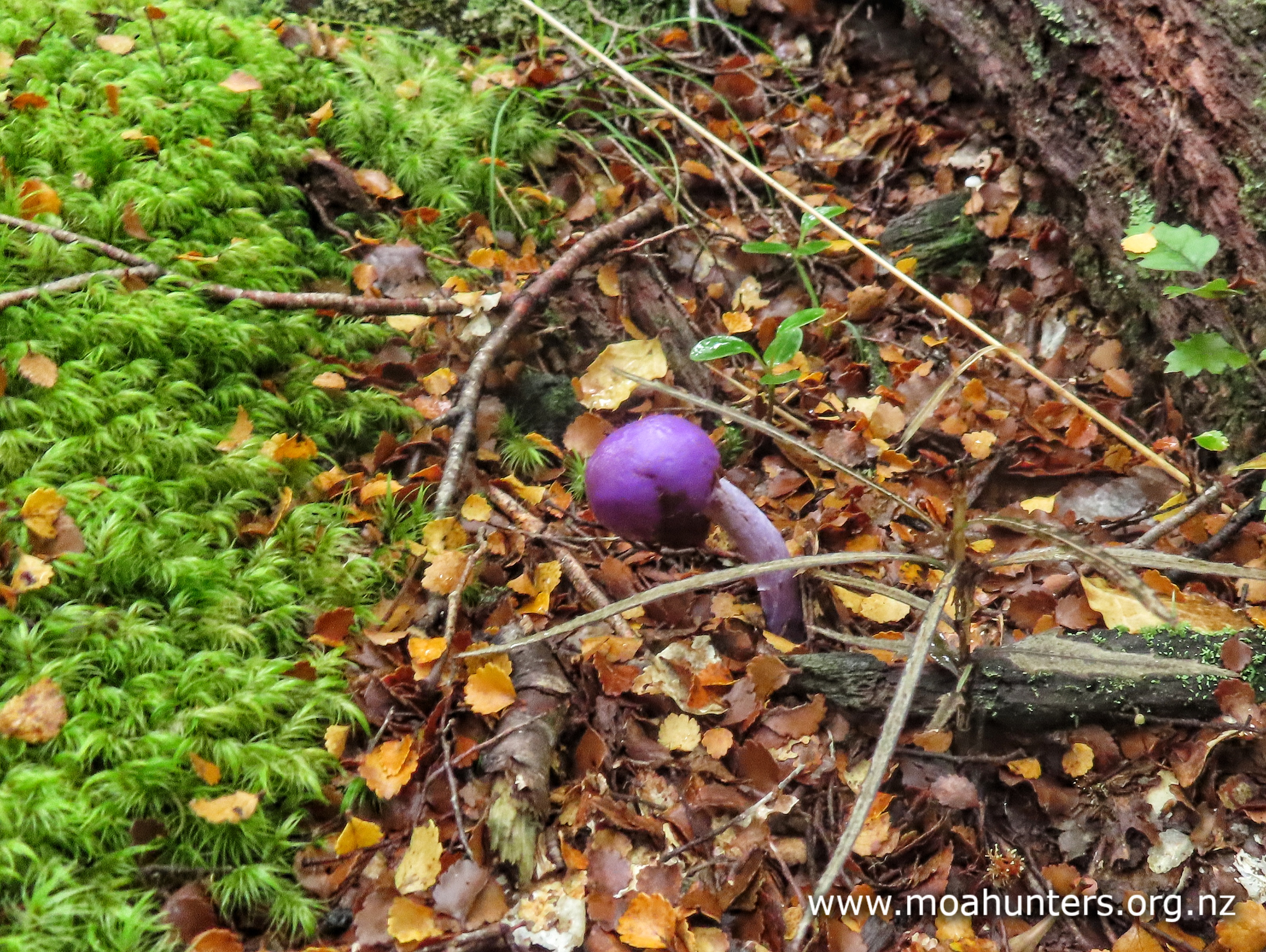
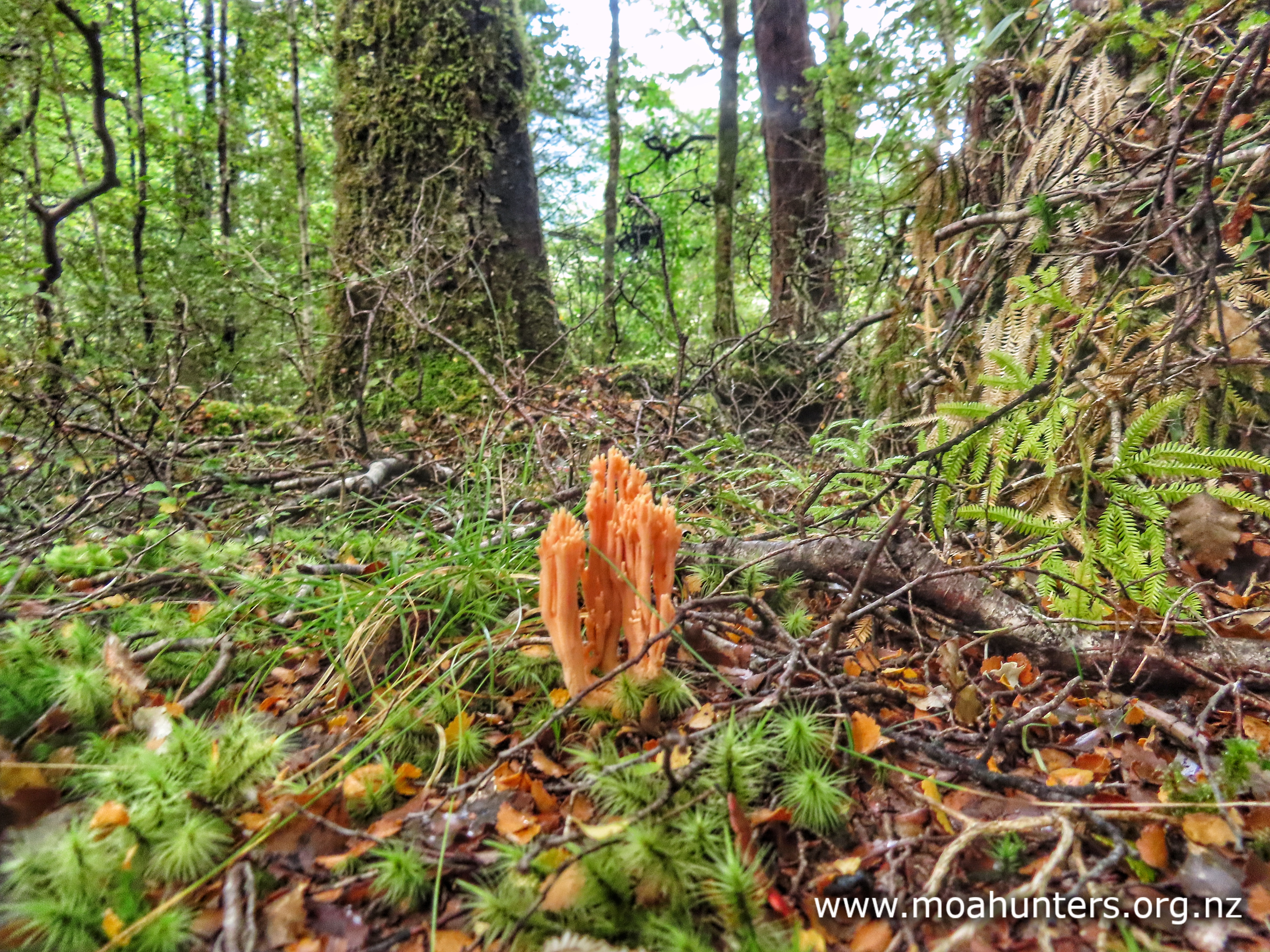
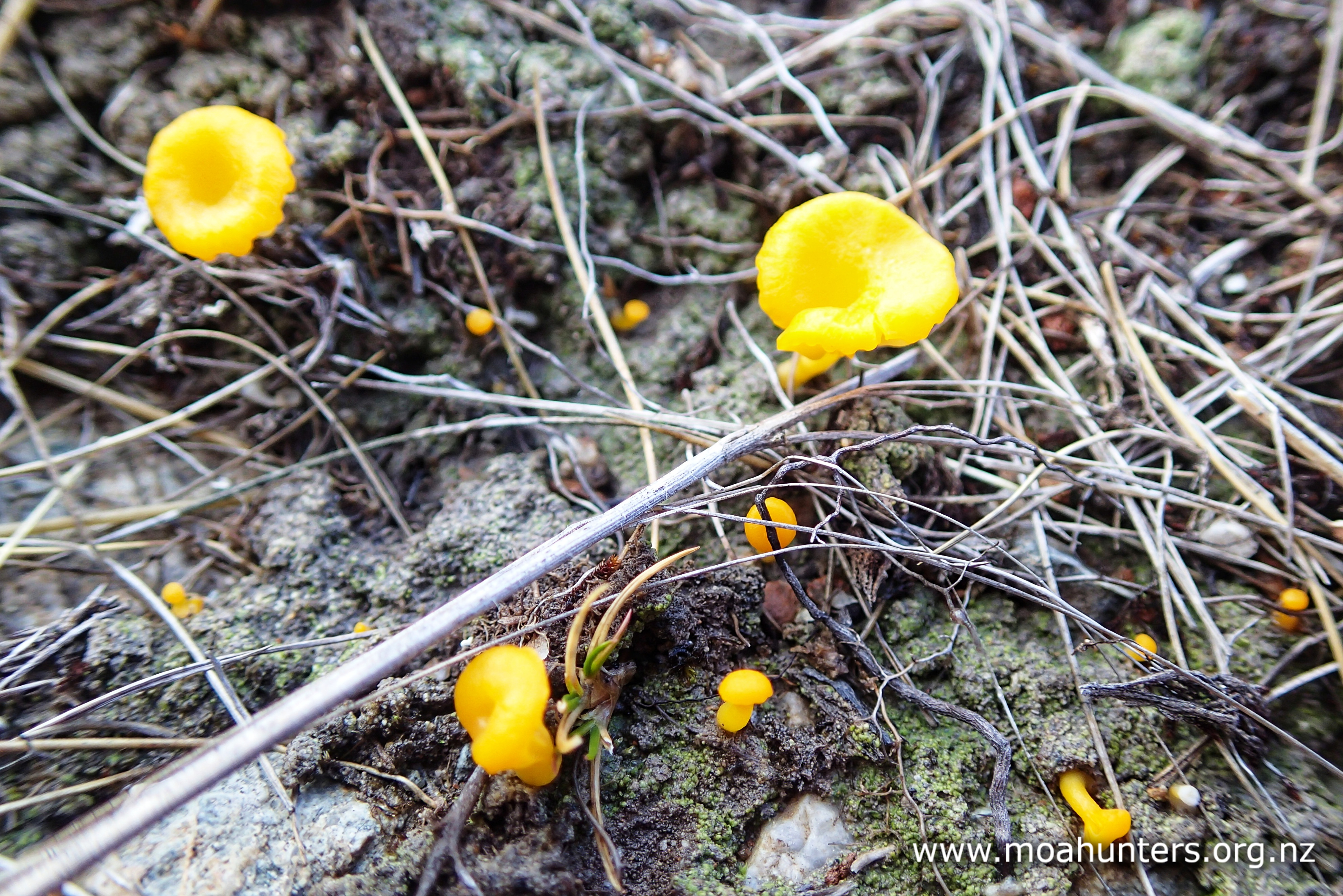
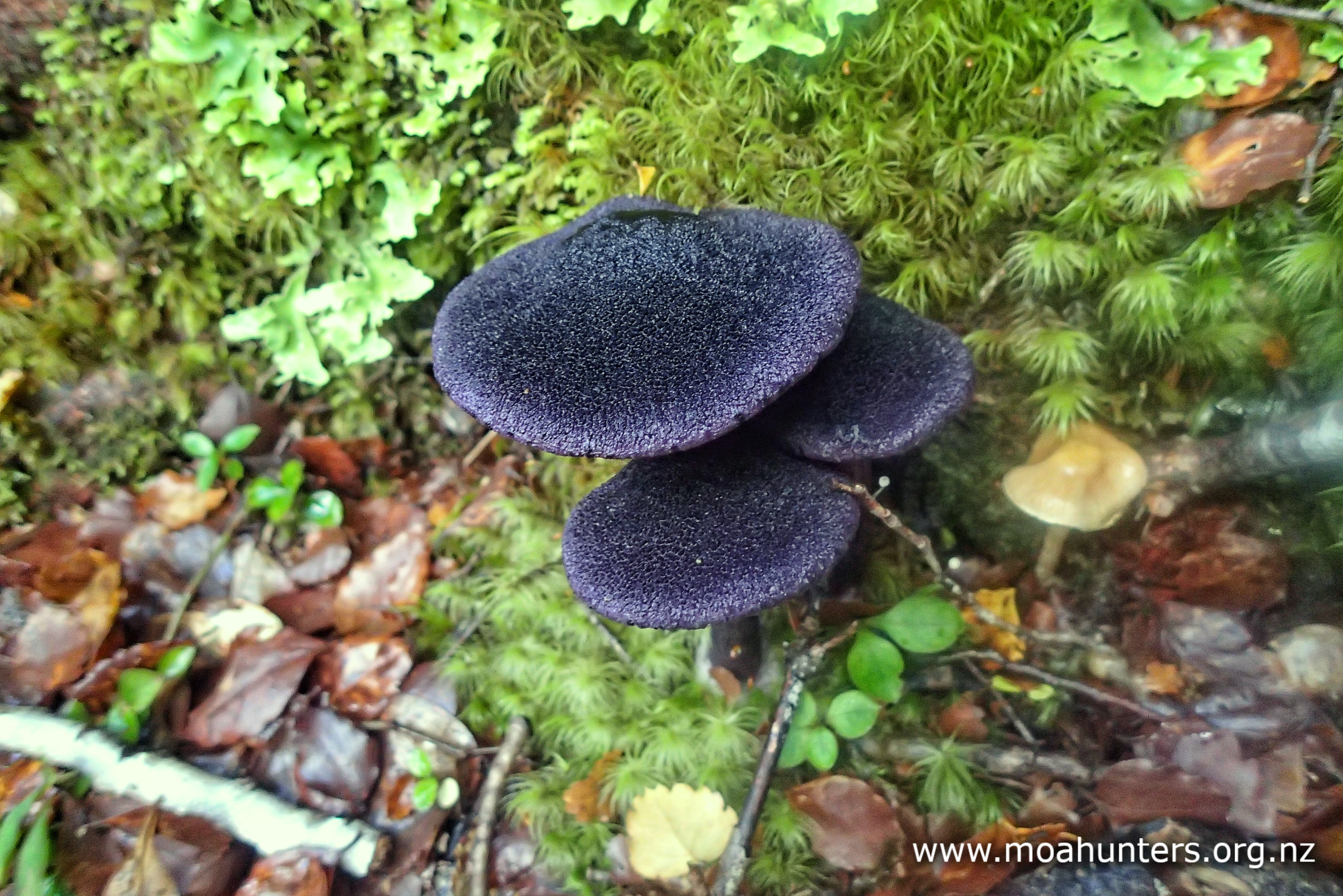
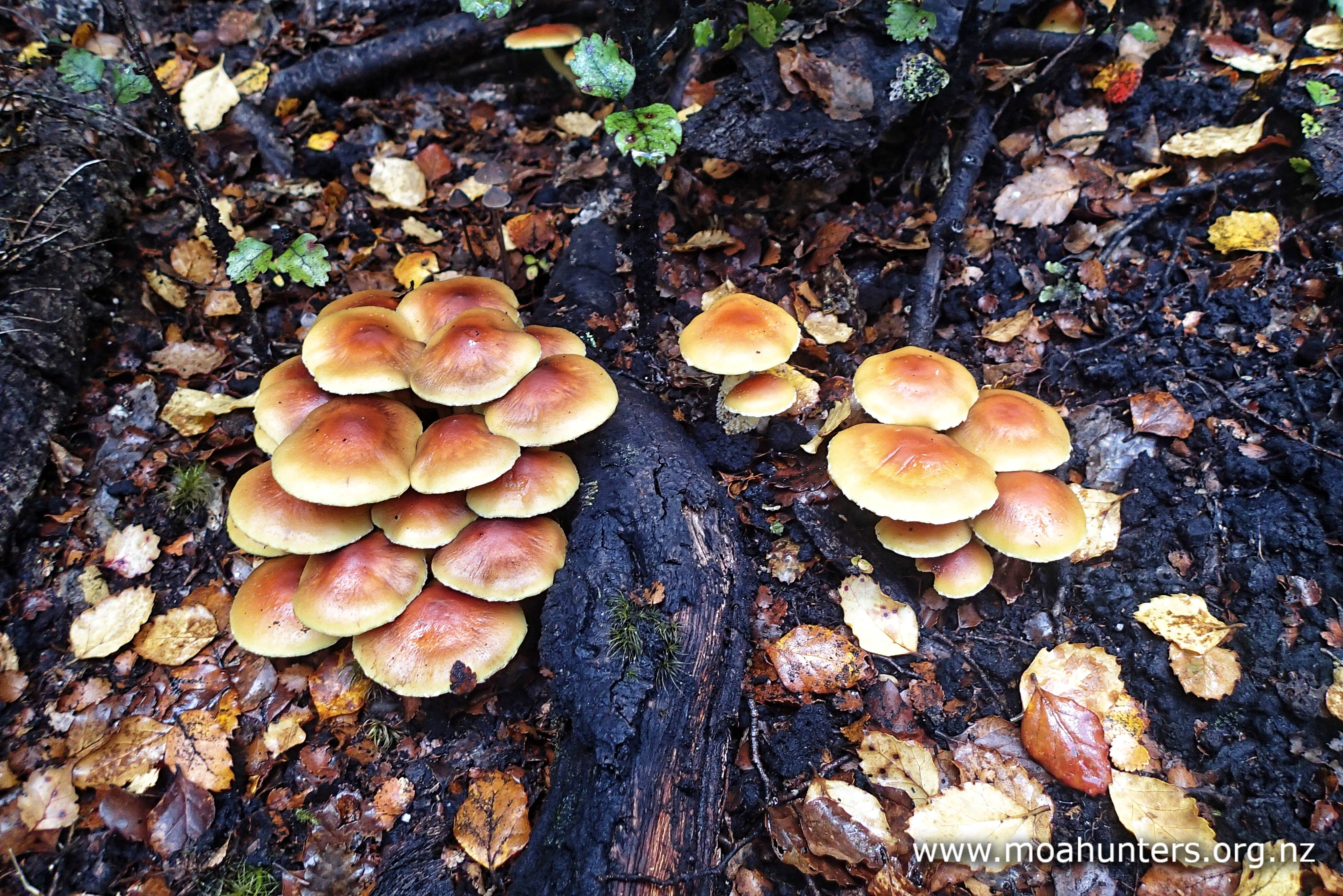
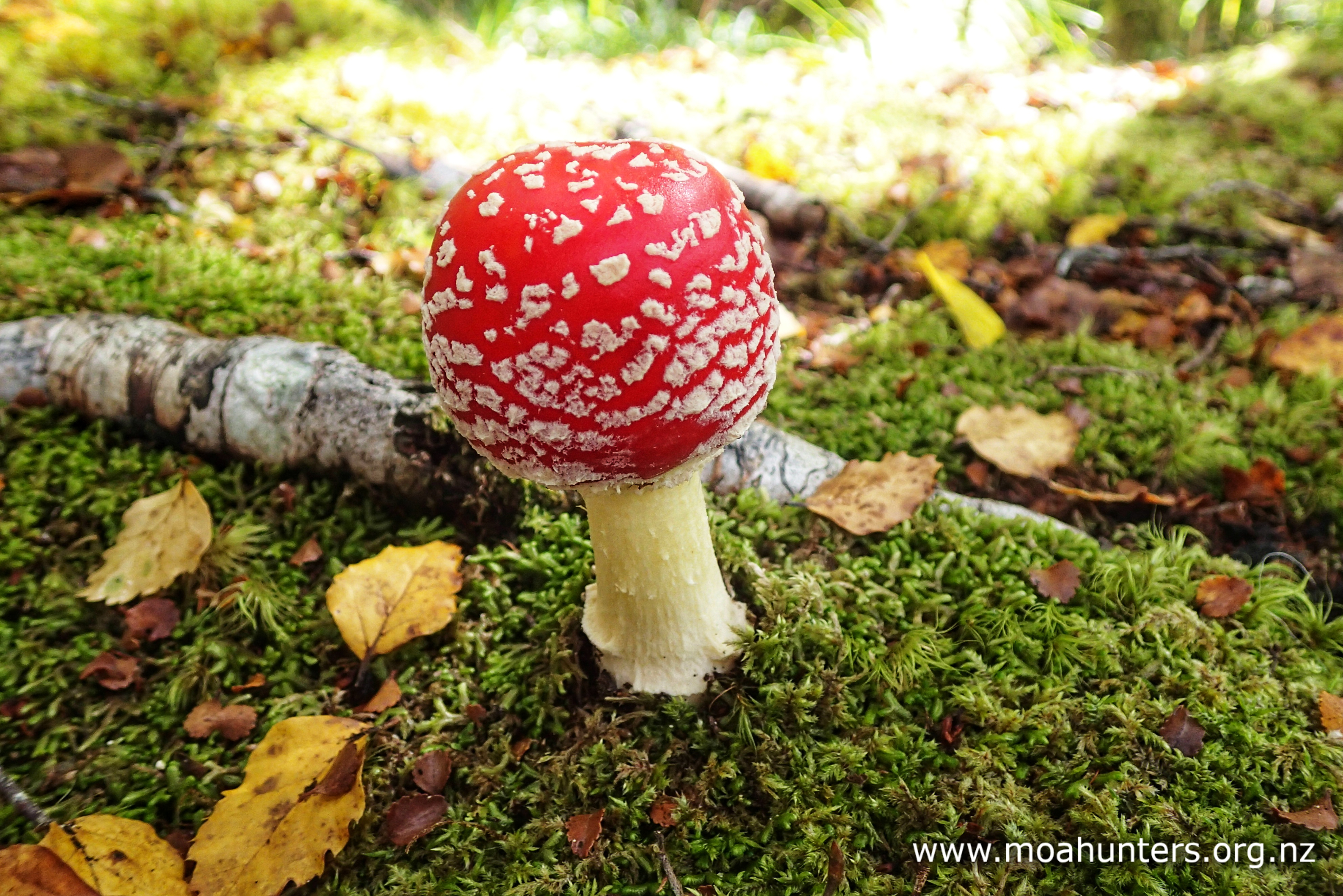

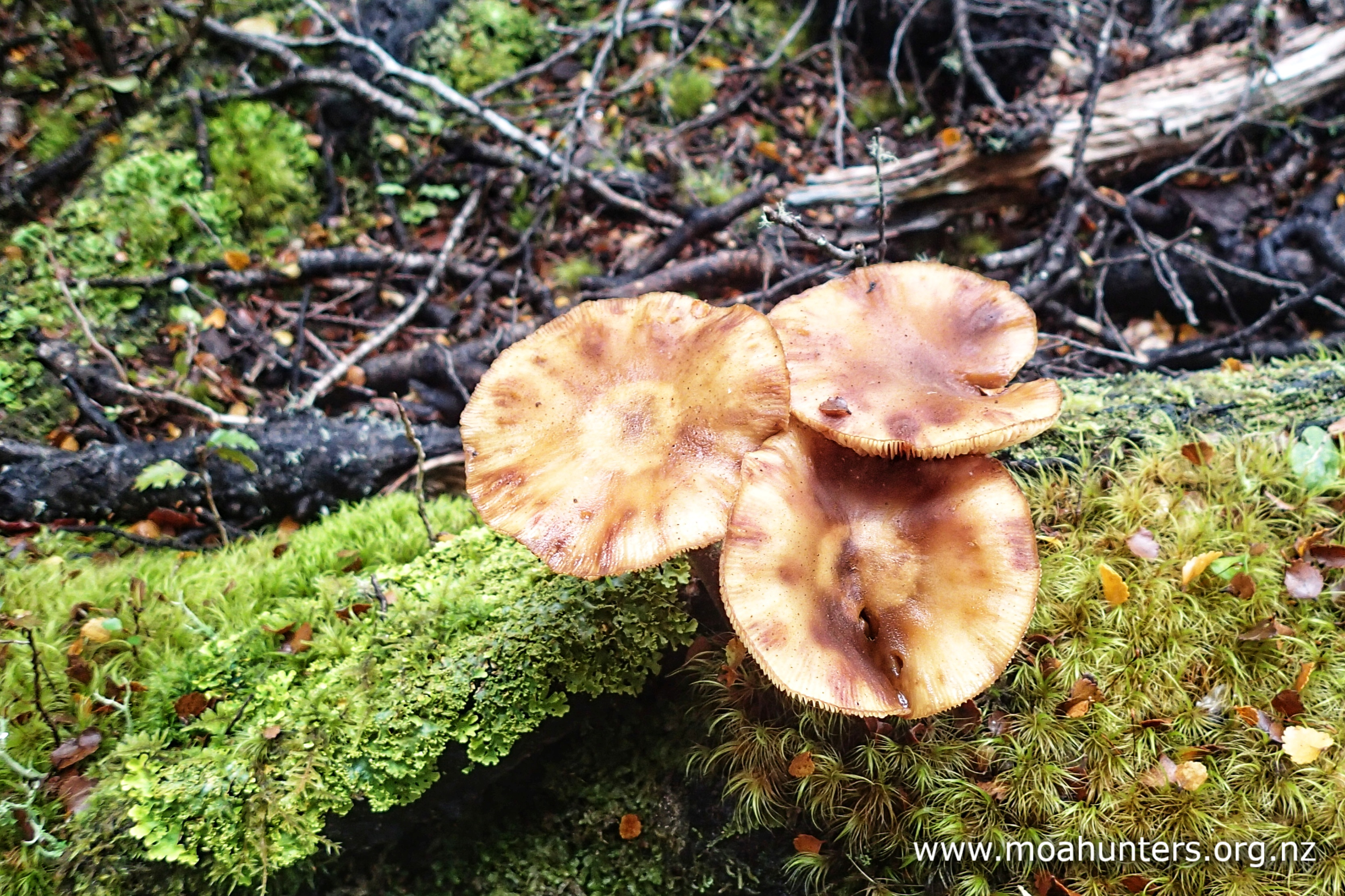


The track did climb annoying high over a bluff about half an hour away from the hut. Chris and Magnus inadvertently missed a turn in the track and rather pleasingly for them, ended up in the riverbed instead. With flows low, they were able to cross back and forwards across the river braids and avoid the uphill grunt. If flows are low, you could probably walk a fair chunk of the trip between Morgan and D’Urville along the river.
We had a couple of short scroggin stops along the way. One beside a small creek that joined the D’Urville below, and one on a large expanse of shingle river bed.

As the valley opened out, we spent more time walking grassy flats and easy beech forest track. Enjoying the easy walking conditions, our pace picked up a little as we neared Lake Rotoroa.

It was 4:00pm when we arrived at D’Urville hut. Tied up to the jetty were two boats. Lounging back in one was Dudley, our water taxi captain. Anticipating our arrival time, he had motored across the lake to meet us. What an awesome guy, and what a great service. We had expected a thirty minute wait at the hut, but were able to board the boat shortly after arriving.

Dudley pointed the water taxi north and eased forward on the throttle. We all felt the usual mixed emotions. Happiness that we were heading back to see our families, but a little sadness to be leaving a beautiful part of New Zealand. Another Moa Hunt was done and dusted.
Just before we reached the far shore of the lake, the weather gods gave us one last little gift; as we looked back, a shower of rain caught some sun rays creating a pretty goodbye.

 The Moa Hunters